Parties
Full legal name and contact for owner and authorized person, including role (owner, agent, dealer representative) and relationship to the vehicle.
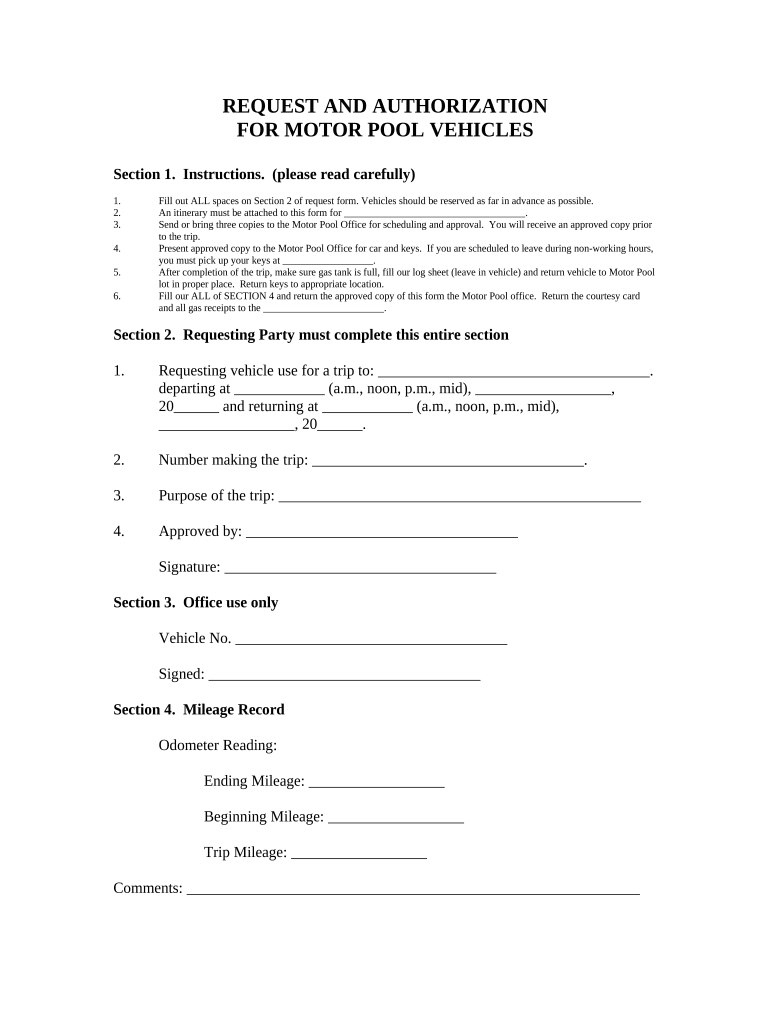
A concise, properly executed Vehicle Authorization reduces disputes about permission and liability, supports insurance and title processes, and speeds administrative handoffs. It also documents intent and attribution, which helps establish legal authority when dealing with DMVs, lenders, insurers, or law enforcement.

Common parties who complete or receive a Vehicle Authorization include private owners, dealerships, fleet operators, and lenders.
Full legal name and contact for owner and authorized person, including role (owner, agent, dealer representative) and relationship to the vehicle.
VIN, make, model, year, license plate, and title number where applicable to ensure the authorization applies to one specific vehicle.
Explicit description of allowed actions (drive, transport, sell, transfer title, obtain plates) and any geographic or operational limitations.
Clear start and end dates or event-based termination conditions so third parties can verify current authority.
If required, state payment, reimbursement, or other consideration; otherwise include a statement of gratuitous authority if applicable.
Signature block, date, and any required notarization or witness lines; include signer identity proofing for remote or high-risk transactions.
| Field | Configuration |
|---|---|
| Authentication | Email link or SMS code; choose stronger methods for high-risk transactions |
| Signing Order | Sequential or parallel signer order depending on required approvals |
| Reminders | Set automatic reminders and expiry to keep workflow timely |
| File Format | PDF/A or PDF for archival compatibility with DMVs and title services |
Decide how recipients will receive, authenticate, and store the completed authorization before sending.
Use integrations and file-format controls to create an audit trail and preserve the record required by regulators or insurers.
Signer execution date should match the stated effective date when required by third parties
Obtain notarization before submitting to DMV or lender to avoid rejection
Expect state title offices to require days to weeks depending on method and backlog
Notify insurer promptly to preserve coverage under new authorized driver scenarios
Retention begins on execution date for most regulatory purposes
Signers execute the authorization and verify identity.
Notary completes acknowledgement and records the act.
Send signed document to DMV, lender, or insurer as required.
Store the executed copy with audit trail for the retention period.
A buyer authorizes a transporter to collect a purchased vehicle on a set date
A fleet manager authorizes an employee to operate a company vehicle for a specified project
| signNow | DocuSign | Adobe Sign | PandaDoc | HelloSign | |
|---|---|---|---|---|---|
| Starting Price | $8/user/mo | $15/user/mo | $14/user/mo | $19/user/mo | $15/user/mo |
| Free Trial | 7-day free trial | Trial varies | Trial varies | Trial available | Trial available |
| Bulk Send | Yes | Yes | Yes | Yes | No |
| Audit Trail | Yes | Yes | Yes | Yes | Yes |
| HIPAA Compliant | Yes | Yes | Yes | No | No |