Bill Book Template Word for Building Services

Streamline your documentation process with airSlate SignNow's user-friendly solution. Enjoy quick eSigning and cost-effective management of your important documents.

Award-winning eSignature solution

What a bill book template word for building services is and when to use it

A bill book template in Microsoft Word for building services is a preformatted, editable invoice and job costing file tailored to contractors, trades, and facilities teams. It combines sections for customer details, service descriptions, labor and materials, tax calculations, and payment terms so crews can generate consistent invoices quickly. Using Word keeps layout control and offline editing while enabling conversion to PDF or upload to an eSignature platform like signNow for secure signature capture and tracking across project lifecycles.

Why use a Word bill book template for building services

A standardized Word bill book template reduces billing errors, speeds invoice creation, and preserves a professional layout that matches company branding while remaining editable for site changes or client adjustments.

Why use a Word bill book template for building services

Common billing challenges in building services

  • Inconsistent invoice fields across teams create reconciliation delays and client disputes on scope or pricing.
  • Manual calculations and rekeying of line items increase errors and require time-consuming double checks.
  • Paper or untracked PDFs make signature collection slow and provide limited evidence for audits.
  • Poor version control on templates leads to outdated terms, pricing, or tax rates being used.

Representative user profiles for billing workflows

Project Manager

Oversees multiple job sites, approves final bill amounts, and tracks change orders. Uses the bill book template to compare estimated vs actual costs and to sign off on invoices before submission to finance.

Field Administrator

Completes line-item entries for labor and materials at each site, attaches photos or notes, converts the Word template to PDF, and initiates the signing and delivery workflow using an eSignature service.

Typical users and team roles for a bill book template

Project and administrative staff in building services adopt bill book templates to standardize billing across sites and subcontractors.

  • Field technicians who document work, materials, hours, and client approvals at the job site.
  • Office administrators who finalize invoices, apply taxes, and manage client billing records.
  • Project managers who review job profitability and approve adjustments before sending invoices.

Templates help both field crews and office teams reduce administrative overhead while improving the clarity and enforceability of invoices.

Essential features to include for reliable billing and compliance

Design templates to include sections and metadata that support legal validity, audits, and internal approvals for building services billing.

Client and job IDs

Include standardized client identifiers, purchase order or job numbers, and project codes to support reconciliation and back-office matching.


Itemized lines

Provide clear line-item descriptions for labor, parts, equipment, and subcontractor charges along with quantities and unit pricing.

Tax and retainage

Show tax calculations, exemptions, and any retainage or holdback amounts required under contract terms.

Payment terms

State net terms, late fees, accepted payment methods, and instructions for remittance to minimize disputes.

Change order log

Add space for documented change orders, approvals, and references to related work orders or purchase orders.

Signature block

Reserve a clearly labeled signature area for client acceptance and for internal approval sign-offs where relevant.

be ready to get more

Choose a better solution

Key integration points for Word bill book templates

Connect templates to eSignature and storage systems to preserve formatting, collect signatures, and automate archiving without rekeying invoice data.

Cloud storage

Link Word templates to cloud storage such as Google Drive, Dropbox, or OneDrive to centralize versions, enable team access, and automate backups while retaining original formatting for later conversion and signature workflows.

CRM sync

Integrate templates with a CRM to automatically populate client contact data, billing addresses, and job references, reducing manual entry and ensuring invoices match customer records.

Payment gateways

Embed links or integration with payment processors to accept card or ACH payments immediately after signature, shortening the cash collection cycle and reducing manual reconciliation work.

eSignature platform

Use an eSignature service to place signature fields on converted PDFs, obtain legally binding signatures, and generate an audit trail showing signer identity, timestamps, and completion status.
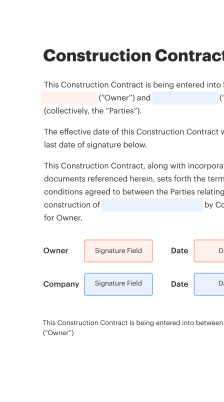
How a Word bill book template flows through a signing workflow

A typical workflow converts the Word template to PDF, applies signature and data fields, sends for electronic signature, and archives the executed document with audit details.

  • Prepare: Complete template fields and save final copy.
  • Convert: Export to PDF for consistent rendering.
  • Sign: Place signature, date, and initials fields.
  • Archive: Store executed file with audit log.
Collect signatures
24x
faster
Reduce costs by
$30
per document
Save up to
40h
per employee / month

Quick setup: prepare a Word bill book template

Create a reusable Word bill book template that captures client, job, itemized charges, taxes, totals, and signature fields for reliable billing.

  • 01
    Create sections: Add header, client, and job fields.
  • 02
    Add line items: Include quantity, rate, and amount columns.
  • 03
    Insert calculations: Use Word formulas for totals.
  • 04
    Save template: Store as .dotx and version control.
be ready to get more

Why choose airSlate SignNow

  • Free 7-day trial. Choose the plan you need and try it risk-free.
  • Honest pricing for full-featured plans. airSlate SignNow offers subscription plans with no overages or hidden fees at renewal.
  • Enterprise-grade security. airSlate SignNow helps you comply with global security standards.
illustrations signature

Typical workflow settings when automating bill book templates

Common workflow settings control reminders, approvals, archiving, and recipient routing to ensure invoices progress reliably from field to paid status.

Setting Name Configuration
Reminder Frequency 48 hours
Approval Required Yes
Auto-archive Delay 30 days
Signing Order Sequential
Notification Channels Email and SMS

Device and software considerations for bill book templates

Ensure templates remain editable in Word on desktop and can be reliably converted to PDF on mobile and desktop for signature capture.

  • Desktop Word: Windows or macOS
  • Mobile access: Word mobile apps
  • PDF conversion: Export to PDF

For consistent rendering across platforms, lock layout elements, avoid unsupported fonts, and validate converted PDFs on typical mobile and desktop viewers before sending for signature to prevent display or field misalignment issues.

Security and protection features to use with templates

Document encryption: AES-256 encryption
Access controls: Role-based access
Two-factor authentication: SMS or authenticator
Audit logging: Immutable logs
Redaction options: Manual redaction
Secure storage: Encrypted cloud

Practical examples of bill book use in building services

Two concise case examples show how different building services teams put a Word bill book template into operational use.

Maintenance Contractor

A regional maintenance contractor used a Word bill book template to standardize monthly service invoices across ten crews

  • Single-page layout with sections for labor, parts, and trip charges
  • Reduced disputes and improved payment speed

Resulting in a 20% reduction in days sales outstanding over six months.

Commercial Renovation Team

A renovation company integrated a Word bill book with its project management system to attach change order notes

  • Template included change log and retainage line items
  • Improved transparency for owners and faster approvals

Leading to fewer invoice revisions and improved project closeouts.

Best practices for secure and accurate billing with Word templates

Follow consistent procedures for template management, signature capture, and secure storage to reduce errors and support audits.

Centralize template control and versioning
Keep a single master template under restricted edit access, maintain a change log for approvals, and require template updates to pass a review checklist to prevent inconsistent billing forms from circulating.
Standardize data entry and codes
Use standardized job codes, material lists, and labor categories to ensure consistency across invoices, improve accounting reconciliation, and simplify reporting on project profitability.
Validate totals and tax calculations
Implement and test formula fields or final spreadsheet checks to verify tax and total calculations before sending; require a secondary review for invoices above a defined financial threshold.
Preserve audit trails and signed copies
Store executed invoices with audit metadata, signer identity, and timestamps in encrypted cloud storage with retention rules aligned to company policy and regulatory requirements.

FAQs: Common questions about bill book templates and eSigning

Short answers to frequent operational and technical questions when preparing and sending Word bill book templates for signature.

Feature availability: signNow versus other leading eSignature platforms

A concise availability comparison for common capabilities used when sending Word-based bill book templates for electronic signature.

Criteria signNow (Recommended) DocuSign Adobe Sign
Supports Word Templates
Bulk Send
Native Mobile App
Audit Trail Detail Full logs Full logs Full logs
be ready to get more

Get legally-binding signatures now!

Retention and archival timelines for executed bill books

Define retention windows and archival steps to meet legal, tax, and internal recordkeeping requirements for invoices and signed documents.

Short-term access:

6 months

Standard retention:

7 years

Tax-related records:

7 years minimum

Contractual disputes:

Retain until resolution

Secure disposal:

Shred or cryptographic delete

Regulatory and operational risks when billing poorly

Contract disputes: Lost claims
Payment delays: Cashflow harm
Compliance exposure: Regulatory fines
Data breaches: Liability risk
Audit failures: Penalties possible
Reputational damage: Client attrition

Pricing and plan characteristics across major eSignature providers

Overview of common plan attributes to consider when evaluating cost, trial availability, and enterprise support for electronic signing of Word bill books.

eSignature Provider signNow (Recommended) DocuSign Adobe Sign HelloSign PandaDoc
Pricing Model Subscription Subscription Subscription Subscription Subscription
Free Trial / Tier Free trial available Free trial available Free trial available Free plan limited Free eSign plan available
API Access Available in plans Available Available Available Available
Payment Integration Native and via Zapier Via integrations Via integrations Via integrations Native gateway options
Enterprise Features SSO, admin controls Advanced admin Enterprise DLP Team management CRM templates
walmart logo
exonMobil logo
apple logo
comcast logo
facebook logo
FedEx logo
be ready to get more

Get legally-binding signatures now!