



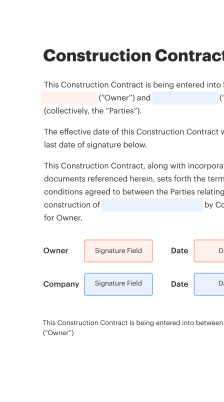
Bill of Receipt Template for Secure Transactions

Empower your business with airSlate SignNow's easy-to-use eSigning solution. Save time and reduce costs while managing your documents seamlessly.

Award-winning eSignature solution

What a bill of receipt template is and when to use it

A bill of receipt template is a standardized document used to record payment received for goods or services, including payer details, payment amount, date, and an itemized description. Templates reduce errors, speed processing, and create a consistent record for accounting and tax purposes. In digital workflows, templates can be combined with eSignature tools, conditional fields, and automation to capture signatures, timestamps, and audit trails. Using a template helps ensure every receipt meets internal controls and regulatory requirements while enabling faster distribution, archival, and retrieval across teams and cloud storage systems.

Why use a bill of receipt template

Templates standardize receipts, reduce manual entry errors, and provide a reliable record for audits and reconciliation across accounting systems.

Why use a bill of receipt template

Common challenges when managing receipts without templates

  • Inconsistent formatting complicates bookkeeping and slows reconciliation across multiple transactions and accounts.
  • Missing or incomplete payer details lead to disputes and delay refunds or adjustments with customers and partners.
  • Manual delivery and storage increase the risk of lost documents and make audit retrieval time-consuming.
  • Paper-based receipts lack tamper-evident metadata and provide no reliable digital audit trail for compliance reviews.

Representative user profiles

Small Business Owner

An owner managing invoicing and payments for a local services company who needs repeatable receipt output for bookkeeping, tax filings, and customer records. They prioritize simple templates, quick signature capture, and exportable data for accounting software reconciliation.

Medical Billing Lead

A clinic billing coordinator responsible for collecting receipts tied to patient visits who requires HIPAA-compliant document handling, signed acknowledgement of charges, and a searchable audit trail for internal audits and payer inquiries.

Who typically uses bill of receipt templates

Organizations of all sizes adopt receipt templates to ensure consistent payment records and simplify accounting.

  • Small businesses and freelancers handling frequent retail or service payments needing reliable records.
  • Healthcare practices and clinics processing patient payments while needing HIPAA-aware handling of billing documents.
  • Property managers and landlords issuing receipts for rent and security deposits with clear payment histories.

Templates are also useful for contract closeout, customer service disputes, and regulatory reporting where auditable receipts are required.

be ready to get more

Choose a better solution

Key tools that improve bill of receipt template workflows

Choose features that reduce manual work, enhance accuracy, and preserve legal validity when issuing receipts.

Reusable Templates

Save standardized receipt layouts with predefined fields, conditional logic, and branded headers so staff can generate accurate receipts quickly without manual reformatting or misplacing required information.

Auto-populated Fields

Connect templates to customer records or invoices so payer name, address, tax ID, and payment amount populate automatically, lowering manual-entry errors and speeding up issuance.

Bulk Send

Send multiple receipts at once for recurring payments or batch settlements, maintaining unique recipient data while reducing per-document handling time and email volume.

API Integration

Integrate templates with accounting or CRM systems to create receipts programmatically, post transactions automatically, and maintain synchronized records across platforms.

How to create and use a bill of receipt template online

Creating a reusable receipt template reduces repetitive tasks and improves consistency across your organization.

  • Choose a template: Select a receipt layout suited to your business.
  • Customize fields: Add required legal, fiscal, and customer fields.
  • Set validation: Require fields and format checks to prevent errors.
  • Publish and reuse: Save template and apply it to new transactions.
Collect signatures
24x
faster
Reduce costs by
$30
per document
Save up to
40h
per employee / month

Step-by-step: complete a bill of receipt template

Follow these core steps to fill and finalize a bill of receipt template accurately and consistently.

  • 01
    Enter payer details: Add full name, contact, and invoice or reference numbers.
  • 02
    Record payment data: Specify amount, currency, payment method, and transaction ID.
  • 03
    Itemize charges: List goods or services with unit prices and totals.
  • 04
    Sign and timestamp: Capture signature and automatic time-stamp for audit.
be ready to get more

Why choose airSlate SignNow

  • Free 7-day trial. Choose the plan you need and try it risk-free.
  • Honest pricing for full-featured plans. airSlate SignNow offers subscription plans with no overages or hidden fees at renewal.
  • Enterprise-grade security. airSlate SignNow helps you comply with global security standards.
illustrations signature

Typical workflow settings when automating receipt templates

Standardize automation settings to ensure timely delivery, clear audit trails, and consistent document lifecycle handling across receipt templates.

Workflow Configuration Setting Name Header Default configuration values used across receipt templates
Reminder Frequency and Escalation Policy 48 hours; two reminders; escalate after 7 days
Signature Order and Required Signers Payer then issuer required sequential signing
Template Auto-fill Source Mapping CRM customer fields mapped to receipt fields
Retention and Archival Period Seven years storage; archived in secure bucket
Notification and Delivery Methods Email by default; optional SMS link delivery

Core security and document protections

Encryption: AES-256 encryption at rest
Transport Security: TLS 1.2+ in transit
Access Controls: Role-based access settings
Authentication: Email, SMS, or SSO
Audit Logging: Immutable signing records
Data Isolation: Tenant separation for enterprise accounts

Industry examples using bill of receipt templates

Practical examples show how templates streamline receipts in different industries while preserving compliance and auditability.

Healthcare Clinic

The clinic standardized patient payment receipts with templated fields for CPT codes and co-pay amounts to reduce billing errors

  • Uses controls to require staff initials and secure eSignature confirmation
  • Improves patient clarity and reduces refund requests

Resulting in faster reconciliations and fewer claim disputes during payer audits.

Property Management

A property manager implemented a receipt template for rent and deposit transactions, capturing tenant name, unit number, and payment method

  • Integrates with accounting to auto-post payments
  • Provides clear proof of receipt to tenants and owners

Leading to reduced tenant disputes and simplified month-end reporting for multiple properties.

Best practices for secure and accurate bill of receipt template use

Adopt consistent procedures and technical safeguards to maintain data integrity, compliance, and operational efficiency when issuing receipts.

Maintain a single canonical template library for all teams
Centralize templates to prevent divergent formats; enforce version control and approvals so only current, audit-reviewed templates are used for official receipts.
Require field validation and standardized tax fields
Use field validation for currency, tax IDs, and invoice references to prevent formatting errors that complicate reconciliation and tax reporting across jurisdictions.
Retain tamper-evident audit trails for each issued receipt
Capture signer identity, timestamps, IP addresses, and document version history to support disputes, audits, and legal verification of payment events.
Align retention policies with accounting and legal requirements
Define retention durations consistent with tax law and industry rules; implement secure backups and access controls to enforce retention and deletion schedules.

FAQs About bill of receipt template

Common questions and answers about creating, signing, and storing bill of receipt templates to help troubleshoot everyday issues.

Digital vs paper: quick compliance and capability comparison

Comparing common digital eSignature platforms against paper receipts highlights availability of legal support, audit trails, and integration capabilities.

Feature and Compliance Comparison Table signNow (Recommended) DocuSign Adobe Sign
ESIGN UETA Legal Support in US
Audit Trail with Signed Metadata Comprehensive logs Comprehensive logs Comprehensive logs
Bulk Send and Mass Signing Capacity High-volume support Enterprise bulk tools Bulk send options
Mobile Signing Support and Apps iOS and Android apps Full mobile apps Mobile and web apps
be ready to get more

Get legally-binding signatures now!

Potential risks from improper receipt handling

Legal exposure: Disputes over payment terms
Regulatory fines: Noncompliance penalties
Data breaches: Sensitive data leaks
Audit failures: Missing records
Operational delays: Slow reconciliations
Customer dissatisfaction: Unresolved payment issues

Feature-level vendor comparison for receipt workflows

Below is a vendor feature snapshot focused on receipt template use, API access, compliance, and integration breadth across five major providers.

Vendor and Plan Summary signNow (Recommended) eSignature solution with API and templates DocuSign global eSignature platform with enterprise integrations and SDKs Adobe Sign integrated eSignature within Adobe Document Cloud ecosystem PandaDoc document automation platform with eSign and workflow tools Dropbox Sign (HelloSign) streamlined eSignature integrated with Dropbox storage
API and Developer Tools Robust REST API and SDKs for common languages Enterprise-grade APIs with extensive SDKs APIs integrated with Adobe ecosystem REST API and webhooks for developers Simple API with developer docs and SDKs
HIPAA Compliance Availability HIPAA BAA available for eligible plans HIPAA support via enterprise BAA HIPAA via enterprise agreements HIPAA options on select plans HIPAA support available upon request
Template Management and Custom Fields Central template library plus reusable fields and conditional logic Advanced template and workflow tools Template library with Adobe-driven forms Template features focused on sales docs Template and reusable field support
Bulk Send and Batch Processing Bulk Send feature for mass receipts Enterprise bulk send capabilities Batch sending and CSV-based workflows Batch send available on higher tiers Limited batch options with simple workflows
Integrations and Native Connectors Prebuilt integrations for CRM, storage, and accounting Extensive marketplace of integrations Deep Adobe ecosystem and enterprise connectors Native CRM and payment integrations Tight Dropbox product integration

Understanding a Bill of Receipt Template

A bill of receipt template is a crucial document used to acknowledge the receipt of payment for goods or services. This template serves as proof of transaction, detailing essential information such as the date of payment, the amount received, the name of the payer, and a description of the goods or services provided. By utilizing a bill of receipt template, businesses can maintain accurate financial records and provide transparency to their customers.

Key Components of a Bill of Receipt Template

When creating a bill of receipt, it is important to include specific elements to ensure clarity and completeness. The key components typically include:

  • Date: The date when the payment was received.
  • Payer Information: Name and contact details of the individual or entity making the payment.
  • Payment Amount: The total amount received, clearly stated.
  • Description of Goods/Services: A brief description of what the payment covers.
  • Receipt Number: A unique identifier for reference.
  • Signature: Space for the authorized person to sign, confirming the receipt.

Benefits of Using a Bill of Receipt Template

Employing a bill of receipt template offers several advantages for businesses and individuals alike. These benefits include:

  • Time Efficiency: A pre-designed template saves time in document creation, allowing for quick and easy customization.
  • Consistency: Using a standard template ensures uniformity across all receipts, enhancing professionalism.
  • Record Keeping: Templates facilitate organized record-keeping, making it easier to track payments and transactions.
  • Legal Protection: A well-documented receipt can serve as legal proof of payment in case of disputes.

How to Create a Bill of Receipt Template

Creating a bill of receipt template can be done efficiently with digital tools. Here are the steps to follow:

  • Select a Format: Choose a digital format that suits your needs, such as PDF or Word.
  • Include Essential Fields: Ensure all key components are present in the template.
  • Design for Clarity: Use clear fonts and layout to enhance readability.
  • Save as a Template: Once finalized, save the document as a template for future use.

Utilizing airSlate SignNow for Bill of Receipt Templates

airSlate SignNow offers an efficient platform for creating and managing bill of receipt templates. Users can easily prepare and send documents for eSigning, ensuring secure and quick transactions. The platform allows for customization of templates to fit specific business needs, enabling users to edit and save documents seamlessly. Additionally, airSlate SignNow provides a secure environment for sharing completed receipts, ensuring that sensitive information remains protected.

Common Use Cases for Bill of Receipt Templates

Bill of receipt templates are versatile and can be used in various scenarios, including:

  • Retail Transactions: Issuing receipts for customer purchases in stores.
  • Service Providers: Acknowledging payments for services rendered, such as consulting or repairs.
  • Freelancers: Providing clients with proof of payment for completed projects.
  • Event Registrations: Confirming payments for event tickets or registrations.
walmart logo
exonMobil logo
apple logo
comcast logo
facebook logo
FedEx logo
be ready to get more

Get legally-binding signatures now!