Building Construction Bill Format in Excel for Technology Industry

Streamline your billing process with airSlate SignNow's intuitive eSigning tool. Enjoy cost-effective document management that enhances efficiency and empowers your business.

Award-winning eSignature solution

What a building construction bill format in excel for technology industry entails

A building construction bill format in Excel for the technology industry is a structured spreadsheet template designed to capture costs, quantities, rates, and procurement details for construction-related works supporting tech facilities. It typically includes sections for labor, materials, subcontractor charges, equipment, contingency, overhead allocation, tax treatment, and line-item descriptions. The template helps standardize estimates, support invoice verification, and integrate procurement data with project accounting. For technology firms, the format often adds items such as server room fit-out, raised flooring, redundant power systems, and specialized cooling costs to reflect industry-specific requirements.

Why standardize with a construction bill format in Excel

Standardized Excel bill formats reduce errors, speed approvals, and improve budget tracking by keeping itemization consistent across projects and vendors for technology-sector construction work.

Why standardize with a construction bill format in Excel

Common challenges when using construction bill formats

  • Inconsistent line-item descriptions make cost comparisons across vendors difficult and slow review cycles.
  • Missing contingency or indirect cost lines can understate budget needs for technology-specific infrastructure additions.
  • Manual data entry across multiple sheets increases risk of transcription errors and lost auditability.
  • Nonstandard units and rates between vendors complicate consolidation and delay procurement approvals.

Primary users of an Excel construction bill format

Project Manager

Project managers use the bill format to consolidate vendor estimates, validate scope alignment with technical requirements, track budget variances, and coordinate approvals across engineering, facilities, and procurement teams for technology builds.

Procurement Officer

Procurement professionals reference the Excel bill to compare supplier quotes, ensure compliance with contract terms, manage purchase orders, and maintain records for invoice reconciliation and vendor performance in technology projects.

Advanced features for technology-industry construction bills

Consider adding advanced fields and controls to address the specialized needs of technology facility construction and compliance tracking.

Redundancy items

Separate line items for redundant power, cooling N+1 configurations, and failover systems to ensure clear costing of resilience measures specific to data centers and critical IT rooms.


Specialty equipment

Fields for racks, PDUs, CRAC units, and cable management hardware provide visibility into high-cost, technology-specific equipment and lifecycle planning.

Commissioning tasks

Include commissioning and testing line items to capture costs for acceptance testing, certification, and handover procedures required for operational readiness.

Change order tracking

Built-in change order rows and summary sections record scope modifications, reason codes, and approved costs for transparent contract management.

Tax and compliance rules

Columns to flag taxable items, jurisdiction, and regulatory codes support accurate tax calculation and reporting for multi-state projects.

Contingency allocation

A designated contingency line with configurable percentage and release conditions preserves budget flexibility and clarifies governance for contingency draws.

be ready to get more

Choose a better solution

Core features to include in a construction bill format

Design your Excel template with features that support auditability, version control, and integration with procurement and accounting systems.

Line-item detail

Detailed cells for quantity, unit, unit price, extended amount, and subcategory allow precise cost tracking and make comparisons with supplier quotations straightforward during technical facility construction.

Version control

A revision table capturing author, date, and change summary helps teams track updates, enforce approvals, and maintain a clear audit trail for technology-related build changes and scope revisions.

Validation rules

Data validation and locked formula sections reduce manual errors by constraining allowed inputs for rates, units, and numeric ranges while preserving editable description fields for vendor notes.

Integration-ready layout

Structured columns and consistent field names enable easier imports into procurement systems, ERP, or eSignature workflows and reduce mapping effort when exporting for financial reconciliation.
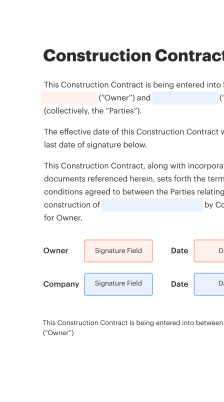
How to use the Excel bill format in everyday workflows

This sequence shows how stakeholders interact with the bill from estimate to final invoice reconciliation.

  • Estimate entry: Vendors submit line-item entries into the template.
  • Internal review: Project and procurement teams validate quantities and scope.
  • Approval: Authorized signoffs are recorded with dates and reviewers.
  • Invoice match: Final invoices are compared to accepted bill rows for payment.
Collect signatures
24x
faster
Reduce costs by
$30
per document
Save up to
40h
per employee / month

Quick setup steps for your Excel construction bill

Follow these core steps to create a reusable bill format tailored for technology industry construction and infrastructure.

  • 01
    Define sections: Create headers for labor, materials, equipment, and overhead.
  • 02
    Standardize units: Use consistent units and descriptions across all line items.
  • 03
    Add formulas: Include quantity x rate calculations and tax/markup rows.
  • 04
    Include metadata: Add project ID, vendor, revision, and approval fields.

Detailed operational steps for managing bills in Excel

Use this grid to structure routine operations from template setup through closure and archiving.

01

Template creation:

Build master sheet and lock formulas.
02

Vendor onboarding:

Distribute template and naming rules.
03

Estimate intake:

Collect and validate submissions.
04

Internal validation:

Cross-check quantities and scopes.
05

Approval routing:

Obtain required signatures.
06

Archive:

Store signed final with metadata.
be ready to get more

Why choose airSlate SignNow

  • Free 7-day trial. Choose the plan you need and try it risk-free.
  • Honest pricing for full-featured plans. airSlate SignNow offers subscription plans with no overages or hidden fees at renewal.
  • Enterprise-grade security. airSlate SignNow helps you comply with global security standards.
illustrations signature

Recommended workflow settings for managing construction bills

Configure workflow defaults to enforce review, reminders, and approval sequencing for construction bill processing.

Setting Name Configuration
Approval Sequence Two-step review
Reminder Frequency 48 hours
Auto-archive After 90 days
Versioning Enabled Yes
Required Signatures 2 approvers

Platform and device considerations for using Excel bills

Ensure teams can access and edit Excel bills across desktop and mobile devices while retaining security and version control.

  • Desktop OS: Windows 10 or later
  • Spreadsheet app: Excel 2016+ or Office 365
  • Mobile access: iOS/Android viewer apps

For collaborative environments, pair the Excel format with a document management system and secure eSignature provider to manage approvals, preserve audit trails, and maintain consistent access controls across devices.

Security and protection considerations

Encryption at rest: AES-256 recommended
Encryption in transit: TLS 1.2 or higher
Access controls: Role-based access
Document watermarking: Optional visibility layer
Audit logging: Immutable event records
Backup frequency: Daily snapshots

Industry examples using a tailored Excel bill format

Two concise examples show how technology organizations adapt Excel bills for infrastructure and office construction projects.

Data Center Fit-Out

A data center project used an Excel bill for precise power and cooling line items to support technical scope

  • Included redundant UPS and chilled water costs
  • Improved vendor comparisons and schedule alignment

Resulting in clearer change orders and faster budget approvals.

Corporate Office Move

A technology company created a bill format to capture raised floor, network rack, and AV installation costs

  • Tracked per-room quantities and cabling runs
  • Streamlined vendor invoicing reconciliation against purchase orders

Leading to on-time occupancy and simplified financial close for the build-out.

Best practices for accurate Excel construction bills

Adopt procedural and structural best practices to maintain accuracy, consistency, and regulatory compliance in construction billing for technology projects.

Use standardized naming conventions and codes
Establish a codified list for materials, labor categories, and equipment to avoid synonym mismatches; ensure codes map to procurement and accounting ledgers to speed reconciliation and reporting.
Lock calculated fields and protect worksheets
Protect formula cells and provide separate editable sheets for vendor input to preserve integrity of totals and reduce accidental overwrites during collaborative reviews.
Include approval and sign-off fields with dates
Record approver name, role, and signature date on each bill version to create an internal audit trail and provide clear accountability for payment and scope acceptance decisions.
Archive revisions with change summaries
Keep a timestamped archive of prior bill versions and a short explanatory note for each revision to support audits, dispute resolution, and historical cost analysis.

FAQs About building construction bill format in excel for technology industry

Answers to frequent questions about template design, validation, and integration when preparing construction bills for technology projects.

Feature availability: signNow versus other eSignature vendors

A concise feature availability comparison for common eSignature and document workflow capabilities used with Excel-based construction bills.

Feature signNow (Recommended) DocuSign Adobe Sign
Basic eSignature
Bulk Send
API integrations REST API REST API REST API
HIPAA-ready option Available Available Available
be ready to get more

Get legally-binding signatures now!

Common document retention and deadline milestones

Set retention times and milestone checkpoints to satisfy auditing needs and project recordkeeping for construction bills in the technology sector.

Initial estimate submission deadline:

Two weeks before procurement

Vendor quote validity period:

30 to 90 days

Approval and signature deadline:

Depends on project timeline

Invoice submission window:

30 days after service

Document retention period:

7 years recommended

Risk points and potential penalties

Contract disputes: Delayed payments
Noncompliance: Fines or corrective orders
Data exposure: Reputational harm
Incorrect billing: Financial loss
Missing records: Audit failure
Regulatory breach: Legal penalties

Pricing comparison across leading eSignature services

Representative entry-level and business-tier pricing and feature notes for signNow and competing vendors commonly used with Excel workflows.

Plan signNow (Featured) DocuSign Adobe Sign HelloSign PandaDoc
Entry-level price $8/user/month (annual) $10/user/month $14.99/user/month $15/user/month $19/user/month
Business plan price $15/user/month $25/user/month $30/user/month $25/user/month $30/user/month
Bulk Send support Included Add-on or higher plan Included Included Included
API access Included Included Included Included Included
Document retention controls Yes Yes Yes Yes Yes
walmart logo
exonMobil logo
apple logo
comcast logo
facebook logo
FedEx logo
be ready to get more

Get legally-binding signatures now!