Check Status E Sign with SignNow

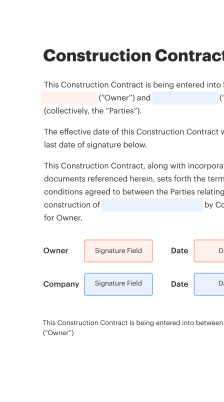
Insert a signature block for your PDF document and configure it in just a few clicks. Send out your digital documents to users and get the data files eSigned from any type of device and from any place.

Award-winning eSignature solution

Understanding check status e sign and how it works

check status e sign refers to the process of verifying where a document stands in an electronic signature workflow, from creation through delivery, signing, and final archiving. It covers visibility into recipient actions, timestamps, and status codes that indicate pending, viewed, signed, or declined states. Organizations use status checks to enforce deadlines, reconcile records, and trigger downstream actions such as billing or onboarding. In a U.S. context, status reporting also supports evidentiary needs for compliance with ESIGN and UETA by preserving metadata and audit logs tied to each signature event.

Why checking e-sign status matters for operations

Regularly checking e-sign status reduces administrative delays, improves record accuracy, and supports compliance verification by maintaining auditable timelines and recipient activity data.

Why checking e-sign status matters for operations

Common challenges when checking e-sign status

  • Unclear status labels across different providers can cause inconsistent interpretations and delayed follow-ups.
  • Email delivery failures or spam filtering often prevent recipients from receiving status-triggering notifications reliably.
  • Team members lacking access rights may not see status updates, creating duplicated outreach and confusion.
  • Missing or truncated audit metadata can weaken legal defensibility and complicate compliance reporting.

Representative user roles and their needs

General Counsel

General Counsel requires reliable status data and full audit trails to verify contract execution dates, signer identities, and preserved metadata for dispute resolution and regulatory compliance across UETA and ESIGN.

HR Manager

HR Managers need quick visibility of pending offers and onboarding documents, automated reminders for unsigned items, and clear exportable reports to integrate with HRIS and retention policies.

Who relies on check status e sign in daily workflows

Legal, HR, sales, and operations teams commonly monitor signature status to validate transactions and keep processes moving.

  • Legal teams tracking execution for contracts and regulatory evidence.
  • Human resources monitoring offer letters, onboarding, and policy acknowledgements.
  • Sales and operations verifying order confirmations and service agreements.

Regular status checks cut manual follow-up, help meet regulatory deadlines, and provide clear handoffs between teams.

Key tools that improve status visibility

Use platform features designed to provide clear, auditable status information to streamline follow-ups and support compliance audits.

Real-time status

Live updates showing when recipients receive, open, and sign documents, enabling immediate follow-up and accurate timeline reconstruction for audit purposes.

Audit trail

Comprehensive, immutable logs that record every event, IP address, and timestamp to substantiate authenticity and execution history during disputes.

Automated reminders

Configurable reminders that trigger by days outstanding or specific status transitions to reduce unsigned documents and accelerate completion rates.

Signer authentication

Multiple verification options including email, SMS OTP, and knowledge-based checks to strengthen identity validation and status confidence.

Bulk Send visibility

Batch monitoring tools that display per-recipient status for mass distributions, helping teams track completion rates across large sends.

API status endpoints

Programmatic endpoints that expose envelope or document status for integration into CRM, ERP, or custom dashboards for centralized monitoring.

be ready to get more

Choose a better solution

Integrations and templates that simplify status checks

Integrate status data into common systems and use templates to standardize signature flows and reporting across teams.

Google Workspace

Embed status indicators in Google Docs and Drive to see signature progress alongside document edits and enable direct resends from the file environment.

CRM integrations

Push status updates to CRM records so sales and account teams immediately see signing progress and trigger next-step workflows based on completion.

Cloud storage sync

Automatically archive completed documents to Dropbox or Box with metadata for retention, simplifying retrieval and status-backed audits.

Reusable templates

Create template-based workflows with predefined recipient roles and reminders to ensure consistent status behavior and predictable completion timelines.

How status updates propagate through an e-sign workflow

Status updates flow from delivery through recipient interaction to final archiving and can trigger automated events or notifications.

  • Delivery: System records initial sent timestamp.
  • View event: Opens log view for recipient.
  • Signature event: Captures signer identity and time.
  • Completion: Document marked as fully executed.
Collect signatures
24x
faster
Reduce costs by
$30
per document
Save up to
40h
per employee / month

Quick steps to check status e sign for a document

Follow these core steps to locate and interpret the current status of an e-signed document in your account.

  • 01
    Locate document: Search by name or ID.
  • 02
    Open status panel: View timeline and events.
  • 03
    Review recipient actions: Check view, sign, decline logs.
  • 04
    Export audit: Download metadata and timestamps.

How to access and interpret an audit trail for status verification

An audit trail provides the factual timeline needed to interpret status and support legal or operational questions.

01

Open document:

Navigate to the document in your dashboard.
02

View history:

Open the activity or audit tab.
03

Inspect events:

Read each event with time and actor.
04

Export log:

Download a signed audit report.
05

Verify signatures:

Confirm signer authentication method used.
06

Store evidence:

Archive audit with document copy.
be ready to get more

Why choose airSlate SignNow

  • Free 7-day trial. Choose the plan you need and try it risk-free.
  • Honest pricing for full-featured plans. airSlate SignNow offers subscription plans with no overages or hidden fees at renewal.
  • Enterprise-grade security. airSlate SignNow helps you comply with global security standards.
illustrations signature

Typical workflow settings that affect status behavior

Adjusting workflow settings determines how and when status updates are generated, who receives notifications, and how long records are retained.

Setting Name Configuration
Reminder Frequency 48 hours
Signer Order Enforcement Sequential
Expiration Window 30 days
Audit Log Retention 7 years
Notification Recipients Sender and admin

Supported platforms for status access

Status checking is available across web browsers, native mobile apps, and via APIs so teams can monitor progress from multiple environments.

  • Web browsers: Chrome, Edge, Safari
  • Mobile apps: iOS and Android
  • APIs and webhooks: REST endpoints

Ensure your users run supported browser versions or the latest mobile app, enable network access for webhooks, and confirm API credentials and scopes are configured to allow status queries and callback deliveries.

Security and authentication elements to check

Encryption in transit: TLS 1.2+
Encryption at rest: AES-256
Access controls: Role-based access
Authentication methods: Password or MFA
Audit logs: Immutable records
Data residency: US-based storage

Industry examples showing status checks in action

Practical scenarios illustrate how status visibility supports different workflows and compliance needs across sectors.

Healthcare consent forms

A healthcare provider sends a HIPAA-sensitive consent form to a patient for signature.

  • The system records viewing time and signed timestamp.
  • The audit trail flags missing signatures for follow-up reminders.

Resulting in preserved consent evidence and reduced appointment delays through timely completion.

Sales order approvals

A sales rep routes a high-value order for manager approval and customer signature.

  • Each recipient action updates the status in real time.
  • Automated reminders reduce manual chasing for pending approvals.

Leading to faster order processing, clearer revenue recognition, and fewer billing disputes.

Best practices for accurate and reliable status monitoring

Adopt standardized procedures that ensure status data is complete, accessible, and actionable for operational and compliance needs.

Standardize naming and metadata conventions
Use consistent document naming, IDs, and metadata fields so status queries return unambiguous results and reports align across systems and teams.
Configure automated reminders and escalation paths
Set reminder schedules and escalation rules for unsigned items to reduce latency, define ownership for follow-up, and ensure time-sensitive documents are completed.
Limit access and audit changes to status records
Apply role-based permissions so only authorized users can view or export status logs, and enforce logging of any administrative changes to protect evidentiary value.
Validate integrations periodically
Schedule recurring tests of API endpoints, CRM syncs, and storage archiving to confirm status data flows as expected and to catch errors early.

FAQs About check status e sign

Common questions about checking e-sign status cover visibility, delays, missing events, and integration behavior; answers focus on practical troubleshooting and configuration checks.

Feature availability for status checks across providers

Compare core status-related features to understand which providers offer the capabilities your workflows require.

eSignature Provider Feature Availability Table signNow (Recommended) DocuSign Adobe Sign
Real-time status updates
Bulk Send status per recipient
API status endpoints REST API REST API REST API
HIPAA compliance option
be ready to get more

Get legally-binding signatures now!

Retention and archival timelines that affect status availability

Retention settings determine how long completed documents and their status histories remain accessible for audits or legal use.

Default retention period:

7 years for contracts and legal records

Short-term archival:

90 days for temporary documents and drafts

Automated deletion policy:

Configurable per account or folder

Export before purge:

Export audit logs prior to scheduled deletion

Legal hold option:

Preserve records during disputes

Risks from inadequate status tracking

Compliance gaps: Regulatory fines
Contract disputes: Enforcement delays
Operational delays: Missed deadlines
Data loss: Incomplete records
Security exposure: Unauthorized access
Reputational harm: Client distrust

Entry-level pricing and plan features that affect status tools

Basic plan features vary and can influence access to advanced status reporting, API calls, and retention controls; compare entry-level tiers for status-related functionality.

Vendor Plans and Pricing signNow (Recommended) DocuSign Adobe Sign HelloSign PandaDoc
Monthly starting price $8/user $10/user $9.99/user $15/user $19/user
Free trial availability Yes Yes Yes Yes Yes
API access included Limited Paid add-on Paid add-on Paid add-on Paid add-on
Audit log export Included Included Included Included Included
Bulk Send limits 500 envelopes/month 250 envelopes/month 200 envelopes/month 100 envelopes/month 200 envelopes/month

eSign and Handle Documents At Ease with airSlate SignNow

airSlate SignNow is a sturdy, full-featured, and award-winning solution for eSigning and managing contracts both on desktop and cell phone. A large number of businesses, including Xerox, CBS Sports, and Colliers have already experienced the benefits of using airSlate SignNow. Not only does it streamline and increase document turnover as the vast majority of eSignature software does, it also adds versatility to the whole process of eSigning.

The differentiating features of airSlate SignNow making it an exclusive and paramount solution among the competitors are the following:

  • Upload ready forms or create templates via the online editor and reuse them later on.
  • Use handwritten, typed in, or scanned signatures. Just before delivering a contract out for validation, you can determine what kind of signature a recipient may use.
  • Send a contract out for signing to one or several signers via email or link.
  • Configure an expiry date to have your document validated on time.
  • Stay up-to-date with reminders. All recipients including the sender will receive notifications until each role has been done (changeable in advanced settings).
  • Keep the signing process comfortable for recipients. Signees don't need to register or sign-up to execute the contract.

airSlate SignNow's intuitive interface makes it convenient for users to share folders between departments, and build top quality workflows. Utilizing the apps for iOS and Android, handling and validating documents on the go is really possible.

Being compliant with major security standards, airSlate SignNow ensures your data is protected. The embedded, court-admissible Audit Trail tracks every change to your file, keeping everyone accountable.

Sign up for a totally free trial and begin building efficient eSignature workflows with airSlate SignNow.


walmart logo
exonMobil logo
apple logo
comcast logo
facebook logo
FedEx logo
be ready to get more

Get legally-binding signatures now!