Unique invoice identifier
A persistent, system-wide invoice ID allows deduplication, reliable references across systems, and linkage to payments, credits, and purchase orders for end-to-end traceability.




Standardized electronic bill formats reduce processing time, lower human error, and improve downstream reporting accuracy for accounting teams.

Controllers oversee financial close and compliance; they evaluate electronic bill formats to ensure reliable posting, standard tax handling, and sufficient audit metadata. They require formats that support automated GL mapping and provide verifiable signing and retention records to satisfy internal control frameworks and external auditors.
Billing managers coordinate vendor templates, validate incoming invoice structure, and manage exceptions. They prefer formats that reduce manual touchpoints, integrate with AP automation, and include clear payment terms and remittance fields to speed cash application and reduce days payable outstanding.
Finance and operations teams adopt standardized e-bill formats to accelerate invoice processing and improve control.
Consistent formats aid automation, reduce exceptions, and make audits faster for internal and external reviewers.
A persistent, system-wide invoice ID allows deduplication, reliable references across systems, and linkage to payments, credits, and purchase orders for end-to-end traceability.
Line-level tax codes, jurisdiction identifiers, and tax amounts enable precise tax calculations, support remittance reporting, and simplify audits across multi-state operations.
Fields to reference supporting documents—purchase orders, receipts, contracts—so systems can associate evidence with each invoice for validation and audit readiness.
Include approver IDs, approval timestamps, and status codes so downstream systems can verify authorization before posting and maintain a defensible approval trail.
Structured payment routing details (ACH, wire, account numbers) reduce payment errors and streamline automated disbursements while preserving security constraints.
Standardized reason codes for mismatches, tax queries, or pricing disputes help route issues and accelerate exception resolution with consistent reporting.
Include discrete fields for quantity, unit price, discounts, tax classification, and SKU or service codes so systems can reconcile, apply tax logic, and match purchase orders without manual parsing.
Capture vendor tax IDs, remit-to addresses, payment terms, and preferred payment methods to automate vendor setup and payment execution while maintaining consistent supplier records.
Specify clear due dates, early payment discounts, late fees, and remittance references so accounting automation can calculate cash discounts and schedule payments accurately.
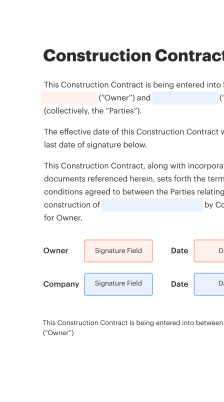
Embed a digital signature area with signer name, role, timestamp, and signature method to support non-repudiation and audit requirements for signed invoices.
| Setting Name | Configuration |
|---|---|
| Reminder Frequency | 48 hours |
| Approval Flow | Two-step |
| Field Mapping Template | Invoice to AR |
| Exception Routing | AP Queue |
| Retention Period | 7 years |
Ensure the chosen electronic bill format and signing platform support the operating systems and browsers your teams and vendors use.
Confirm that your eSignature provider and AP platform offer mobile-responsive signing, accessible APIs for file exchange, and fallbacks for legacy file types to maintain vendor participation and a reliable processing experience.
A regional distributor consolidated 18 vendor templates into a canonical electronic bill format to enable automated data extraction
Leading to shorter processing cycles and more predictable working capital management.
A university implemented an electronic bill format for accounting that aligned departmental purchasing to central templates
Resulting in clearer internal controls and simplified year-end reconciliation for finance.
| Criteria | signNow (Featured) | DocuSign | Adobe Sign |
|---|---|---|---|
| ESIGN/UETA Validity | |||
| HIPAA / BAA availability | BAA available | BAA available | BAA available |
| Mobile App Availability | iOS/Android | iOS/Android | iOS/Android |
| Bulk Send capability |
| Pricing Comparison | signNow (Featured) | DocuSign | Adobe Sign | HelloSign | PandaDoc |
|---|---|---|---|---|---|
| Plan Type | Business | Standard | Business | Pro | Business |
| Starting Price (monthly) | $8 | $10 | $14.99 | $15 | $19 |
| Free Trial | 7-day trial | Free trial | Free trial | Free trial | Free trial |
| Bulk Send Limit | Up to 1000 | Varies by plan | Limited | Up to 250 | Varies by plan |
| Advanced Authentication | 2FA, access codes | 2FA, SMS auth | 2FA, certificate | SMS OTP | SSO, 2FA |