Electronic Bill Format for Legal Services

Watch your invoicing process turn quick and seamless. With just a few clicks, you can perform all the required actions on your electronic bill format for Legal Services and other important files from any gadget with internet access.

Award-winning eSignature solution

Legal validity and compliance for electronic billing in law practice

An electronic bill format for legal services supports enforceability under ESIGN and UETA when intent, consent, and reliable records are preserved; additional administrative safeguards help meet HIPAA or state bar requirements when handling protected client information.

Legal validity and compliance for electronic billing in law practice

Typical users and their roles in billing workflows

Billing Administrator

A Billing Administrator configures invoice templates, sets automation rules, and reviews exception reports. They manage integrations with accounting systems, enforce retention policies, and support collections workflows across matters and client accounts.

Managing Partner

A Managing Partner reviews high-value invoices, approves final billing for complex matters, and monitors firm-level metrics. They ensure billing practices align with engagement terms and regulatory obligations while overseeing disputes and write-offs.

Essential features in an electronic bill format for legal services

A robust electronic bill format for legal services combines templating, itemization, compliance controls, automation, and integrations to reduce errors and speed collections across legal workflows.

Custom Templates

Template libraries let firms standardize billing formats, preserve professional headers and disclaimers, and include matter-specific fields so every invoice aligns with internal billing rules and client requirements.


Itemized Fields

Structured line-item support captures time entries, disbursements, tax breakdowns, and unit rates to ensure clarity for clients and easier reconciliation with trust accounting systems.

Tax Calculations

Built-in tax routines compute jurisdictional taxes and apply exemptions where needed, reducing manual calculations and minimizing post-billing adjustments for complex multi-jurisdiction engagements.

Automated Reminders

Reminder scheduling and escalation automate past-due notices and approval prompts, lowering days sales outstanding and keeping accounts receivable processes consistent across matters.

Audit Trail

Comprehensive event logs capture who viewed, modified, and signed invoices with timestamps and IP data, supporting enforceability and dispute resolution with clear evidence.

Integration APIs

APIs enable synchronization with practice management, accounting, and document systems to populate invoices and post payments automatically, reducing duplicate data entry and errors.

be ready to get more

Choose a better solution

Integrations and template controls for electronic invoices

Integrations with document editors, CRMs, and cloud storage reduce manual work and ensure an electronic bill format for legal services stays synchronized and auditable.

Google Docs

Enable invoice draft creation in Google Docs, convert templates to signed-ready PDFs, and map document fields so final invoices reflect edits while preserving version history and comments for internal review.

CRM Sync

Two-way synchronization with CRM systems keeps client contact, billing preferences, and matter codes current so invoices populate correctly and client billing histories remain consistent.

Dropbox

Automate saving completed invoices to firm cloud folders, apply folder-level retention policies, and maintain a centralized archive accessible to authorized finance and compliance staff.

Templates

Create role-based templates that include conditional fields, dynamic calculations, and required legal text to standardize invoices and simplify approvals across practice groups.
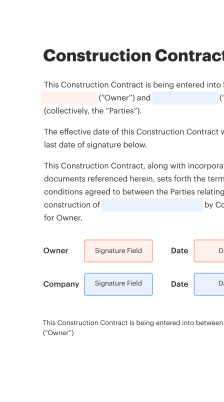
How the electronic bill format for legal services works online

Create an electronic bill format for legal services online by uploading an invoice file, mapping billing fields, assigning recipients, applying required authentication, and sending with tracking and status updates.

  • Upload document: Start with your invoice template or PDF file.
  • Map fields: Place payer, amount, and signature fields on the document.
  • Set recipients: Assign primary and secondary signers and reviewers.
  • Track status: Monitor deliveries, opens, and completed signatures in real time.
Collect signatures
24x
faster
Reduce costs by
$30
per document
Save up to
40h
per employee / month

Quick setup for an electronic bill format for legal services

Quickly set up an electronic bill format for legal services by preparing templates, defining payer and matter fields, adding itemized line entries, and configuring signature and delivery options for consistent billing.

  • 01
    Prepare template: Create a reusable invoice template with client and matter fields.
  • 02
    Add line items: Include hours, rates, expenses, taxes, and narrative descriptions.
  • 03
    Configure signing: Assign signers, set authentication, and add signature fields.
  • 04
    Send and archive: Deliver electronically and archive a secured copy with metadata.

Audit trail checklist for electronic billing transactions

Maintain a consistent audit trail for each electronic bill format for legal services to preserve evidence and simplify audits or disputes.

01

Record creation:

Capture invoice originator and timestamp.
02

Field changes:

Log edits and prior values.
03

Signer events:

Record signature time and method.
04

Delivery logs:

Store email and access events.
05

Authentication records:

Keep MFA and verification data.
06

Retention notes:

Include archival location and policy.
be ready to get more

Why choose airSlate SignNow

  • Free 7-day trial. Choose the plan you need and try it risk-free.
  • Honest pricing for full-featured plans. airSlate SignNow offers subscription plans with no overages or hidden fees at renewal.
  • Enterprise-grade security. airSlate SignNow helps you comply with global security standards.
illustrations signature

Automation settings for electronic billing workflows

Configure automation to route invoices, trigger reminders, and archive completed bills in alignment with firm policies and client agreements.

Feature Configuration
Reminder Frequency 48 hours
Approval Routing Two-step approval
Auto-archive Delay 30 days
Field Mapping Rules Custom mappings
Notification Channels Email and SMS

Device and platform considerations for bills and signatures

Use mobile, tablet, or desktop to access and complete an electronic bill format for legal services, but ensure your environment meets basic browser or app requirements.

  • iOS app: iOS 13 or newer
  • Android app: Android 8 or newer
  • Web browser: Latest Chrome, Edge, or Safari

For reliable performance, keep devices updated, use secure network connections, enable device-level biometrics when available, and verify document rendering across platforms before sending client invoices.

Security controls for electronic bill formats

Encryption at rest: AES-256 encryption
Encryption in transit: TLS 1.2+ protection
Access controls: Role-based permissions
Multi-factor authentication: Optional MFA for users
Document watermarking: Dynamic watermark options
Granular permissions: Field-level access rules

Use cases: how law teams adopt electronic bill formats

Real-world examples show how electronic bill formats reduce disputes, speed approvals, and feed billing systems for accounting and trust management.

Small law firm billing

A small firm standardized an electronic bill format to capture hourly entries and expenses automatically from timekeeping software

  • Template mapping reduced manual entry and errors
  • Clients received clearer invoices and paid faster

Resulting in shorter collection cycles and fewer client inquiries after invoicing.

Corporate legal department invoices

A corporate legal team used an electronic bill format to enforce matter codes and client billing rules before sending invoices

  • Validation rules prevented noncompliant line items from being submitted
  • The centralized process reduced disputes and approval delays

Leading to more consistent payments and improved internal auditability.

Best practices for secure and accurate electronic billing

Adopt practices that reduce disputes and preserve compliance when using an electronic bill format for legal services, balancing accessibility with data protection.

Standardize template and data fields
Use firm-wide templates with predefined matter and client fields to ensure consistent invoices, reduce manual edits, and make reconciliation with practice management and accounting systems straightforward and auditable.
Enforce authentication and consent
Require clear signer intent and appropriate authentication methods for clients, document consent to electronic delivery, and retain consent records to support enforceability under ESIGN and UETA.
Maintain detailed audit logs
Capture timestamps, IP addresses, and event details for every invoice lifecycle stage to support dispute resolution, compliance checks, and internal audits without relying on paper trails.
Limit data exposure
Avoid including unnecessary sensitive data in invoices, apply redaction or partial data display where appropriate, and control access through role-based permissions and time-limited links.

Common mistakes and troubleshooting for electronic billing

Answers to frequent issues encountered with electronic bill formats for legal services, including signature failures, formatting problems, and integration errors.

Vendor feature snapshot for electronic bill formats

This vendor snapshot focuses on vendor capabilities relevant to an electronic bill format for legal services, comparing signature validity, audit detail, customization, and API access.

Feature signNow (Recommended) DocuSign Adobe Sign
Legally binding (US)
Audit trail detail Full Full Full
Template customization Extensive Extensive Moderate
API availability
be ready to get more

Get legally-binding signatures now!

Retention and deadline guidelines for billing records

Define retention periods and deadlines for invoices and related records to meet regulatory, tax, and client agreement requirements while supporting audits and dispute handling.

Client invoice retention period:

Seven years

Dispute submission window:

30 days

Billing cycle reminder schedule:

14 days before due

Tax record retention timeline:

Seven years

Document destruction policy timing:

After retention period

Pricing and service snapshot for electronic billing platforms

Pricing and support differ across vendors; this table summarizes billing model, support, market focus, API availability, and trial options for common e-signature providers relevant to legal billing.

Provider signNow (Featured) DocuSign Adobe Sign OneSpan HelloSign
Billing model Subscription plans Subscription plans Subscription plans Enterprise pricing Subscription plans
Support level Email and chat support Email and phone support Email and phone support Enterprise-grade support Email and chat support
Target market SMBs and law firms Enterprises and legal teams Enterprise customers Regulated industries SMBs and teams
API access Yes, REST API Yes, REST API Yes, REST API Yes, API Yes, REST API
Free trial Yes, limited trial Yes, trial available Yes, trial available Contact sales Yes, trial available
walmart logo
exonMobil logo
apple logo
comcast logo
facebook logo
FedEx logo
be ready to get more

Get legally-binding signatures now!