Free Cost Estimating Software for Legal

free cost estimating software for Legal

Award-winning eSignature solution

What free cost estimating software for legal does and why it matters

Free cost estimating software for legal provides law firms and legal departments with tools to generate, compare, and manage cost estimates for matters, litigation, and transactional work. These solutions typically include templates for task lists, rate cards, time and expense assumptions, and basic reporting to support budgeting and client communications. A reliable free tool can reduce manual spreadsheet work, standardize estimate presentation, and create a traceable record for fee negotiations, audits, and internal approvals while integrating with document workflows and timekeeping systems.

When to consider free cost estimating software for legal

Use free cost estimating software for legal when teams need a low-cost way to standardize estimates, reduce calculation errors, and create consistent client-facing documents without committing to expensive enterprise systems.

When to consider free cost estimating software for legal

Common challenges addressed by free cost estimating software for legal

  • Inconsistent rate application across attorneys and matter types leading to inaccurate client estimates.
  • Manual spreadsheet calculations that increase errors and consume billable time during estimate preparation.
  • Difficulty tracking assumptions and changes for later audit or scope disputes with clients.
  • Limited visibility into aggregate estimate data for budgeting and capacity planning across matters.

Representative user profiles for legal cost estimating

Legal Operations Manager

Manages matter budgets, rate structures, and vendor panels across the firm. Uses cost estimating tools to standardize proposals, track historical estimates, and produce reports for leadership. Requires exportable estimates, version control, and basic integrations with timekeeping and billing systems to reconcile actuals against budgets.

Solo Practitioner

Prepares client fee estimates and flat-fee proposals without dedicated billing staff. Needs a simple interface, templates for common matters, and the ability to save assumptions. Prioritizes speed, clarity of client communications, and a defensible record of pricing decisions for later reference.

Teams and roles that commonly use cost estimating tools

Legal operations, billing teams, and practice group leaders rely on cost estimating tools to produce standardized budgets and client proposals.

  • Legal operations managers coordinating cross-firm budgeting and vendor rates.
  • Billing and finance staff preparing fee estimates and client fee letters.
  • Practice group leads creating matter budgets and resourcing plans.

Small firms and solo practitioners also use basic free tools to provide quick, defensible estimates without complex procurement.

Core features to evaluate in free cost estimating software for legal

Assess feature parity across templates, rate management, reporting, export formats, integrations, and permission controls to determine suitability for firm workflows.

Templates

Prebuilt matter templates and the ability to create custom templates for litigation, M&A, and standard transactions, enabling rapid, repeatable estimate generation across practice areas.


Rate management

Support for multiple rate cards, role-based rates, and blended rates so estimates can reflect negotiated client rates, discounts, and tiered billing.

Assumptions library

Stored assumptions for hours per task, contingency percentages, and expense estimates to ensure consistency across matters and simplify updates.

Reporting

Aggregate reporting on estimates, variances versus actuals, and utilization to assist budgeting and practice profitability reviews.

Export formats

Export to PDF, DOCX, and CSV for client delivery, internal review, and integration with billing or reporting systems.

Access controls

Role-based permissions, share settings, and approval workflows to manage who can create, edit, and approve estimates.

be ready to get more

Choose a better solution

Integrations and templates that improve accuracy

Integration with document tools and CRMs plus reusable templates reduce manual steps and ensure consistency across estimates.

Google Docs

Template-driven export and merge to Google Docs allows estimates to be converted into polished engagement letters while preserving assumptions, formatting, and version control for client communications and internal records.

CRM

Bi-directional CRM integration syncs client and matter data so estimates reflect current client billing arrangements and contact details, reducing duplicate entry and improving traceability.

Cloud storage

Integration with Dropbox or similar services stores finalized estimates in a shared, access-controlled folder to align with firm retention policies and backup procedures.

Timekeeping

Connecting to time entry systems enables comparison of estimate to actuals, facilitating variance analysis and better future estimates.
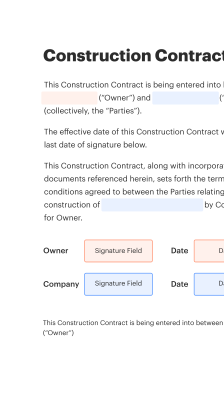
How free cost estimating software for legal functions in practice

A streamlined workflow converts inputs into a repeatable estimate document while preserving assumptions and version history for auditability.

  • Input data: Select matter type and populate tasks.
  • Apply rules: Attach rate cards and billing rules.
  • Review: Validate totals and exceptions.
  • Export: Export to client letter or PDF.
Collect signatures
24x
faster
Reduce costs by
$30
per document
Save up to
40h
per employee / month

Quick setup: get started with a free cost estimating tool

Follow a short setup to create repeatable estimate templates and begin producing client-ready budgets.

  • 01
    Create templates: Define common matter types and task lists.
  • 02
    Add rates: Enter attorney and staff rate cards.
  • 03
    Set assumptions: Specify hours, expenses, and contingency rules.
  • 04
    Generate estimate: Produce a formatted estimate for client review.

Maintaining an audit trail for estimates and approvals

Capture change history, approvals, and version notes so every estimate includes a clear audit trail for compliance and client discussions.

01

Record changes:

Log edits and user IDs.
02

Versioning:

Save sequential estimate versions.
03

Approval stamps:

Record approver name and date.
04

Assumption logs:

List baseline assumptions used.
05

Exportable history:

Provide history with PDFs.
06

Retention tags:

Apply retention metadata.
be ready to get more

Why choose airSlate SignNow

  • Free 7-day trial. Choose the plan you need and try it risk-free.
  • Honest pricing for full-featured plans. airSlate SignNow offers subscription plans with no overages or hidden fees at renewal.
  • Enterprise-grade security. airSlate SignNow helps you comply with global security standards.
illustrations signature

Typical workflow settings for estimate automation

Configure automated reminders, approval thresholds, and export defaults to streamline estimate creation and review across teams.

Setting Name Configuration
Approval Threshold 5000 USD
Reminder Frequency 72 hours
Default Export Format PDF
Auto-save Interval 5 minutes
Retention Flag Default 7 years

Supported platforms and device guidance

Free cost estimating software for legal is typically accessible via modern web browsers and may offer mobile-friendly views for on-the-go review.

  • Web: Chrome, Edge, Safari
  • Mobile: Responsive web; iOS/Android apps
  • Desktop: Windows and macOS support

For full functionality—template editing, bulk exports, and integrations—use a desktop browser; mobile interfaces are best for approvals and quick reviews.

Security and authentication features to look for

Data encryption: AES-256 at rest
Transport security: TLS 1.2+ in transit
User authentication: SAML or OAuth options
Access controls: Role-based permissions
Audit logging: Detailed change history
Data residency: US-based storage available

Practical legal use cases for cost estimating

Real-world examples show how free cost estimating software for legal supports matter intake, client proposals, and internal budgeting.

Small Litigation Matter

A regional firm prepares a litigation budget with task-level estimates and hourly assumptions to set client expectations.

  • Includes phased tasks and contingency rates.
  • Improves fee transparency and reduces later billing disputes.

Resulting in clearer client agreements and fewer scope-related write-offs.

Transactional Engagement

A corporate team uses a template to estimate hours across due diligence, documentation, and closings for mid-market deals.

  • Applies standardized rate cards and disbursement rules.
  • Speeds internal approvals and produces consistent engagement letters.

Leading to faster sign-off and more accurate budgeting against realized hours.

Best practices for accurate and secure estimates

Adopt consistent templates, document assumptions, and apply access controls to ensure reliable estimates that meet client and compliance expectations.

Standardize templates and rate cards firm-wide
Maintain a single source of truth for templates and rate information to avoid discrepancies between practice groups. Regularly review rates and templates to reflect negotiated client arrangements and market changes, and version updates with approval records.
Document clear assumptions and contingencies
Include explicit statements of scope, assumed hours, and contingency allowances so clients understand the basis of estimates and disputes are minimized. Store assumptions with each estimate for future audits and variance analysis.
Enable role-based access and approvals
Limit editing of master rate cards and templates to designated administrators and require managerial approval for client-facing estimates above threshold amounts to reduce errors and unauthorized pricing changes.
Reconcile estimates with actuals regularly
Schedule periodic reviews comparing estimated to actual time and expenses to calibrate templates, update assumptions, and inform future matter pricing strategies for improved accuracy.

FAQs about free cost estimating software for legal

Common questions address accuracy, integrations, and the limitations of free tiers versus paid plans.

Feature comparison: digital versus paper estimates and leading platforms

Compare capability and availability across common estimate features to decide between digital tools and paper-based processes for legal cost estimating.

Criteria signNow (Recommended) DocuSign Adobe Sign
Template library
Rate card support Limited Limited
Version history
Direct billing integration CSV export
be ready to get more

Get legally-binding signatures now!

Document retention and backup schedule recommendations

Set retention schedules that align with legal obligations and firm policies to manage storage, compliance, and risk.

Estimate retention policy:

Retain final estimates seven years after matter close

Backup frequency:

Daily incremental backups

Audit log storage:

Store audit trails for seven years

Data deletion window:

90-day soft-delete before permanent removal

Compliance review cadence:

Annual policy and retention review

Regulatory and operational risks to consider

Fee disputes: Client claims over estimate accuracy
Noncompliance: Missing required disclosures
Data loss: Insufficient backups
Unauthorized access: Weak access controls
Audit gaps: Incomplete change history
HIPAA exposure: Handling PHI without protections

Pricing and tier differences among popular platforms

Understanding free tier limits and paid features helps assess total cost of ownership for legal estimating and related eSignature or workflow functions.

Platform / Tier signNow (Recommended) DocuSign Free Adobe Sign Trial HelloSign Free PandaDoc Free
Starting monthly price Free tier available; paid from 8 USD/user Free limited plan; paid from 10 USD/user Trial then paid plans from 12 USD/user Free for basic users; paid from 15 USD/user Free for single users; paid from 19 USD/user
Core functionality included eSignature, templates, basic integrations, audit log eSignature, mobile apps, templates eSignature, Acrobat integration eSignature, templates, Zapier Document creation, eSignature, templates
Integrations relevant to legal Google Workspace, Dropbox, CRM connectors Salesforce, Google Workspace Adobe Document Cloud, Microsoft 365 Google Workspace, CRM plugins CRM, Zapier integrations
Compliance and security ESIGN/UETA support, SOC 2 controls, HIPAA options ESIGN/UETA, SOC 2 ESIGN/UETA, ISO certifications ESIGN/UETA, SOC reports ESIGN/UETA, SOC 2 reports
API and automation REST API with webhooks and SDKs; developer resources Robust API and Connect features API via Adobe I/O API access limited on free tier API available on paid plans
walmart logo
exonMobil logo
apple logo
comcast logo
facebook logo
FedEx logo
be ready to get more

Get legally-binding signatures now!