Modèle De Facture LibreOffice Pour Prêt Hypothécaire

See your invoicing process become fast and seamless. With just a few clicks, you can perform all the required steps on your libreoffice invoice template for Mortgage and other crucial files from any gadget with internet access.

Award-winning eSignature solution

What the libreoffice invoice template for mortgage is and when to use it

A libreoffice invoice template for mortgage is a customizable invoice layout created in LibreOffice Calc or Writer tailored to charge fees, record escrow items, or bill mortgage-related services. It standardizes line items such as origination fees, appraisal costs, title insurance, and monthly service charges, while preserving fields for borrower and loan identifiers. Lenders, brokers, and servicers use these templates to produce consistent, auditable invoices that can be exported to PDF, attached to loan files, and prepared for electronic signing and delivery.

Why a dedicated mortgage invoice template matters

A purpose-built template enforces consistent fee descriptions, improves clarity for borrowers, and reduces manual entry errors across loan portfolios.

Why a dedicated mortgage invoice template matters

Common challenges when using mortgage invoice templates

  • Inconsistent field naming across templates creates reconciliation and accounting mismatches during audits.
  • Failure to include loan identifiers or escrow codes delays payment posting and customer inquiries.
  • Manually converting multiple files to PDF adds repetitive work and increases chance of formatting errors.
  • Poor version control leads to outdated fee schedules being applied to new loan transactions.

Representative user roles for mortgage invoice templates

Mortgage Broker

A Mortgage Broker prepares fee estimates and invoices for clients and referral partners, ensuring line items match lender disclosures and that borrower identifiers are present to avoid posting errors during underwriting and closing.

Loan Processor

A Loan Processor integrates invoice records with loan files, identifies missing documents, and ensures completed invoices include tax IDs and service dates before the file advances to closing or servicing.

Who typically uses a libreoffice invoice template for mortgage

  • Loan officers and mortgage brokers who generate fee breakdowns for borrowers and partners.
  • Settlement agents and title companies preparing closing cost statements and invoices.
  • Back-office accounting teams reconciling payments and maintaining loan records.

Templates help these groups maintain consistent records, reduce dispute risk, and prepare documents for electronic workflows and signing.

Essential features to support mortgage invoice workflows

These features help create, protect, and route mortgage invoices from LibreOffice templates into compliant electronic workflows for signing and storage.

Template fields

Dynamic placeholders for borrower details, loan numbers, dates, and fee codes that can be prefilled from loan systems to reduce manual entry and standardize output.


Calculated totals

Built-in formulas and validation rules ensure taxes, prorations, and totals compute correctly and highlight inconsistencies before export to PDF for signing and storage.

Export to PDF

High-fidelity PDF export preserves layout, fonts, and table formatting so the invoice appears identically when uploaded to eSignature or archival systems.

Digital signing compatibility

Ensure exported PDFs comply with eSignature providers' recommended formats and embedding requirements to produce valid, auditable signed documents.

Version control

Maintain template version identifiers and change logs to ensure staff use current fee schedules and to support audits requiring historical templates.

Access permissions

Restrict who can edit templates and who can generate invoices, reducing risk of unauthorized fee changes and preserving consistency across the organization.

be ready to get more

Choose a better solution

Common integrations and template customizations

Integrations and template features reduce manual work and connect invoices to loan records, CRMs, and cloud storage for reliable document handling.

Google Workspace

Exported invoices can be attached to Google Drive, and data can be synced to Google Sheets for aggregation and reporting, simplifying cross-team access while preserving file version history and link-based sharing controls.

CRM integration

Connect invoices to customer records in CRM systems so loan and billing history appear in the borrower profile, enabling staff to see invoice status and payment history alongside the loan file.

Cloud storage

Save completed invoices automatically to enterprise storage like Dropbox or OneDrive to centralize retention, apply lifecycle policies, and ensure consistent backup and access across the team.

Template fields

Use placeholder fields for borrower name, loan number, and closing date to auto-populate invoices from loan records and reduce manual data entry errors when generating documents at scale.
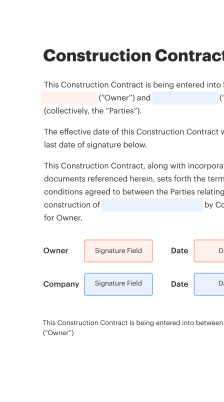
How to prepare, export, and send the invoice for signature

A simple three-step flow: prepare the LibreOffice invoice, export to PDF, and deliver it for electronic signature using a compliant eSignature provider.

  • Prepare: Complete all required loan and client fields
  • Export: Save as high-quality PDF for consistency
  • Upload: Send PDF to the eSignature service
  • Sign: Collect signatures and store executed copy
Collect signatures
24x
faster
Reduce costs by
$30
per document
Save up to
40h
per employee / month

Quick setup: create a mortgage invoice template in LibreOffice

Follow these core steps to build a reusable LibreOffice invoice template that captures mortgage-related fees and identifiers for consistent billing.

  • 01
    Create layout: Design header, borrower, and loan ID fields
  • 02
    Define items: Add standardized line-item rows and codes
  • 03
    Add calculations: Insert formulas for totals and taxes
  • 04
    Save template: Store as an .ott or .ots template file

Audit trail essentials for invoiced mortgage transactions

Maintain a clear, timestamped history of invoice creation, edits, exports, and signature events to support compliance and dispute resolution.

01

Record creation:

Log creator and timestamp
02

Edit history:

Track what changed and by whom
03

Export events:

Log PDF generation time
04

Signature events:

Record signer identity and timestamp
05

Access logs:

Store who viewed or downloaded
06

Retention markers:

Tag documents with retention policy
be ready to get more

Why choose airSlate SignNow

  • Free 7-day trial. Choose the plan you need and try it risk-free.
  • Honest pricing for full-featured plans. airSlate SignNow offers subscription plans with no overages or hidden fees at renewal.
  • Enterprise-grade security. airSlate SignNow helps you comply with global security standards.
illustrations signature

Typical workflow and recommended default settings for invoice handling

Suggested workflow settings streamline automation from template generation to signed archival while maintaining clear responsibilities and automated reminders.

Feature Configuration
Reminder Frequency 48 hours
Signature Order Sequential
Retention Tagging Loan ID + Year
Export Format PDF/A
Access Expiration 90 days

Supported platforms and device considerations

  • Desktop: Full editing support
  • Mobile viewing: PDF viewing only
  • eSignature apps: Mobile signing supported

For editing and template maintenance use desktop LibreOffice; for signature collection and cloud workflows use a compliant eSignature provider accessible from web or mobile to complete the process.

Key security and protection features to use

Password protection: Protects files at rest
PDF flattening: Prevents post-signature edits
Access controls: Limits user actions
Encrypted transit: Secures uploads and downloads
Audit logging: Records file events
Role-based rights: Assigns granular permissions

Practical examples of using the libreoffice invoice template for mortgage

Two concise case examples show typical usage patterns for lenders and settlement agents preparing mortgage-related invoices.

Lender billing example

A regional lender issues monthly service invoices to borrowers using the template to list escrow advances and servicing fees

  • Template includes loan number and charge codes to match servicing ledger
  • Automated export to PDF preserves layout for the accounting system

Resulting in faster reconciliation and fewer borrower disputes due to consistent line-item descriptions and identifiers.

Closing agent invoice

A title company uses the template for settlement invoices that itemize title, recording, and escrow fees

  • The template contains standardized tax ID and closing date fields
  • After closing, the document is exported and attached to the loan package for compliance

Leading to an auditable closing folder and reduced post-closing follow-ups.

Best practices for secure, accurate mortgage invoicing

Adopt controls and standards to reduce errors and support compliance when issuing mortgage invoices from LibreOffice templates.

Standardize line-item descriptions and codes
Create and maintain a fee schedule with consistent naming and numeric codes for each charge type, mapping codes to accounting accounts and loan ledger entries to ensure accurate posting and straightforward reconciliation.
Require loan identifiers on every invoice
Include loan number, borrower name, and property address on all invoices to avoid ambiguous records, speed payment application, and ensure documents are properly associated with the correct loan file.
Lock final PDFs before sending
Export and flatten PDF invoices to prevent post-export edits, then use an eSignature solution that provides tamper-evidence and preserves an immutable signed copy for the loan record and audit trail.
Maintain version control for templates
Track template versions and document change logs so teams use the current fee schedule and layout, and store previous versions for compliance and historical reference.

FAQs About libreoffice invoice template for mortgage

Common questions and practical answers about building, exporting, protecting, and delivering LibreOffice-based mortgage invoices.

Feature availability: signNow (Recommended) compared to other providers

A concise feature comparison showing availability and capabilities relevant to LibreOffice-exported mortgage invoices and signing workflows.

Feature / Provider signNow (Recommended) DocuSign Adobe Sign
Native LibreOffice support Indirect integration Indirect integration Indirect integration
Bulk Send
Offline signing capability Limited Limited
Tamper-evident PDFs
be ready to get more

Get legally-binding signatures now!

Retention and storage timelines for mortgage invoices

Set retention and backup policies that align with regulatory expectations and internal recordkeeping requirements for loan documentation.

Short-term access window:

30–90 days for active processing

Standard retention period:

Maintain records 7 years for general documentation

Closed loan retention:

Keep permanent loan files as required

Backup frequency:

Daily incremental backups recommended

Offsite archival:

Store long-term archives offsite or in compliant cloud

Regulatory and operational risks to watch

Data exposure: Breach risk
Noncompliance: Legal fines
Record gaps: Audit issues
Incorrect billing: Refunds required
Tampered documents: Invalid signatures
Retention failures: Compliance gaps

Pricing and plan comparison for eSignature providers used with LibreOffice invoices

High-level plan and feature differences for common eSignature providers used to finalize LibreOffice-exported mortgage invoices.

Plan / Vendor signNow (Recommended) DocuSign Adobe Sign HelloSign PandaDoc
Entry-level cost Low-cost per-user plans available Mid-range per-user pricing Mid-range per-user pricing Entry-level free tier Tiered pricing with templates
Free tier availability Limited free trial Limited trial Trial available Free tier for basic use Trial available
Enterprise capabilities Advanced workflows, SSO Advanced workflows, API Enterprise compliance features Team plans, API Sales-focused automation
Typical security features AES encryption, audit logs Encryption, extensive compliance Adobe cloud security, audit Basic encryption, audit Encryption, role controls
API and automation REST API and integrations Robust API and marketplace API and Adobe integrations API available API and CRM connectors
walmart logo
exonMobil logo
apple logo
comcast logo
facebook logo
FedEx logo
be ready to get more

Get legally-binding signatures now!