Order Invoice Template for Financial Services

Streamline your document workflows with airSlate SignNow. Enjoy a cost-effective solution to send and eSign invoices effortlessly.

Award-winning eSignature solution

What an order invoice template for financial services does

An order invoice template for financial services standardizes billing documents used by banks, asset managers, and fintech firms to request payment and record chargeable items. It captures client and account identifiers, detailed line items, taxes or fees, subtotal and total calculations, payment terms, and remittance instructions. Templates reduce manual entry, ensure consistent formatting for regulatory and audit needs, and make it easier to attach required disclosures. When integrated with secure eSignature and document workflows, templates speed approval, permit version control, and create an auditable record of invoice issuance and acceptance.

Why use a standardized order invoice template

Using a consistent template reduces errors, clarifies payment terms, supports compliance checks, and streamlines reconciliation across client accounts and reporting systems.

Why use a standardized order invoice template

Common challenges when issuing financial services invoices

  • Inconsistent invoice fields lead to manual reconciliation and delayed payments across accounts and custodians.
  • Manual calculations increase the risk of numerical errors and require extra verification steps.
  • Regulatory disclosures may be omitted or misformatted without template enforcement and validation.
  • Tracking approvals and signatures is time-consuming without an auditable digital workflow.

Representative user profiles

Accounts Receivable Manager

Typically responsible for generating and sending invoices to clients, reconciling payments, and managing follow-ups. They require templates that include client account references, payment terms, tax calculations, and a clear audit trail to support month-end close and regulatory reporting.

Compliance Officer

Oversees that invoice language and retention meet legal and regulatory requirements. They need templates that include standard disclosures, configurable retention rules, and immutable audit logs to demonstrate adherence to ESIGN, UETA, and sector-specific rules.

Who typically relies on invoice templates in finance

Departments that issue recurring or regulated charges use standardized templates to reduce operational risk and maintain audit trails.

  • Accounts receivable teams responsible for client billing and payment reconciliation.
  • Client services or relationship managers issuing fee notifications and statements.
  • Compliance and risk teams validating regulatory language and auditability.

These templates support teams from front-office billing to back-office reconciliation, improving traceability and consistency across the organization.

Key template features for reliable financial invoicing

Effective templates combine data validation, signature options, and automation to support secure, auditable billing.

Prefilled Fields

Auto-populate client and account identifiers from CRM or ERP to avoid manual errors and speed document creation for recurring invoices.


Calculated Totals

Built-in calculations for subtotals, taxes, discounts, and final totals reduce arithmetic errors and maintain consistent presentation across invoices.

Conditional Sections

Display or hide sections based on client type, tax status, or jurisdiction to ensure only relevant disclosures and fee lines appear.

Signature Blocks

Configurable signature fields support signer order, witness requirements, and delegation for authorized signatories in financial institutions.

Retention Tags

Attach retention metadata and classification labels to support records management and regulatory retention policies across document stores.

Template Versioning

Maintain version history for templates so changes are auditable and prior invoices remain tied to the template used at issuance.

be ready to get more

Choose a better solution

Integrations that make invoice templates practical

Seamless integrations reduce rekeying and keep billing synchronized with account systems and cloud storage.

CRM Sync

Two-way synchronization with CRMs populates client names, addresses, and billing contacts so invoices use current data and reduce manual entry errors.

Document Repositories

Direct save and retrieval from cloud storage like Dropbox or enterprise repositories ensures invoices are archived to the correct client folders with retention metadata.

Accounting Systems

Integration with accounting software posts invoice totals and payment status directly into ledgers to shorten reconciliation cycles and reduce bookkeeping work.

Google Docs

Create and edit template content in Google Docs and push finalized invoices into the signing workflow with consistent formatting and version control.
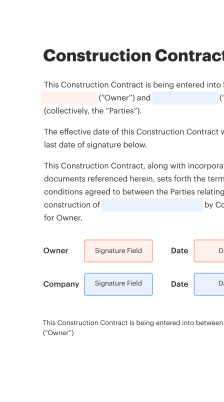
How templated invoices flow through a financial workflow

A clear process ensures each invoice moves from creation to approval, signature, and archival with traceability at every step.

  • Drafting: Populate template with client and line-item data
  • Approval: Route to internal approvers with role checks
  • Signing: Collect eSignature from client or authorized rep
  • Archival: Store final PDF with audit metadata
Collect signatures
24x
faster
Reduce costs by
$30
per document
Save up to
40h
per employee / month

Quick setup: create an invoice template

Follow these basic steps to establish a reusable order invoice template that captures required financial and client information.

  • 01
    Create Template: Start with a standardized layout and header fields
  • 02
    Add Fields: Insert line items, tax, totals, and client ID fields
  • 03
    Set Rules: Add validation and mandatory field rules
  • 04
    Save & Test: Preview with sample data and test workflows

Managing audit trails for invoice signing

An auditable trail records who accessed, edited, and signed each invoice to support compliance and dispute resolution.

01

Capture Events:

Log view, edit, and signature events
02

Timestamping:

Record precise UTC timestamps
03

User Identification:

Associate actions with user IDs
04

Document Snapshots:

Store final PDF plus metadata
05

Exportable Logs:

Provide CSV or PDF audit exports
06

Retention Linking:

Link logs to retention policy
be ready to get more

Why choose airSlate SignNow

  • Free 7-day trial. Choose the plan you need and try it risk-free.
  • Honest pricing for full-featured plans. airSlate SignNow offers subscription plans with no overages or hidden fees at renewal.
  • Enterprise-grade security. airSlate SignNow helps you comply with global security standards.
illustrations signature

Recommended workflow settings for invoice templates

Configure these workflow settings to enforce approvals, reminders, and secure handling of invoices across teams.

Workflow Automation Setting Name Header Default configuration and recommended values
Automatic Signer Reminder Frequency Setting 48 hours with two follow-ups
Approval Routing Sequence Configuration Sequential approvers based on amount thresholds
Signature Authentication Requirement Email plus optional SMS code
Document Retention Classification Tag Financial-Invoice 7 years
Template Access Permission Scoping Role-limited edit access

Device and platform requirements

Invoice templates and signing workflows are supported on modern browsers and mobile apps; confirm browser and OS versions for optimal security and functionality.

  • Desktop: Windows 10+, macOS recent releases
  • Mobile: iOS and Android with latest app
  • Browser: Chrome, Edge, Firefox, Safari supported

For mobile signing, ensure the native app is updated, that mobile browsers support secure TLS connections, and that any required authenticator apps or SMS delivery mechanisms are provisioned for users who need multi-factor authentication.

Security and protection features to look for

Encryption at rest: AES-256 storage encryption
Transport security: TLS 1.2+ for data in transit
Access controls: Role-based permissions
Multi-factor authentication: MFA for user access
Audit logging: Immutable signature audit trail
Document watermarking: Dynamic watermarks for exports

Use-case examples from financial operations

Real-world scenarios illustrate how templates reduce risk, speed processing, and support compliance across financial services workflows.

Regional Bank Billing

A regional bank standardized invoice templates to include account identifiers and fee schedules for retail and commercial clients.

  • Templates enforced required regulatory disclosures and calculation validation fields.
  • Automated reminders and reconciliation tags reduced unapplied payments and manual corrections.

Resulting in faster month-end close and fewer client disputes that improved cash application accuracy and audit readiness.

Wealth Management Fees

A wealth manager implemented templated invoices for advisory fees with prefilled client billing data and tiered fee calculations.

  • The template integrated standard custodial references and tax treatment notes.
  • Electronic signatures and a locked audit trail ensured fee acceptance and record integrity.

Leading to clearer client communications, reduced approval cycle time, and defensible records for regulatory examinations.

Best practices for secure, accurate invoicing

Adopt controls that prevent errors, preserve evidence, and align templates with operational and regulatory requirements.

Design templates with mandatory validation rules
Require key fields such as client account number, invoice date, due date, and tax calculation fields to be mandatory. Validation reduces incomplete invoices and supports downstream accounting automation while preventing common manual-entry errors.
Use role-based approvals and signer sequencing
Configure approval chains so high-value invoices route to senior approvers and specify signer order. This enforces internal controls and creates clear responsibility for invoice authorization before client delivery.
Maintain template version history and change logs
Store each template version with effective dates and reviewer notes. Versioning helps explain discrepancies and demonstrates control during audits or regulatory reviews.
Apply retention and archival policies consistently
Tag invoices with retention metadata and automate archival to secure storage. Ensure retention periods reflect regulatory requirements for financial records and support safe disposal when retention expires.

FAQs About order invoice template for financial services

Answers to common operational and technical questions about creating, sending, and managing invoice templates in financial environments.

Comparing digital signing platforms for invoice templates

This comparison highlights availability and technical details across leading eSignature providers for financial invoice workflows.

eSignature Platform Comparison Matrix Summary signNow (Recommended) DocuSign Adobe Sign
U.S. Legal Validity and Standards
Bulk Sending and Template Capacity Limits High capacity Enterprise tiers High capacity
API Access and Webhooks Support Available Available Available
HIPAA Compliance and Healthcare Features Availability Offered Offered Offered
be ready to get more

Get legally-binding signatures now!

Suggested retention and review timelines

Define retention and periodic review windows that align with regulatory obligations and internal recordkeeping policies for financial invoices.

Short-term dispute window:

30 days for initial dispute resolution

Standard document retention:

7 years for financial documentation

Template review cadence:

Annual review for accuracy

Security policy review:

Biannual review of access controls

Audit readiness checks:

Quarterly verification of logs

Potential legal and operational risks

Noncompliance: Regulatory penalties possible
Incorrect billing: Revenue loss and disputes
Data breach: Customer data exposure
Invalid signatures: Contractual disputes risk
Retention failures: Audit gaps and fines
Operational delays: Slower collections and cashflow

Pricing snapshot for common eSignature plans

Pricing varies by plan, billing frequency, and enterprise features; use this snapshot for broad comparisons relevant to invoice template deployments.

Pricing Comparison Table Header signNow (Recommended) DocuSign Adobe Sign Dropbox Sign PandaDoc
Monthly Individual Plan Price $8 per user per month billed annually $10 per user per month $9.99 per user per month $12 per user per month $19 per user per month
Annual Business Plan Price $60 per user per year billed annually $300 per user per year $120 per user per year $120 per user per year $228 per user per year
Free Trial Availability Yes, 7-15 days trial Yes, short trial Yes, limited trial Yes, short trial Yes, trial available
Advanced Features Included Templates, Bulk Send, API access Advanced workflows, integrations Document workflows, APIs Simple templates and eSign Document automation and CRM sync
Enterprise Add-on Availability SSO, custom domains, dedicated support SSO, compliance modules SSO, enterprise features SSO, admin controls SSO, custom features
walmart logo
exonMobil logo
apple logo
comcast logo
facebook logo
FedEx logo
be ready to get more

Get legally-binding signatures now!