Rfp Response Content Automation Software for Teams

Streamline your document processes with airSlate SignNow’s easy-to-use platform, designed for efficient eSigning and seamless team communication.

Award-winning eSignature solution

What rfp response content automation software for teams does

rfp response content automation software for teams centralizes and automates preparation, assembly, and reuse of proposal content so teams can respond to RFPs faster and with consistent quality. It stores approved answers and clauses in a searchable library, supports template-driven document generation, and enables multi-user collaboration with role-based access. Integrated workflows route content through review and approval steps, while version control reduces duplication and maintains an audit history. The platform often includes integrations with CRM and storage systems to keep responses aligned with account data and document sources.

Why teams adopt rfp response content automation software

Automating RFP content reduces manual assembly, enforces consistent language, and shortens response cycles for teams managing frequent proposals.

Why teams adopt rfp response content automation software

Common challenges before automation

  • Inconsistent answers across proposals increase legal and brand risk when multiple contributors edit content.
  • Slow review cycles and manual approvals create missed deadlines and reduce win rates on time-sensitive RFPs.
  • Difficulty locating prior responses forces repeated effort and lowers productivity across sales and proposal teams.
  • Version control problems lead to outdated clauses being used, complicating contract negotiations and compliance.

Typical user profiles and responsibilities

Proposal Manager

Manages the RFP response lifecycle, assigns sections to subject matter experts, consolidates content into templates, and ensures deadlines are met. They monitor review status and maintain the approved content library for reuse across future proposals.

Legal Counsel

Reviews and approves contractual language, maintains an auditable record of accepted clauses, and updates standard terms. They enforce compliance requirements and reduce exposure by centralizing legal-approved content for proposal teams.

Teams and roles that benefit most

Proposal managers, sales operations, and legal teams commonly coordinate RFP responses and own content workflows.

  • Proposal managers who assemble responses and track deadlines across multiple RFPs.
  • Legal or compliance reviewers who approve standard clauses and manage risk.
  • Sales and account teams who supply customer-specific data and approvals for proposals.

Coordination between these roles is simplified when the platform provides templates, permissions, and audit history to keep responses consistent.

Advanced features for team-scale workflows

Beyond core capabilities, advanced platforms offer automation, analytics, and security features that scale with enterprise needs and complex RFP requirements.

Conditional Logic

Rules-driven content selection that inserts or omits sections based on project parameters, ensuring proposals include only relevant material while reducing manual edits.


Batch Generation

Create multiple tailored responses or related documents in parallel for similar RFPs or proposals using shared templates and variable data inputs.

Role-Based Access

Granular permissions control who can view, edit, or approve content, limiting exposure of sensitive clauses to authorized personnel only.

Reporting & Analytics

Usage metrics and win-rate tracking highlight which responses perform best and which content items require updates or legal review.

Content Expiration

Automated lifecycle rules flag or retire outdated answers and clauses to maintain current, compliant content.

API Access

Programmatic endpoints for template generation and content retrieval integrate with internal systems to automate document creation.

be ready to get more

Choose a better solution

Core capabilities to look for

Effective RFP content automation platforms combine content management, template generation, workflow controls, and integrations to support team collaboration and compliance needs.

Content Library

A centralized, searchable repository for approved answers, clauses, and supporting documents with tagging and version history to ensure consistent reuse across responses.

Template Engine

Template-driven document assembly allows teams to define section logic, conditional fields, and variable placeholders so responses are generated consistently and quickly.

Workflow & Approvals

Configurable workflows route sections for review, track approvals, and enforce sign-offs from legal or subject matter experts before finalizing proposals.

Integrations

Connectors to CRM, cloud storage, and document-signing services keep account data synchronized and automate the final delivery and signature steps.
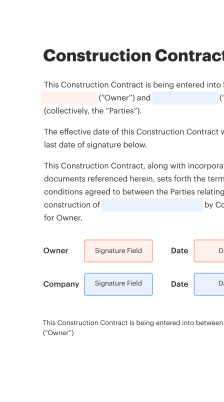
How content automation integrates within team workflows

Understanding the flow clarifies how each team role contributes and when automation accelerates the process.

  • Input: Subject matter experts submit answers.
  • Centralize: Content is tagged and stored in the library.
  • Assemble: Templates pull approved content automatically.
  • Approve: Legal and managers sign off via workflow.
Collect signatures
24x
faster
Reduce costs by
$30
per document
Save up to
40h
per employee / month

Quick setup: create your first automated RFP response

A concise walkthrough shows the core actions to move from manual responses to a template-driven RFP process.

  • 01
    Create Library: Add approved answers and standard clauses.
  • 02
    Build Template: Define sections and variable fields for reuse.
  • 03
    Assign Reviewers: Set permissions and approval workflows.
  • 04
    Generate Response: Assemble template and export final document.

Detailed steps to produce a compliant RFP submission

Follow these operational steps to ensure each generated RFP response is accurate, reviewed, and auditable before send.

01

Identify Requirements:

Map RFP sections to template fields.
02

Select Content:

Choose approved answers from the library.
03

Populate Variables:

Insert account and pricing data.
04

Run Validation:

Check for missing fields and conflicts.
05

Approval Routing:

Send sections to legal and SMEs.
06

Export Final:

Generate PDF or editable document for submission.
be ready to get more

Why choose airSlate SignNow

  • Free 7-day trial. Choose the plan you need and try it risk-free.
  • Honest pricing for full-featured plans. airSlate SignNow offers subscription plans with no overages or hidden fees at renewal.
  • Enterprise-grade security. airSlate SignNow helps you comply with global security standards.
illustrations signature

Typical workflow configuration defaults

Standard settings help teams automate approvals, reminders, and document lifecycles when generating RFP responses.

Feature Configuration
Reminder Frequency 48 hours
Approval Timeout 7 days
Versioning Enabled Yes
Auto-Archive Age 365 days
Notification Channel Email

Supported platforms and device considerations

Most modern RFP content automation tools support web access and provide responsive interfaces for mobile and tablet use.

  • Web Browser: Chrome, Edge supported
  • Mobile App: iOS and Android
  • Desktop Tools: Windows and macOS

For optimal performance in enterprise deployments, verify browser versions, enable TLS 1.2+, and confirm SSO compatibility; offline editing is limited and often requires specific applications.

Security controls and data protections

Access Controls: Role-based permissions
Encryption: AES-256 at rest
Transport Security: TLS 1.2+ in transit
SAML SSO: Enterprise identity
Data Isolation: Tenant separation
Logging: Immutable audit logs

Industry examples of automation in action

These short case narratives show how teams in different sectors reduce time and improve accuracy using RFP content automation.

Enterprise IT Services

A global IT services firm consolidated a decade of RFP answers into a managed content library that standardizes technical and pricing responses

  • Rapid assembly of templates for common service offerings
  • Reduced review cycles by centralizing legal-approved clauses

Leading to faster submissions and higher compliance assurance, improving proposal throughput by measurable margins.

Healthcare Vendor

A healthcare solutions vendor implemented role-based templates to ensure HIPAA-relevant language is applied consistently

  • Automated insertion of validated privacy clauses
  • Review queues routed to compliance for final sign-off

Resulting in fewer redlines during procurement and clearer audit trails for regulatory reviews.

Best practices for secure and accurate responses

Adopt processes that maintain content quality, enforce approvals, and protect sensitive information throughout the RFP lifecycle.

Maintain a single source of approved content
Centralize answers and clauses in a governed library, enforce version control, and require legal sign-off for any changes to reduce risk and ensure consistent messaging across all proposals.
Use templates with conditional logic
Design templates that adapt to different RFP structures and automate insertion of relevant sections to reduce manual editing and prevent inclusion of irrelevant or outdated clauses.
Enforce clear approval workflows
Implement mandatory review stages for technical, pricing, and legal reviewers; track approvals in the audit trail to provide accountability and support compliance audits.
Log and retain audit trails
Capture immutable records of edits, approvals, and exports to satisfy procurement and regulatory requirements and to provide a defensible history for contract negotiations.

FAQs: Common issues and resolutions

This FAQ addresses common user challenges and practical solutions for troubleshooting content automation, approvals, and integrations.

Feature availability: signNow and competitors

A concise feature matrix shows availability and brief technical details for common RFP automation capabilities across vendors.

Comparison Criteria and Vendor Options signNow (Recommended) DocuSign Adobe Acrobat Sign
Bulk Send / Team Templates
API Access and Webhooks REST API REST API REST API
HIPAA Compliance Option
Native CRM Integrations Salesforce, MS Dynamics Salesforce Salesforce
be ready to get more

Get legally-binding signatures now!

Key timeline checkpoints for RFP response management

Set and monitor milestones to coordinate contributors and avoid last-minute rushes that compromise accuracy and compliance.

RFP Release Date:

Start immediate scoping and assign owners.

Initial Content Draft Due:

Complete core answers within 5 business days.

Legal Review Completion:

Allow 3–5 business days for review.

Final Internal Approval:

Obtain sign-offs at least 48 hours prior.

Submission Deadline:

Submit before the stated closing time.

Operational risks and compliance penalties

Contract Errors: Financial loss
Noncompliance: Regulatory fines
Data Breach: Reputational damage
Missed Deadlines: Lost opportunities
Unauthorized Access: Legal exposure
Recordkeeping Failures: Audit penalties

Representative starting costs across providers

Pricing varies by plan, feature set, and contract terms; the table lists common starting price points and plan descriptors to compare baseline costs.

Plan / Starting Price signNow (Featured) DocuSign Adobe Acrobat Sign PandaDoc Dropbox Sign
Individual / Single User $8 / month billed annually $10 / month $9.99 / month $19 / month $15 / month
Business / Team Plan $20 / user / month $25 / user / month $29 / user / month $25 / user / month $20 / user / month
Enterprise / Custom Custom pricing Custom pricing Custom pricing Custom pricing Custom pricing
API Access Included Yes with plan Yes with plan Yes with plan Yes with plan Yes with plan
HIPAA Support Option Available Available Available Available Available
walmart logo
exonMobil logo
apple logo
comcast logo
facebook logo
FedEx logo
be ready to get more

Get legally-binding signatures now!