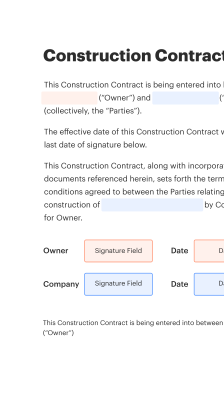
Sales Receipt Sample for Accounting and Tax

Watch your billing procedure become quick and effortless. With just a few clicks, you can complete all the required actions on your sales receipt sample for Accounting and Tax and other crucial files from any device with internet access.

Award-winning eSignature solution

What a sales receipt sample for accounting and tax includes

A sales receipt sample for accounting and tax is a structured record that documents the sale, payment method, tax applied, and identifying details needed for bookkeeping and filings. It typically lists seller and buyer names, invoice or receipt number, date of sale, itemized descriptions, quantities, unit prices, subtotal, tax amounts, and total. Well-constructed samples support accurate ledger entries, tax reporting, and audit readiness, and they can be adapted for digital workflows and eSignature platforms to streamline record retention and compliance in U.S. accounting practices.


Why standardized sales receipt samples matter

A consistent sales receipt sample improves accounting accuracy, simplifies tax preparation, reduces reconciliation errors, and ensures receipts include legally relevant information required for U.S. tax reporting and audits.

Why standardized sales receipt samples matter

Common challenges when using sales receipt samples

  • Missing or inconsistent tax codes across receipts complicate state and local tax reporting and reconciliation.
  • Incomplete buyer or seller details make it difficult to validate transactions during audits or customer disputes.
  • Manual entry of itemized lines increases the risk of arithmetic mistakes and ledger mismatches.
  • Failing to record payment method or transaction ID reduces traceability for refunds and chargebacks.

Typical users and roles

Small Business Owner

A sole proprietor or small company owner who issues receipts daily and needs clear, tax-ready documentation for quarterly estimated taxes and annual filings. They require straightforward templates and mobile-friendly capture to record sales at point of service and reconcile with bank deposits.

Corporate Accountant

An in-house accountant or external CPA who integrates receipts into accounting software, enforces uniform data fields, and ensures receipts meet audit standards for revenue recognition and tax compliance across multiple jurisdictions.

Who typically relies on sales receipt samples

Small business owners, accountants, and finance teams use sales receipt samples to standardize recordkeeping for accounting and tax preparation.

  • Bookkeepers who prepare monthly reconciliations and maintain the general ledger.
  • Tax preparers who need consistent source documents for deductions and filings.
  • Sales and billing teams that issue receipts to customers and record revenue.

Consistent use of templates reduces reconciliation time and improves the quality of audit evidence when filing federal and state tax returns.

Advanced template and workflow capabilities to consider

For organizations that handle higher volumes or compliance-sensitive receipts, include capabilities that support automation, security, and audit readiness.

Conditional fields

Enable dynamic fields that appear based on transaction type or region, such as tax-exempt reason fields for qualifying customers, ensuring receipts capture necessary documentation for differing tax treatments without cluttering common transactions.

Pre-filled integration

Connect templates to POS, CRM, or ERP to autofill customer records, product data, and pricing to reduce manual entry and prevent mismatches between receipts and accounting records during reconciliation.

Template locking

Prevent unauthorized edits to key receipt fields after issuance using signatures or digital seals, preserving the integrity of tax-related information for audits and regulatory review.

Batch processing

Support Bulk Send or batch issuance for grouped transactions, enabling rapid generation of receipts for recurring invoices or mass sales events while maintaining unique identifiers for each receipt.

Audit-friendly logs

Produce immutable audit trails that record who created, viewed, or modified receipts, with timestamps and IP details to satisfy audit requirements and demonstrate chain-of-custody for tax records.

Retention policies

Apply configurable retention periods that align with U.S. tax record retention rules, automating archival or deletion to reduce storage costs and ensure compliance.

be ready to get more

Choose a better solution

Document features to include in templates

When building a sales receipt sample for accounting and tax, prioritize fields and controls that ensure completeness, traceability, and integration readiness.

Itemization

Detailed item lines with SKU or service codes, quantity, unit price, and an optional description field that ensures each revenue line maps directly to chart of accounts or project codes for accurate accounting entries.

Tax detail

Separate fields for state, county, and local tax rates plus line-level tax calculation to support multi-jurisdiction tax reporting and to produce clear tax liability documentation for filings and audits.

Payment record

Fields to capture payment method, transaction or authorization ID, last four of card number, and payment date to aid reconciliation with bank statements and merchant processor reports.

Metadata

Receipt-level metadata such as receipt number, customer account ID, invoice link, and internal tags that facilitate automated import into accounting software and streamlined retrieval during tax preparation.

How to generate and use the sample in digital workflows

A simple four-step flow converts a template into a signed, stored sales receipt ready for accounting and tax use.

  • Create template: Design fields for all required receipt data
  • Populate data: Auto-fill from CRM or POS
  • Obtain signature: Sign electronically if required
  • Store and index: Archive with metadata for retrieval
Collect signatures
24x
faster
Reduce costs by
$30
per document
Save up to
40h
per employee / month

Quick steps to prepare a compliant sales receipt sample

Follow these essential steps to build a sales receipt sample that supports accounting entries and tax reporting.

  • 01
    Collect identifiers: Include seller and buyer legal names
  • 02
    Assign receipt number: Use sequential, unique IDs
  • 03
    Itemize charges: Record descriptions, quantities, unit prices
  • 04
    Record tax and total: Show tax breakdown and final total

Managing audit trails and evidence for receipts

Maintain an audit-ready trail for each sales receipt to support internal reviews and tax audits.

01

Capture events:

Log creation, edits, views, and signatures
02

Record metadata:

Store IP, timestamp, and user ID
03

Preserve versions:

Keep historical document states
04

Tamper evidence:

Apply cryptographic seals
05

Exportability:

Provide export in CSV or PDF
06

Retention controls:

Automate archival schedules
be ready to get more

Why choose airSlate SignNow

  • Free 7-day trial. Choose the plan you need and try it risk-free.
  • Honest pricing for full-featured plans. airSlate SignNow offers subscription plans with no overages or hidden fees at renewal.
  • Enterprise-grade security. airSlate SignNow helps you comply with global security standards.
illustrations signature

Recommended workflow settings for sales receipt processing

Configure these workflow settings to automate receipt generation, signing, and archival while preserving accounting controls.

Workflow Setting Name and Configuration Default configuration values
Reminder Frequency before signature deadline 48 hours
Signing Order and role assignment Sequential roles
Template locking post-issue Enabled
Expiration Period for signature requests 30 days
Audit Trail Retention timeframe 7 years

Supported devices and platform needs

Ensure your sales receipt sample can be created, signed, and accessed on common devices used in accounting and retail operations.

  • Desktop browsers: Chrome, Edge, Safari supported
  • Mobile devices: iOS and Android apps available
  • Tablet usage: Responsive web and app support

Confirm that chosen platforms support secure mobile capture, offline data entry where needed, and reliable synchronization with accounting systems to avoid data gaps when staff operate from varied locations or on the move.

Core security and protection features

Encryption in transit: TLS 1.2+ encryption
Encryption at rest: AES-256 storage
Access controls: Role-based permissions
Multi-factor authentication: Optional MFA for users
Audit logging: Immutable event logs
Data residency options: US-based storage available

Industry examples using sales receipt samples

Two representative use cases show how standardized sales receipt samples streamline accounting and tax tasks across business types.

Retail point-of-sale

A small retail store uses a standardized sales receipt template to capture item descriptions, SKU, and tax rate at the register

  • The template enforces tax code selection and records transaction IDs
  • Staff scans receipts into the accounting system daily for reconciliation

Resulting in faster month-end close and clearer sales tax filings.

Professional services billing

A consulting firm issues detailed receipts for hourly work that include project codes and service descriptions

  • Receipts integrate with invoicing and timekeeping systems to tag expenses
  • The consistent format supports deductible expense tracking and client billing disputes

Leading to reduced billing disputes and cleaner records for annual tax preparation.

Best practices for secure, accurate receipt samples

Adopt consistent design and controls to ensure receipts remain reliable records for accounting and tax purposes across teams and systems.

Standardize required fields across templates
Define a minimum data set (seller info, buyer info, receipt number, date, itemization, tax breakdown, payment method, and metadata) and enforce these fields to eliminate inconsistent or incomplete documentation that impedes accounting and tax workflows.
Integrate with accounting systems
Map receipt fields to chart of accounts and customer records in your accounting software to enable automated posting, reduce manual reconciliation, and avoid classification errors that could affect tax reporting or financial statements.
Enable secure signing and tamper evidence
Use electronic signatures that include audit trails and tamper-evident seals so receipts remain admissible as evidence and maintain integrity for audit or dispute resolution without relying on paper copies.
Retain and index receipts consistently
Implement a searchable retention system with standardized file naming, tags, and retention schedules aligned to federal and state recordkeeping requirements to simplify retrieval during audits and tax preparation.

FAQs About sales receipt sample for accounting and tax

Common questions and clear answers about creating, signing, storing, and using sales receipt samples in accounting and tax workflows.

Quick compliance and capability comparison

Compare essential legal and technical capabilities among leading eSignature providers for handling sales receipt samples used in U.S. accounting and tax contexts.

Feature or Compliance Comparison Across Vendors signNow (Recommended) DocuSign Adobe Sign
ESIGN / UETA compliance
HIPAA support availability BAA option BAA option BAA option
Audit trail detail Detailed Detailed Detailed
Bulk send capability
be ready to get more

Get legally-binding signatures now!

Risks if receipts are inadequate

Tax assessment: Additional tax liability
Penalties and interest: Potential fines accrue
Audit exposure: Higher audit risk
Reconciliation gaps: Unmatched transactions
Customer disputes: Refund complexity
Data breaches: Regulatory fines

Feature-level comparison across popular eSignature vendors

Feature availability and plan naming compared across five widely used eSignature providers; signNow is listed first as a recommended option for straightforward receipt workflows.

Feature Comparison Across Vendors and Plans signNow (Recommended) DocuSign Adobe Sign Dropbox Sign PandaDoc
Entry-level plan name Business plan (lowest-tier, monthly billed) Personal Individual Essentials Individual
Free trial availability Free trial available Free trial available Free trial available Free trial available Free trial available
Bulk send / mass signatures Bulk Send on business plans Available on higher tiers Available on select plans Available on Business tiers Available on Business tiers
API and developer tools REST API and SDKs available Comprehensive API and SDKs REST API and SDKs API and SDKs available API with templates
HIPAA / BAA support BAA available with eligible plans BAA available with agreements BAA available on qualifying plans BAA option via enterprise BAA available on Enterprise
walmart logo
exonMobil logo
apple logo
comcast logo
facebook logo
FedEx logo
be ready to get more

Get legally-binding signatures now!