Sample Invoice Template Excel for Finance

Empower your business with airSlate SignNow's intuitive features for seamless document signing and efficient invoice management.

Award-winning eSignature solution

What a sample invoice template excel for finance does and why it matters

A sample invoice template excel for finance is a preformatted spreadsheet designed to capture billing details, line items, taxes, totals, and client information in a consistent format that accountants and finance teams can reuse. Templates reduce data entry errors, speed up invoicing cycles, and standardize presentation across clients and projects. When combined with an eSignature workflow and secure document management, an Excel invoice template becomes an auditable, trackable billing record that supports collections, reconciliations, and internal controls while remaining compatible with common accounting systems.

When to use a structured Excel invoice template in finance operations

Using a standardized sample invoice template excel for finance increases accuracy and consistency, shortens billing cycles, and simplifies integration with accounting systems and digital signature platforms for audit-ready records.

When to use a structured Excel invoice template in finance operations

Common operational challenges addressed by invoice templates

  • Inconsistent line items and formatting cause reconciliation delays and client disputes when invoices lack standard fields.
  • Manual calculations increase the risk of arithmetic errors, tax misstatements, and downstream accounting adjustments.
  • Dispersed storage of signed invoices makes retrieval slow and complicates audit preparation for finance teams.
  • Lack of signer verification or tamper-evident seals undermines legal defensibility of billing records in disputes.

Typical user profiles for an Excel invoice template

Staff Accountant

A Staff Accountant prepares and issues invoices, ensures tax and discount calculations are correct, and reconciles invoices with payments. They use templates to speed monthly close tasks and to maintain consistent invoice structure across customer accounts.

Billing Manager

A Billing Manager sets template rules, oversees approval workflows, and enforces retention policies. They integrate templates with CRM and eSignature systems to ensure invoices are approved, signed when needed, and archived for auditability.

Which teams and roles commonly use invoice templates

Finance, billing, and accounts receivable teams rely on standardized Excel invoice templates to maintain consistent billing practices and support collections workflows.

  • Corporate accounting departments handling recurring and project-based billing across departments.
  • Finance teams in professional services firms issuing time-and-material or fixed-fee invoices.
  • Small business owners and freelancers who need repeatable, professional invoices for clients.

Templates support collaboration between finance and operations by reducing back-and-forth corrections and improving the completeness of each invoice before sending.

Advanced features to support finance-grade invoicing

For larger organizations, advanced features help automate reconciliation, maintain compliance, and scale invoice processing.

Bulk Send

Ability to send hundreds or thousands of invoices in a single batch while preserving unique recipient data and tracking status for each document.


Conditional Fields

Dynamic fields that appear based on line item types or contract conditions to reduce template proliferation and ensure only relevant data is captured.

Prebuilt Integrations

Connectors for ERP and accounting platforms that automatically post invoice metadata and payment status, minimizing manual reconciliation tasks.

Advanced Authentication

Multiple signer authentication options, such as SMS codes and knowledge-based questions, to meet varying risk levels for approvals and payment authorizations.

Custom Retention Rules

Policy-driven retention and archival settings ensure signed invoices are kept according to legal and internal requirements without manual intervention.

Detailed Reporting

Analytics dashboards and exportable reports that show aging, approval times, and signing metrics to identify bottlenecks in collections.

be ready to get more

Choose a better solution

Features to look for when pairing templates with digital signing

Choose features that preserve invoice integrity, enforce signer identity, and make retrieval easy for finance audits.

Template Library

Centralized template storage with version control simplifies updates and enforces a single source of truth for invoice formatting across teams, preventing inconsistent client communications and reducing rework.

Field Validation

Validation rules for numeric fields and required entries prevent incomplete invoices from being sent, reducing back-and-forth and ensuring invoices include all necessary tax and billing information.

Audit Trail

A tamper-evident audit trail records timestamps, signer IPs, and actions, making signed invoices defensible records for collections or regulatory review without altering the original invoice content.

Integrations

Prebuilt connectors to accounting systems, CRMs, and cloud storage streamline posting, reconciliation, and storage of signed invoices to reduce manual transfer tasks.
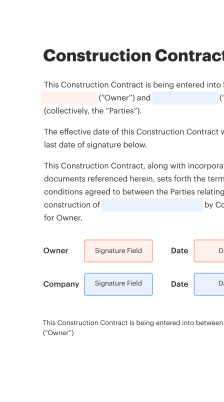
How to use an invoice template with an eSignature workflow

Integrate the template into a signing workflow to ensure invoices are approved and retained with a verifiable audit trail.

  • Prepare file: Save invoice as PDF from Excel
  • Upload to platform: Add invoice and recipient details
  • Add fields: Place signature, date, and initials
  • Send and track: Monitor signing and receipt status
Collect signatures
24x
faster
Reduce costs by
$30
per document
Save up to
40h
per employee / month

Quick steps to set up your Excel invoice template

Follow these core steps to prepare a reliable, reusable invoice template suitable for finance teams and compatible with eSignature workflows.

  • 01
    Create header: Add company and client details
  • 02
    Define line items: Include quantity, rate, taxes
  • 03
    Add formulas: Use SUM and tax calculations
  • 04
    Lock cells: Protect formulas from editing

Step-by-step: preparing a template, converting, and sending

Use these tactical steps to go from a blank spreadsheet to a signed invoice ready for archiving and reconciliation.

01

Design fields:

Define headers and required columns
02

Apply formulas:

Set totals and tax calculations
03

Lock areas:

Protect formulas from edits
04

Export to PDF:

Flatten the layout for signing
05

Upload and tag:

Add metadata for searchability
06

Send for signature:

Assign signing order and authentication
be ready to get more

Why choose airSlate SignNow

  • Free 7-day trial. Choose the plan you need and try it risk-free.
  • Honest pricing for full-featured plans. airSlate SignNow offers subscription plans with no overages or hidden fees at renewal.
  • Enterprise-grade security. airSlate SignNow helps you comply with global security standards.
illustrations signature

Typical workflow settings for invoice processing and signing

Configure these workflow settings to automate reminders, approvals, and archival for signed invoices while keeping a concise configuration map for administrators.

Workflow Setting Identifier and Name Configuration Value
Automatic Reminder Frequency Default Setting 48 hours; two reminders
Signature Routing Order Default Setting Sequential by approver
Template Field Mapping Default Configuration CRM to invoice fields
Notification Email Format and Sender Finance@company.com
Document Retention and Archive Policy Seven years; cloud archive

Supported platforms and device considerations for signing invoices

Verify system compatibility and device support before deploying templates at scale to ensure smooth signer experiences and reliable audit data.

  • Desktop browsers: Chrome, Edge, Safari supported
  • Mobile devices: iOS and Android apps available
  • PDF viewers: Modern viewers maintain field fidelity

For enterprise deployments, test templates and signing flows across representative devices and browsers, and provide clear instructions for external clients to reduce signing friction and support tickets.

Key security controls for invoice documents

Access Controls: Role-based access only
Encryption: In transit and at rest
Authentication: Multi-factor available
Tamper Evidence: Audit trail retained
Data Masking: Sensitive fields masked
Retention Controls: Configurable retention

Finance use cases: real-world examples

Two concise scenarios illustrate how an Excel invoice template supports common finance workflows and improves outcomes.

Mid-Market Services Billing

A consultancy standardizes an invoice template across project teams to capture hours, rates, and expense line items

  • The template enforces required fields and automated totals
  • It integrates with the finance system and an eSignature provider for approvals

Resulting in faster client acceptance, fewer disputes, and a clearer audit trail for month-end close.

Healthcare Vendor Invoicing

A healthcare supplier uses a template to list device shipments, unit pricing, and tax exemptions

  • The spreadsheet includes validation for contract pricing and patient billing codes
  • It is paired with secure delivery and signer authentication to protect PHI when required

Leading to reduced billing errors, HIPAA-aligned handling, and improved payment timeliness.

Best practices for secure and accurate invoice templates

Adopt consistent practices to reduce errors, maintain compliance, and speed collections when using Excel invoice templates in finance operations.

Keep templates version controlled and centrally managed
Store templates in a centralized repository with access controls and version history so teams use approved formats; this avoids inconsistent invoice fields, preserves auditability, and simplifies updates following policy or tax changes.
Use protected cells for formulas and calculations
Protect cells that contain formulas and totals to prevent accidental edits; clearly label editable fields for line items and client notes to reduce input errors and preserve calculation integrity.
Validate required fields before sending
Implement validation checks that enforce required fields such as invoice number, due date, and tax IDs; this reduces rejections, accelerates approvals, and improves reconciliation with received payments.
Combine templates with authenticated signature capture
Pair templates with signer authentication and a robust audit trail to ensure invoices are legally defensible and meet internal controls for approvals and retention policies.

FAQs and troubleshooting for invoice templates and signing

Answers to common questions and solutions for typical problems encountered when using Excel invoice templates with digital signing workflows.

Feature availability: signNow compared to other eSignature providers

A concise feature availability comparison across three major providers for finance-focused invoice workflows.

Feature or Requirement Reference Name signNow (Recommended) DocuSign Adobe Sign
Bulk Send / Mass Distribution Capability
Audit Trail and Detailed Logs
Mobile App Support for Signing
HIPAA Compliance Availability for Accounts
be ready to get more

Get legally-binding signatures now!

Typical timing milestones for invoice processing

Establish clear timeframes for each stage of the invoice lifecycle to improve cash flow and accountability.

Invoice creation and internal approval due date:

Within 2 business days

Client delivery and signature request timeframe:

Send immediately after approval

Standard payment terms and due date:

Net 30 or negotiated

Reminder schedule before overdue status:

7 and 14 days prior

Retention period for signed invoices:

Minimum seven years

Regulatory and business risks to monitor

Incorrect Taxation: Penalties may apply
Missing Approvals: Payment disputes
Unauthorized Access: Data breach fines
Poor Retention: Audit failures
Unsigned Records: Legal challenge
Incomplete Logs: Noncompliance risk

Pricing and plan comparison for invoice signing and management

Compare typical starting prices, trial availability, and enterprise capabilities across five providers to inform procurement decisions for finance teams.

Plan and Price Overview signNow (Recommended) DocuSign Adobe Sign HelloSign PandaDoc
Starting Price (per user per month) Starts at $8 per user per month Starts at $10 per user per month Starts at $12.99 per user per month Starts at $15 per user per month Starts at $19 per user per month
Free Trial and Entry Offerings 14-day free trial available 30-day developer trial and limited free tier 30-day trial for many plans Free tier with limits and trial 14-day trial available
Core features included in base plans Basic signing, templates, mobile app Core signing, templates, integrations Core signing, Adobe Document Cloud Signing, templates, Dropbox integration Document creation and signing tools
Enterprise-level options and services Custom enterprise plans and SSO Extensive enterprise features and compliance Enterprise licensing and workflow tools Enterprise offerings via Dropbox Sign Enterprise plans with CRM focus
API access and developer support Full REST API with SDKs and docs Robust API ecosystem and developer tools API access with Adobe integrations API available; developer docs provided API with templating and automation features
walmart logo
exonMobil logo
apple logo
comcast logo
facebook logo
FedEx logo
be ready to get more

Get legally-binding signatures now!