Set Signer Name Requirements with SignNow

Require a signer to provide their first and last name before accessing and signing a document in iOS. Using the signer name requirement helps avoid signing misprints.

Award-winning eSignature solution

What set signer name requirements means for your eSign workflow

Set signer name requirements is a document control feature that enforces expectations for how a signer’s name must appear during an electronic signing process. It can require full legal names, block capitalization, or exact matches against stored records, and is often combined with identity checks such as email verification or government ID review. Implemented within an eSignature platform, these rules reduce ambiguous signatures, improve record accuracy, and support downstream processes like identity verification, audit trails, and compliance with U.S. electronic signature standards such as ESIGN and UETA.

Why standardize signer name entry

Consistent signer names reduce errors, streamline record matching, and support admissibility of electronic agreements under ESIGN and UETA while minimizing downstream reconciliation work.

Why standardize signer name entry

Common challenges when signer names are not enforced

  • Inconsistent name formats delay identity verification and require manual reconciliation across systems and records.
  • Nicknames, initials, or omitted middle names can cause mismatches with government IDs or CRM records.
  • International name conventions and diacritics may not map correctly to templates or validation rules.
  • Manual corrections increase administrative overhead and create audit trail gaps for compliance reviewers.

Representative users and their responsibilities

Contract Manager

A Contract Manager defines name-format policies and enforces them in templates. They coordinate with legal and IT to ensure rules match stored identity data and that audit logs capture any manual exceptions for compliance reviews.

HR Administrator

An HR Administrator applies signer name requirements during onboarding to ensure employee names match payroll and benefits records. They set simple validation rules and manage exceptions workflows for name corrections and dual-name records.

Typical teams that benefit from name requirement rules

Organizations that handle regulated agreements, identity-sensitive transactions, or high-volume onboarding rely on controlled signer name entry to reduce risk and speed processing.

  • Legal and compliance teams ensuring contract enforceability and auditability.
  • Human resources and benefits administrators onboarding employees and collecting signed forms.
  • Sales and account teams closing deals that require exact customer record matching.

Clear signer name policies help legal, HR, sales, and compliance teams maintain accurate records and reduce exceptions in downstream systems.

Core capabilities for enforcing signer name accuracy

Effective signer name requirements combine validation options, authentication, auditability, and template controls to deliver consistent, auditable results across workflows.

Exact-match rules

Require signer names to match a stored record exactly, useful when names must match government IDs or legal entity records for high-assurance transactions.


Fuzzy matching

Allow controlled variations such as accommodating middle initials or diacritics while still preventing common mismatches and typos that could delay processing.

External verification

Query external identity sources or HRIS/CRM systems during signing to validate names against authoritative records and reduce manual checks.

Authentication options

Combine name rules with two-factor authentication, knowledge-based checks, or ID uploads to strengthen signer identity assertions and evidentiary value.

Template enforcement

Embed name requirements in templates so all sends using that template automatically inherit validation rules without additional configuration.

API validation

Expose name validation functions via API to enforce rules in custom integrations and server-side workflows before sending documents for signature.

be ready to get more

Choose a better solution

Integration and validation features that matter

Connect name requirements to identity sources and downstream systems to automate validation and maintain consistent records across platforms.

Google Docs integration

Map signer name fields directly from a Google Doc template and populate name validation rules from document metadata or connected user data to keep source documents and signed copies aligned.

CRM synchronization

Push validated signer names back to the CRM to update contact records, avoid duplicates, and ensure sales and account teams have verified, consistent customer names for billing and reporting.

Dropbox connector

Save completed agreements with standardized signer names into Dropbox folders with consistent filenames to simplify retrieval and legal archiving for audits or disputes.

Custom templates

Create reusable templates that include pre-configured name rules so teams can enforce consistent signer naming across repeat documents and reduce setup time for recurring workflows.
How name validation works during signing

Name rules are evaluated at the point of signing; platforms validate entered names against the configured rule (exact, allowed variants, or external records) and either accept, warn, or block progress.

  • Field entry: Signer types the name
  • Rule evaluation: System runs configured checks
  • Action taken: Accept, warn, or block
  • Audit record: Log decision for compliance
Collect signatures
24x
faster
Reduce costs by
$30
per document
Save up to
40h
per employee / month

Quick setup: define signer name rules

A short sequence to add and enforce signer name requirements in a typical eSignature template.

  • 01
    Open template: Select the document to edit
  • 02
    Add name field: Place a signer name form field
  • 03
    Configure rules: Set exact or fuzzy match
  • 04
    Save and test: Send a test envelope

Audit trail steps for signer name verification

Maintain a complete log of name validation actions and decisions to support compliance and dispute resolution.

01

Capture entry:

Store the exact typed name
02

Record rule applied:

Log which rule ran
03

Validation result:

Accepted, warned, or blocked
04

Authentication method:

Record OTP or ID check
05

Timestamps:

Time and timezone recorded
06

Change history:

Log manual edits and approver
be ready to get more

Why choose airSlate SignNow

  • Free 7-day trial. Choose the plan you need and try it risk-free.
  • Honest pricing for full-featured plans. airSlate SignNow offers subscription plans with no overages or hidden fees at renewal.
  • Enterprise-grade security. airSlate SignNow helps you comply with global security standards.
illustrations signature

Typical workflow settings for enforcing signer names

Key configuration settings control how name checks operate in a template or account-level policy.

Setting Name Configuration
Name Matching Rule Exact match
Allow Nicknames No
Validation Source CRM lookup
Reminder Frequency 48 hours
Delegate Signing Allowed Yes

Platform and device considerations for name validation

Name-entry controls must function consistently across web, mobile, and tablet signing experiences to avoid discrepancies and signing failures.

  • Desktop browsers: Chrome, Edge, Safari supported
  • Mobile platforms: iOS and Android apps
  • Tablet behavior: Responsive validation UI

Test name validation on target devices and browsers; ensure mobile keyboards, autocorrect, and accessibility tools do not alter required name formats, and document supported platforms for senders.

Security and validation controls to pair with name requirements

Exact match: Compare to stored record
Fuzzy match: Allowance for minor variants
ID cross-check: Government ID verification
Email verification: Confirm signer contact
Two-factor: OTP or SMS code
Audit logging: Record all changes

Industry examples applying signer name rules

Real-world use cases show how precise signer name requirements remove ambiguity and support compliance across common workflows.

Real estate closings

Buyers must enter full legal names as shown on title documents

  • Name validation against closing package
  • Reduces post-closing disputes and title search delays

Resulting in cleaner records and faster funding timelines for transactions.

Employee onboarding

New hires enter names matching payroll and benefits records

  • Integration with HRIS name fields
  • Eliminates manual payroll reconciliation and benefits enrollment errors

Leading to accurate payroll runs and reduced HR support tickets after onboarding.

Best practices for secure and accurate signer name requirements

Adopt rules and workflows that balance strictness with practical flexibility to avoid blocking legitimate signers while preserving auditability and compliance.

Define legal-name policy and exceptions
Document whether full legal names, middle initials, or common variations are acceptable. Specify an exceptions process for name corrections and assign an approver to review and log changes.
Link validation to authoritative systems
Integrate name checks with HRIS, CRM, or identity providers so the platform can validate entries against trusted records and reduce manual reconciliation after signing.
Combine with authentication methods
Use name rules alongside email verification, SMS OTP, or ID uploads for higher-risk transactions. This layered approach increases confidence in signer identity without relying solely on text matching.
Train teams and document standards
Provide templates, examples, and clear guidance to senders so they understand required name formats. Regularly review audit logs to identify recurring issues and refine rules.

FAQs About set signer name requirements

Common questions and answers to help troubleshoot name validation issues and exception handling.

How signNow compares on name requirement features

A concise feature comparison showing availability and configuration options for name validation across two major eSignature providers.

Criteria signNow (Featured) DocuSign
Set Signer Name Requirements
Name validation source Custom rules Basic verification
Custom name rule templates Configurable templates Limited templates
API name validation support REST API endpoints Connect API available
be ready to get more

Get legally-binding signatures now!

Risks from weak signer name controls

Invalid signings: Disputed signatures
Regulatory exposure: Compliance penalties
Identity fraud: Unauthorized access
Operational delays: Manual reconciliation
Legal challenges: Admissibility questions
Data mismatch: CRM inconsistencies

How do I use signer name requirements on iOS?

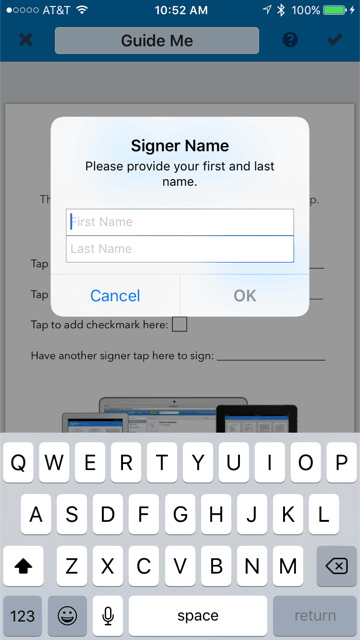
With airSlate SignNow’s iOS app, the signer is required to provide their first and last name before accessing a document and signing the necessary fields (please see screenshot).

First, open the document that was sent to you by the sender. You’ll then be instructed to enter your first and last name in order to access the document and start signing. Please communicate with the sender your full first and last name, to avoid any misspellings. After you enter your correct first and last name, click “OK” and start signing the document.

walmart logo
exonMobil logo
apple logo
comcast logo
facebook logo
FedEx logo
be ready to get more

Get legally-binding signatures now!