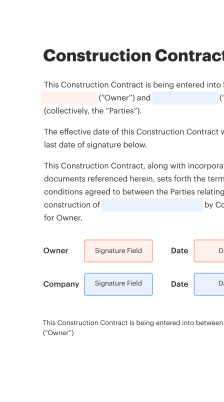
Shipping Invoice Template for Product Management

See your invoicing process turn fast and smooth. With just a few clicks, you can execute all the required steps on your shipping invoice template for Product Management and other crucial files from any device with internet access.

Award-winning eSignature solution

What a shipping invoice template for product management is and why it matters

A shipping invoice template for product management standardizes the billing and shipment details tied to product orders, returns, and transfers. It captures line items, SKUs, quantities, weights, carrier information, declared value, taxes, and internal cost allocations to help product teams reconcile inventory and accounting. Digital templates reduce manual entry, support version control, and simplify cross-team handoffs between product, logistics, and finance. When paired with an eSignature solution such as signNow, templates can also enforce approvals and record validated acceptance for audit and regulatory purposes, improving traceability across the fulfillment lifecycle.

Why standardized shipping invoice templates improve product workflows

Standard templates reduce errors, speed processing, and provide a consistent record for inventory audits, warranty claims, and financial reconciliation while improving communication between product, warehouse, and accounting teams.

Why standardized shipping invoice templates improve product workflows

Common challenges when managing shipping invoices

  • Inconsistent fields across departments cause data mismatches and reconciliation delays.
  • Manual entry of SKUs and quantities increases the risk of inventory and billing errors.
  • Lack of version control leads to disputes over terms, prices, and shipment responsibilities.
  • Difficulty capturing signed approvals for shipment releases creates compliance gaps.

Representative user profiles

Logistics Manager

Oversees outbound and inbound shipments, validates carrier data and packing lists, and uses templates to ensure consistent documentation for customs and internal audits across multiple warehouses.

Product Manager

Tracks SKU movement, approves shipment-related costs, and coordinates with finance to ensure shipping charges and returns are recorded against the correct product cost centers and roadmapped items.

Teams and roles that rely on shipping invoice templates

Product managers, logistics coordinators, and finance teams use shipping invoice templates to align on costs, returns, and shipment responsibilities before goods move.

  • Product managers requiring SKU-level cost and return tracking.
  • Logistics and warehouse staff coordinating carriers and shipment manifests.
  • Finance teams reconciling invoice totals with general ledger entries.

These templates support operational handoffs and provide documented approvals that reduce disputes and speed month-end close processes.

Advanced features to support enterprise product management

For larger operations, incorporate automation, integrations, and governance controls to scale shipping invoice templates across regions and partners without sacrificing control.

ERP Integration

Bi-directional integration with ERP systems ensures template fields map directly to master data, enabling auto-population of SKUs, GL codes, and cost centers while preventing duplicate entries and manual imports.

Bulk Send

Bulk Send enables dispatch of hundreds or thousands of invoice templates for signing in a single workflow, streamlining recurring reconciliations and mass shipment confirmations for distributed operations.

Role-based Workflows

Define granular approval chains so that low-risk shipments follow a fast path while high-value or international shipments require additional reviews and compliance attestations before release.

Custom Fields and Logic

Add conditional fields, calculations, and dropdown lists to enforce business rules, compute totals, and standardize classification for returns, discounts, and freight charges.

Audit Trail

Maintain an immutable log of actions, timestamps, and signer metadata to support financial audits, customs inquiries, and dispute resolution with traceable evidence.

Archival and eDiscovery

Integrated archival with advanced search and eDiscovery features lets legal and finance teams retrieve signed invoices quickly for compliance reviews and tax audits.

be ready to get more

Choose a better solution

Essential features to include in a shipping invoice template

When designing a template for product management, include fields and controls that support inventory traceability, financial reconciliation, and regulatory compliance across shipments.

Line-item detail

Include SKU, description, quantity, unit price, and extended total for each product to ensure precise matching with inventory records and accounting journals.

Carrier and tracking

Capture carrier name, service level, tracking number, and estimated delivery so product teams can correlate shipment events with inventory status and order fulfillment metrics.

Customs and duties

Provide HS codes, country of origin, declared value, and duty payment terms for cross-border shipments to support customs declarations and compliance requirements.

Approval and signatures

Design a clear approval block for dispatch and receipt confirmations, including space for printed name, role, date, and an eSignature field to validate acceptance.

How a digital shipping invoice template works in practice

Digital templates integrate form fields, validation rules, and approval steps to create a controlled document flow between product, logistics, and finance teams.

  • Populate: Pre-fill from ERP or product catalog
  • Validate: Field checks prevent invalid entries
  • Authorize: Require eSignature or approval
  • Archive: Store with audit trail
Collect signatures
24x
faster
Reduce costs by
$30
per document
Save up to
40h
per employee / month

Step-by-step: create a shipping invoice template for product management

Follow these core steps to build a usable, compliant shipping invoice template that supports product workflows and approvals.

  • 01
    Define fields: List required SKU, quantity, weight, and carrier fields
  • 02
    Standardize codes: Use consistent SKU and location codes
  • 03
    Add approvals: Include signature and approval blocks
  • 04
    Test and iterate: Pilot with a single route before scaling
be ready to get more

Why choose airSlate SignNow

  • Free 7-day trial. Choose the plan you need and try it risk-free.
  • Honest pricing for full-featured plans. airSlate SignNow offers subscription plans with no overages or hidden fees at renewal.
  • Enterprise-grade security. airSlate SignNow helps you comply with global security standards.
illustrations signature

Recommended workflow settings for template-based shipping invoices

Typical configuration values help standardize approvals, reminders, and archival rules to match product management needs and audit expectations.

Setting Name Configuration
Reminder Frequency 48 hours
Approval Chain Depth Two levels
Auto-archive Delay 90 days
Retention Period 7 years
Signature Requirement Mandatory for dispatch

Platform and device requirements for working with shipping invoice templates

Ensure your chosen document platform and devices meet basic browser, OS, and security requirements to support template editing, signing, and archival across teams.

  • Supported browsers: Chrome, Edge, Safari
  • Mobile platforms: iOS and Android
  • Minimum connection: TLS 1.2+

Confirm platform compatibility with your ERP and storage providers, and verify mobile signing behavior for field staff to prevent delays in dispatch approvals and maintain a consistent user experience across desktop and mobile devices.

Key security controls for digital shipping invoices

Access Controls: Role-based access
Encryption: AES-256 at rest
Transport Security: TLS in transit
Authentication: Multi-factor options
Audit Logs: Detailed event history
Retention: Configurable policies

Real-world examples of template use

Two concise case scenarios show how a shipping invoice template streamlines product management and preserves compliance across teams.

High-volume distributor

A regional distributor adopted a standardized shipping invoice template to capture SKU, lot, and batch details for every outbound pallet shipment.

  • The template included prefilled carrier and insurance fields for speed.
  • It reduced packing errors and improved first-pass invoice accuracy for reconciliation.

Resulting in faster invoicing cycles and fewer credit memos during monthly close, improving working capital visibility and reducing manual corrections by operations staff.

Product returns processing

An electronics brand used a template to document returned units with serial numbers, return reasons, and disposition codes.

  • The template required signed acknowledgment when units were received.
  • This linked returns to warranty validations and repair workflows.

Leading to clearer warranty liability, faster RMA resolution, and defensible records for warranty claims that cut dispute resolution time and administrative overhead.

Best practices for secure and accurate shipping invoice templates

Apply standard controls and workflows to reduce errors, ensure compliance, and keep records auditable across teams involved in fulfillment and product accounting.

Use consistent SKU and location coding across systems
Align SKU definitions and warehouse location codes with your ERP and inventory management system so templates map cleanly to master data, preventing reconciliation mismatches and reducing manual corrections.
Require approvals for high-value or international shipments
Set conditional approval steps in your workflow for shipments exceeding defined value thresholds or for cross-border consignments to ensure additional review and compliance checks occur before dispatch.
Validate critical fields with automated rules
Implement field-level validation for quantities, weights, and numeric totals, and use dropdowns for carriers and HS codes to minimize free-text errors that break downstream processes.
Maintain an immutable audit trail for signed invoices
Ensure every submission records a timestamp, signer identity, IP address, and document hash so finance and compliance teams can verify authenticity during audits and dispute resolution.

FAQs and troubleshooting for shipping invoice templates

Common questions about template setup, signing, and recordkeeping with digital invoices, including authentication and retention concerns.

Feature comparison: signNow versus other eSignature providers

This concise comparison focuses on capabilities that matter for managing shipping invoice templates and approvals within product operations and finance.

eSignature Platform Comparison signNow (Featured) DocuSign Adobe Sign
Template Library Availability
Bulk Send Support
API Access and SDKs REST API REST API REST API
HIPAA Compliance Options Available Available Available
be ready to get more

Get legally-binding signatures now!

Key retention and deadline milestones for shipping invoices

Track retention start dates and key deadline windows to meet financial, tax, and regulatory obligations for shipping invoice documentation.

Document creation and dispatch date:

Start retention clock at issue

Monthly reconciliation cutoff date:

Align with month-end close

Quarterly audit preparation window:

Store accessible for audits

Tax reporting and compliance deadline:

Keep records for reporting

End of retention and secure deletion:

Schedule secure purge

Operational risks and potential compliance impacts

Revenue leakage: Lost charges
Inventory discrepancy: Stock errors
Customs fines: Regulatory penalties
Contract disputes: Claim exposure
Audit failures: Noncompliance
Data breaches: Privacy incidents
walmart logo
exonMobil logo
apple logo
comcast logo
facebook logo
FedEx logo
be ready to get more

Get legally-binding signatures now!