SignNow CRM Benefits Vs OnePage CRM for Banking

Check out the reviews of the airSlate SignNow CRM vs. OnePage CRM to compare the benefits, features, tools, and pricing of each solution.

Award-winning eSignature solution

What signNow CRM benefits vs OnePage CRM for banking means

signNow CRM benefits vs OnePage CRM for banking refers to the practical differences between using signNow as an integrated eSignature and document workflow component inside banking CRMs, versus relying on OnePageCRM as a CRM platform that lacks native, enterprise-grade eSignature capabilities. The comparison focuses on compliance, security, authentication methods, audit trails, and how document signing ties into loan origination, account opening, and KYC processes. For U.S. banks and financial institutions, the distinction is operational: one solution centers on secure, standards-based signing and integrations, while the other prioritizes CRM-driven sales workflow without the same depth of eSignature controls.

Why compare signNow and OnePageCRM for banking

Comparing signNow with OnePageCRM highlights differences in compliance readiness, authentication options, and workflow automation that affect regulatory reporting, customer onboarding speed, and operational risk in U.S. banking environments.

Why compare signNow and OnePageCRM for banking

Common operational challenges in banking document workflows

  • Maintaining ESIGN/UETA-compliant signatures while integrating with legacy banking CRMs and back-office systems.
  • Verifying signer identity to meet KYC and CIP requirements without slowing account opening throughput.
  • Preserving tamper-evident audit trails and retention policies that satisfy internal audit and examiners.
  • Coordinating multi-party signing across loan officers, underwriters, and external counter-parties efficiently.

Representative user roles and how they work in banking workflows

Loan Officer

Loan officers use integrated eSignature tools to collect borrower signatures, attach signed documents to CRM records, and track status in real time. They need straightforward identity checks and templated workflows to keep loan pipelines moving while maintaining compliance with bank policies and audit requirements.

Compliance Officer

Compliance officers review audit trails, retention records, and authentication logs produced by eSignature integrations. Their focus is on demonstrable adherence to ESIGN and UETA, secure storage, access controls, and the ability to export evidence for examinations or legal discovery requests.

Which banking teams use eSignatures and CRM integrations

Banking teams that manage customer onboarding and document approvals typically require both CRM tracking and compliant eSignature workflows.

  • Retail branch operations handling account opening and disclosures.
  • Commercial banking relationship managers coordinating contract and loan signatures.
  • Compliance and audit teams reviewing signature evidence and retention.

Selection depends on whether primary needs are secure, auditable eSigning or CRM-first customer relationship management with limited signing features.

Additional capabilities that affect banking adoption

Bank deployments may also weigh advanced features that influence scale, security, and integration depth across enterprise systems.

Bulk Send

Ability to send identical documents to many recipients in a controlled batch while tracking individual completion and maintaining distinct audit records for each signer.


Advanced APIs

REST APIs and webhooks enable embedding signing flows into loan origination systems and triggering downstream processing when documents are signed.

Single Sign-On

SAML or OAuth SSO reduces password sprawl, centralizes access control, and integrates with bank identity providers for consistent session management.

Role-Based Access

Granular permissions control who can create templates, send requests, view PII, or export audit logs, supporting segregation of duties.

Document Retention

Configurable retention policies align signed document lifecycle with bank recordkeeping and legal hold requirements.

Enterprise SLAs

Vendor support levels and contractual SLAs define response times, uptime commitments, and escalation paths for mission-critical workflows.

be ready to get more

Choose a better solution

Integration-focused features relevant to banking workflows

When comparing signNow and OnePageCRM for banking, prioritize features that map to compliance, secure identity, automation, and records management across systems.

Document Templates

Reusable, data-driven templates reduce errors during loan document creation. Templates should support conditional fields, calculated values, and pre-population from CRM records to minimize manual entry and speed processing across account opening and loan workflows.

Authentication Options

Flexible signer verification—from email and SMS codes to knowledge-based or SAML-based enterprise authentication—supports KYC and stronger identity assurance where regulators require heightened verification for certain transactions.

Audit Trails

Comprehensive, tamper-evident audit logs capture signer events, timestamps, IP addresses, and document versions to support regulatory examinations, eDiscovery, and internal compliance checks without manual reconstruction.

CRM Sync

Bi-directional synchronization of document status and signed PDFs prevents data gaps between the CRM and document repository, ensuring staff see live signature status and attachments directly from the customer record.
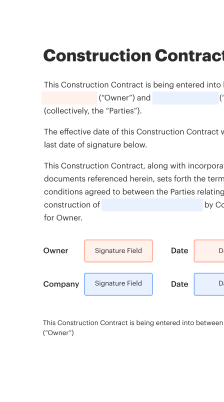
How signNow integration typically works in a banking CRM

Integration flows usually connect CRM records to document templates, trigger signature requests, and sync signed documents and status back to the CRM.

  • Data mapping: Push contact and loan fields into templates.
  • Signature request: Initiate signing from the CRM record.
  • Authentication step: Apply chosen signer verification methods.
  • Sync results: Store signed files and logs in CRM and archive.
Collect signatures
24x
faster
Reduce costs by
$30
per document
Save up to
40h
per employee / month

Quick setup steps for integrating eSignatures into bank CRM workflows

A focused, four-step setup sequence helps IT and operations teams enable compliant eSigning inside banking CRMs with minimal disruption.

  • 01
    Assess requirements: Map compliance, authentication, and retention needs.
  • 02
    Select integration: Choose an eSignature provider with banking-ready controls.
  • 03
    Configure workflows: Create templates and signer roles in the system.
  • 04
    Test and validate: Run end-to-end tests and review audit trails.

Audit trail management: step-by-step checklist

Manage audit trails systematically to preserve evidentiary quality and make compliance reviews more efficient.

01

Capture events:

Log each signer action
02

Record metadata:

Store IP, timestamp, method
03

Preserve versions:

Archive pre- and post-sign states
04

Export options:

Provide PDF and CSV logs
05

Access control:

Restrict audit exports
06

Retention schedule:

Apply legal holds as needed
be ready to get more

Why choose airSlate SignNow

  • Free 7-day trial. Choose the plan you need and try it risk-free.
  • Honest pricing for full-featured plans. airSlate SignNow offers subscription plans with no overages or hidden fees at renewal.
  • Enterprise-grade security. airSlate SignNow helps you comply with global security standards.
illustrations signature

Suggested workflow settings for CRM + eSignature setups

A concise configuration table helps technical teams standardize workflow parameters for banking use cases where automation and compliance are essential.

Setting Name Configuration
Reminder Frequency 48 hours
Signature Expiration 30 days
Authentication Level MFA or SMS
Template Versioning Enabled
Retention Policy 7 years

Platform compatibility and system requirements

Confirm platform and browser compatibility, mobile support, and integration prerequisites before deployment to avoid downstream issues.

  • Web browsers: Modern Chromium and Safari
  • Mobile platforms: iOS and Android supported
  • Identity providers: SAML and OAuth ready

Review API documentation, firewall rules, and data residency requirements with your security team to ensure the eSignature integration meets bank IT and compliance standards before rolling out to production.

Security and authentication features to evaluate

Data encryption: At-rest and in-transit
Access controls: Role-based permissions
Authentication: Multi-factor options
Audit logs: Immutable event history
Document integrity: Tamper-evident seals
Compliance support: ESIGN and UETA

Banking use examples that illustrate differences

Two concise case examples show how an eSignature-focused integration compares with a CRM-first approach in typical banking workflows.

Account Opening with Integrated eSignature

A regional bank automates retail account opening with signNow embedded in its loan origination system, pre-populating customer data and sending signature requests instantly

  • Uses Strong Customer Authentication and identity verification steps
  • Reduces manual handoffs and document re-keying

Resulting in faster account funding and clearer compliance evidence for examiners.

Pipeline Management with CRM-First Workflow

A small commercial banking team manages leads and follow-ups in OnePageCRM while sending documents via separate email or third-party signing tools

  • Relies on manual linking of signed PDFs back to CRM records
  • Maintains sales cadence but requires extra administrative steps

Leading to potential delays in completing regulatory checklists and more manual reconciliation for audits.

Practical best practices for secure and compliant signing

Adopt consistent procedures that link the CRM, signing platform, and records retention to minimize risk and improve operational efficiency.

Standardize templates and field mappings
Use centrally managed templates and strict data mapping rules to eliminate inconsistent disclosures, reduce rework, and ensure every signed document includes required regulatory statements and fields.
Use multi-factor authentication for high-risk transactions
Require stronger authentication methods—such as SMS codes or SAML SSO—for transactions that trigger fund disbursement, large transfers, or account access changes to reduce fraud risk.
Maintain immutable audit trails
Ensure the chosen solution generates tamper-evident logs with signer events, timestamps, and IP addresses stored alongside the final signed document to support audits and legal challenges.
Align retention with bank policies
Implement retention schedules that match regulatory retention periods and support legal holds, ensuring documents are archived securely and can be retrieved reliably when needed.

FAQs About signNow CRM benefits vs OnePage CRM for banking

Common questions address compliance, identity verification, integration complexity, and when to use an eSignature-first approach versus a CRM-centric workflow.

Feature-by-feature availability: signNow vs OnePageCRM

A compact comparison highlights core eSignature and compliance capabilities that matter for banking, showing whether each platform provides the listed feature or technical detail.

Document Feature and Compliance Criteria signNow OnePageCRM
eSignature Validity (ESIGN/UETA) No (CRM only)
Tamper-evident Audit Trail Partial
Native Document Signing
Advanced Authentication Options Limited
be ready to get more

Get legally-binding signatures now!

Key risks and regulatory consequences

Invalid signatures: Contract unenforceability
Incomplete audit trail: Regulatory findings
Weak authentication: Fraud exposure
Poor retention: Compliance breaches
Data exposure: Privacy violations
Operational delays: Customer dissatisfaction

Pricing and plan comparison across common vendors

High-level pricing and positioning can influence vendor selection. This table compares starting price signals, included core features, compliance posture, typical fit, and enterprise support options.

Plan or Metric signNow (Recommended) OnePageCRM DocuSign Adobe Acrobat Sign Dropbox Sign
Starting Price Starts at $8/user/month (annual) Starts at $12.50/user/month (annual) Starts at $25/user/month Starts at $14.99/user/month Starts at $15/user/month
Core Features Included eSign, templates, audit trails, integrations CRM, pipelines, activity tracking Advanced eSignatures, integrations, templates eSign, Adobe ecosystem, integrations eSign, API, simple workflows
Compliance & Certifications ESIGN, UETA, HIPAA support options CRM tooling, not eSignature-focused ESIGN, UETA, SOC2 ESIGN, UETA, SOC2 ESIGN, UETA, SOC2
Best for Banks needing compliant eSign and integrations Sales-focused CRM workflow management Large enterprises with broad signature needs Organizations using Adobe tools heavily Teams needing simple, developer-friendly eSign
Enterprise Support Dedicated plans and SLAs available Standard CRM support tiers Enterprise-grade support and SLAs Enterprise support and integrations Business and enterprise support options
walmart logo
exonMobil logo
apple logo
comcast logo
facebook logo
FedEx logo
be ready to get more

Get legally-binding signatures now!