SignNow CRM Benefits Compared to Salesforce

Check out the reviews of the airSlate SignNow CRM vs. Salesforce to compare the benefits, features, tools, and pricing of each solution.

Award-winning eSignature solution

What signNow CRM benefits vs Salesforce comparison covers

This comparison explains how signNow, a standalone eSignature provider, differs from Salesforce, a CRM platform with partner-based eSignature capabilities. It focuses on functional differences relevant to U.S. organizations: signing workflows, CRM integration approaches, security controls, compliance with ESIGN and UETA, deployment and pricing models, and typical implementation steps. The goal is to help teams evaluate which option better aligns with document workflows, IT constraints, and regulatory responsibilities while keeping emphasis on technical and operational factors rather than marketing claims.

When signNow CRM benefits vs Salesforce matters

Choose an eSignature-first solution when you need focused signing features, predictable per-user pricing, and straightforward integration with multiple CRMs; choose a CRM-centric approach when core sales, pipeline, and customer data must remain tightly coupled to the signature process.

When signNow CRM benefits vs Salesforce matters

Key features to evaluate in signNow and Salesforce eSignature use

Compare capabilities that affect document lifecycle management, CRM integration, and compliance when deciding between an eSignature specialist and a CRM-centric approach.

eSignature core

Digital signing with signer intent capture, reusable signing links, and multi-party workflows designed specifically to optimize signature collection, reduce errors, and preserve legal admissibility under U.S. eSignature laws.


Templates

Create and store reusable templates with field mapping and conditional logic to accelerate repeat documents, reduce manual preparation time, and ensure consistent placement of required signature and data fields across agreements.

Bulk Send

Send a single document to many recipients with individualized fields and tracking, enabling mass signature collection for standard agreements without creating separate workflows for each recipient.

CRM Integration

Two-way data synchronization with CRMs, allowing automatic population of documents from contact and opportunity records, and automatic recording of signed documents back to the associated CRM objects and audit fields.

Audit Trail

Comprehensive tamper-evident audit logs documenting signer events, IP addresses, timestamps, and actions to support legal defensibility and internal compliance reviews.

Developer API

REST API for embedding signature flows, automating envelope creation, and creating custom integrations so development teams can build signing into customer portals or backend processes.

be ready to get more

Choose a better solution

Integrations and templates: practical benefits for CRM workflows

Integration capabilities and template features affect how well an eSignature solution supports CRM-driven processes and document reuse.

Google Docs

Direct integration enables sending documents created in Google Docs for signature without manual downloads. Users can map doc fields to signer fields, preserve formatting, and return signed PDFs to the original storage location to maintain version history and simplify collaboration.

CRM connectors

Native connectors or marketplace apps link signNow to CRMs for automated document generation from record fields. This reduces data entry, attaches signed documents to the correct record, and triggers CRM workflow updates when agreements are completed.

Dropbox integration

Integration with cloud storage supports automatic saving of signed documents to Dropbox folders, consistent file naming, and archival policies so compliance and audit teams can access finalized documents alongside other records.

Reusable templates

Advanced template capabilities allow conditional fields, multiple signer roles, and data mapping so repeated agreements are prepared consistently, shortening turnaround and reducing error rates across sales and HR processes.
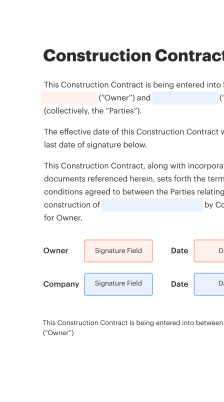
How signNow workflows operate compared with Salesforce CRM workflows

A typical signing flow moves documents from upload to signer completion, while CRM workflows often trigger or record signature events; here are the core stages.

  • Upload document: Upload file and select a template or new document.
  • Prepare fields: Place signature, date, and data fields for signers.
  • Send for signature: Configure recipients, authentication, and delivery options.
  • Complete and return: Signed documents and audit records are stored automatically.
Collect signatures
24x
faster
Reduce costs by
$30
per document
Save up to
40h
per employee / month

Quick setup: signNow CRM benefits vs Salesforce start-up steps

Follow these steps to set up signNow integration with your CRM and begin secure signing.

  • 01
    Create account: Register and verify account with business details.
  • 02
    Install connector: Add the signNow integration or app to your CRM.
  • 03
    Map fields: Map CRM fields to document fields and templates.
  • 04
    Send test: Send a test envelope to confirm workflow and audit trail.

Managing audit trails and records for signed documents

Maintain a defensible record of signature events by following these steps for audit trail retention and review.

01

Enable logging:

Turn on detailed event logging in the platform.
02

Configure retention:

Set document retention periods aligned to policy.
03

Capture signer identity:

Require authentication and record identifiers.
04

Store signed PDFs:

Archive final signed documents securely.
05

Export audit reports:

Generate tamper-evident reports for compliance.
06

Periodic review:

Audit trails should be reviewed regularly.
be ready to get more

Why choose airSlate SignNow

  • Free 7-day trial. Choose the plan you need and try it risk-free.
  • Honest pricing for full-featured plans. airSlate SignNow offers subscription plans with no overages or hidden fees at renewal.
  • Enterprise-grade security. airSlate SignNow helps you comply with global security standards.
illustrations signature

Typical workflow settings when implementing signNow with a CRM

Standard configuration elements to review during deployment to ensure reliable signing workflows and CRM synchronization.

Workflow setting name and description field Default value or recommended configuration
Default user authentication method and options OAuth 2.0 with SAML available
Webhook endpoint URL for callbacks and security HTTPS endpoint with verification token
Reminder frequency for pending signatures 48 hours default, configurable
Bulk send daily limit per account Configured by plan, example 500
Template library access and sharing rules Team templates enabled by default

Signing on mobile, tablet, or desktop

signNow supports web browsers and native mobile apps for common devices, while CRM integrations require compatible browser and API access.

  • Supported desktop browsers: Chrome, Edge, Safari, Firefox
  • Mobile apps and OS: iOS and Android native apps
  • API and network needs: HTTPS and outbound webhooks required

For best results, use recent OS versions and supported browsers, enable TLS for integrations, and ensure mobile users install the native app for offline signing or push notifications where required.

Security and authentication features for signNow and CRM eSignature

Encryption in transit: TLS 1.2+ enforced
Encryption at rest: AES-256 storage encryption
Access controls: Role-based permissions
Authentication options: Password, SMS, knowledge-based
Compliance attestations: SOC2 and audit logs
Document integrity: Tamper-evident seals

Industry use cases showing where signNow differs from Salesforce options

Real-world examples illustrate practical differences in deployment, speed, and compliance when using signNow versus a CRM-led approach.

Case Study 1

A regional healthcare provider needed HIPAA-compliant signed consent forms processed quickly and stored securely

  • Template-based bulk sending reduced preparation time
  • Maintained encryption, audit trail, and signer authentication

Resulting in faster patient onboarding and clearer compliance records.

Case Study 2

A mid-market sales team required signed quotes tied to opportunities inside their CRM

  • signNow templates and field mapping auto-populated documents from opportunity fields
  • Signatures and PDFs automatically returned to the CRM record and archived

Leading to shorter sales cycles and fewer manual updates.

Best practices for secure and compliant signNow CRM integration

Practical steps to reduce risk, maintain compliance, and keep CRM document workflows efficient when using signNow or CRM-integrated eSignature solutions.

Standardize templates and field mappings across teams
Use centralized templates to enforce consistent document structure and ensure required signer fields are always present; field mappings should align with CRM object schemas so that data populates documents accurately and returned PDFs attach to the proper CRM records without manual intervention.
Enforce appropriate signer authentication methods
Select authentication levels that match the transaction risk, using stronger methods such as SMS or knowledge-based authentication for sensitive agreements; document the chosen method and rationale to support audit and legal review for ESIGN and UETA compliance.
Retain audit trails and signed documents securely
Store tamper-evident audit logs and final signed PDFs in encrypted storage with controlled access; configure retention schedules that meet regulatory and organizational recordkeeping requirements, and test restore processes periodically.
Test workflows and integrations before production rollout
Perform end-to-end testing from CRM-triggered document creation through signing and return to confirm field mappings, webhook notifications, and error handling; include negative testing to ensure graceful failure modes for missing data or network issues.

FAQs About signNow CRM benefits vs Salesforce

Common questions and practical answers to help teams choose between an eSignature-focused solution like signNow and CRM-centric options when evaluating integration and compliance needs.

Feature comparison: signNow CRM benefits vs Salesforce for signatures

A concise feature matrix comparing core eSignature capabilities and typical CRM integration patterns for signNow and Salesforce.

Feature signNow (Recommended) Salesforce
Native eSignature
Bulk Send Depends on partner integration
Audit Trail
Developer API
be ready to get more

Get legally-binding signatures now!

Pricing and plan characteristics across eSignature vendors

Compare high-level pricing model characteristics and plan features for signNow and commonly chosen eSignature providers that integrate with CRMs.

Plan signNow (Recommended) Salesforce DocuSign Adobe Sign PandaDoc
Starting cost and model Subscription per user, predictable billing CRM subscription model, add-ons for eSign Per-user or envelope pricing options Included in Adobe Document Cloud plans Per-user subscription with free tier options
Free trial or tier available Free trial available Free trial for CRM available Free trial available Free trial available Free tier and trial available
Per-envelope billing option Not primary model Not primary model Common option Supports envelope-like transactions Not primary model
Enterprise contract availability Enterprise plans available Enterprise CRM tiers available Enterprise agreements available Enterprise licensing available Business and enterprise tiers
Typical billing cadence Monthly or annual subscriptions Annual contracts common Monthly or annual Monthly or annual Monthly or annual subscriptions
walmart logo
exonMobil logo
apple logo
comcast logo
facebook logo
FedEx logo
be ready to get more

Get legally-binding signatures now!