Establishing secure connection… Loading editor… Preparing document…
Navigation

Fill and Sign the 3 Rule 3 Form

Fill and Sign the 3 Rule 3 Form

How it works

Open the document and fill out all its fields.
Apply your legally-binding eSignature.
Save and invite other recipients to sign it.

Rate template

4.8
44 votes
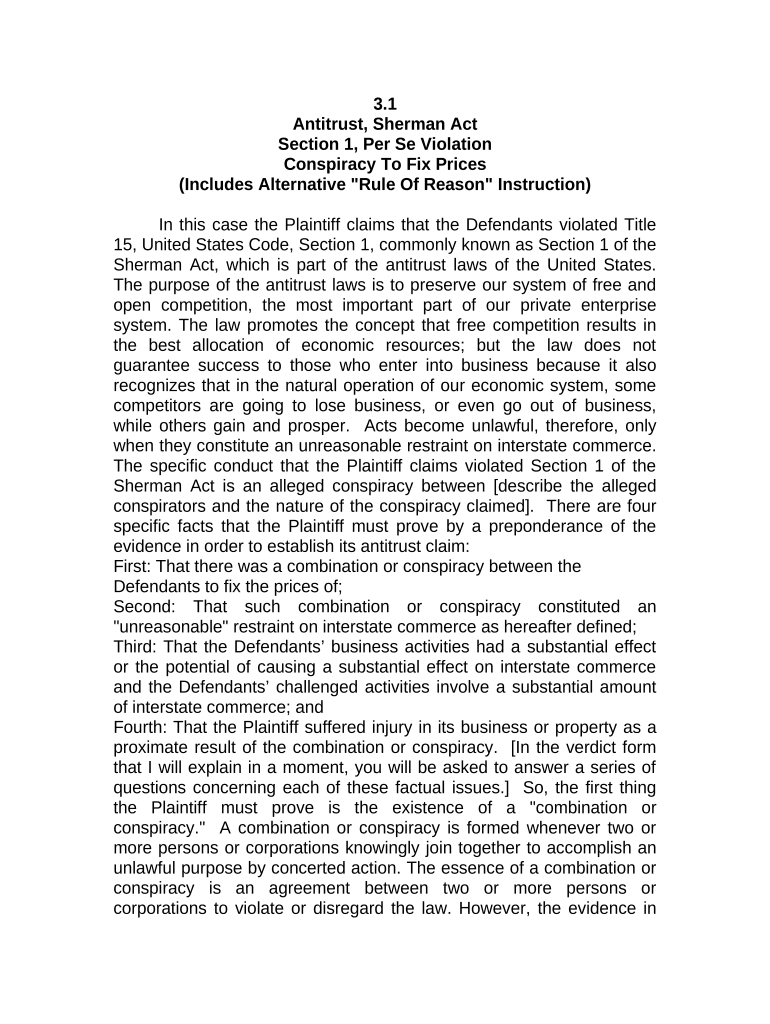
3.1 Antitrust, Sherman Act Section 1, Per Se Violation Conspiracy To Fix Prices (Includes Alternative "Rule Of Reason" Instruction) In this case the Plaintiff claims that the Defendants violated Title 15, United States Code, Section 1, commonly known as Section 1 of the Sherman Act, which is part of the antitrust laws of the United States. The purpose of the antitrust laws is to preserve our system of free and open competition, the most important part of our private enterprise system. The law promotes the concept that free competition results in the best allocation of economic resources; but the law does not guarantee success to those who enter into business because it also recognizes that in the natural operation of our economic system, some competitors are going to lose business, or even go out of business, while others gain and prosper. Acts become unlawful, therefore, only when they constitute an unreasonable restraint on interstate commerce. The specific conduct that the Plaintiff claims violated Section 1 of the Sherman Act is an alleged conspiracy between [describe the alleged conspirators and the nature of the conspiracy claimed]. There are four specific facts that the Plaintiff must prove by a preponderance of the evidence in order to establish its antitrust claim: First: That there was a combination or conspiracy between the Defendants to fix the prices of; Second: That such combination or conspiracy constituted an "unreasonable" restraint on interstate commerce as hereafter defined; Third: That the Defendants’ business activities had a substantial effect or the potential of causing a substantial effect on interstate commerce and the Defendants’ challenged activities involve a substantial amount of interstate commerce; and Fourth: That the Plaintiff suffered injury in its business or property as a proximate result of the combination or conspiracy. [In the verdict form that I will explain in a moment, you will be asked to answer a series of questions concerning each of these factual issues.] So, the first thing the Plaintiff must prove is the existence of a "combination or conspiracy." A combination or conspiracy is formed whenever two or more persons or corporations knowingly join together to accomplish an unlawful purpose by concerted action. The essence of a combination or conspiracy is an agreement between two or more persons or corporations to violate or disregard the law. However, the evidence in the case need not show that the members of an alleged conspiracy entered into any express or formal agreement. What a preponderance of the evidence in the case must show is that the Defendants knowingly came to a common and mutual understanding to accomplish, or to attempt to accomplish, an unlawful purpose. To act "knowingly" means to act voluntarily and intentionally, and not because of mistake or accident. You will note that there must be at least two separate persons or corporations who reach an agreement or understanding in order to find that a conspiracy was formed. [One cannot conspire with one's self, and a single corporation cannot agree, combine or conspire with its own officers or employees. Unincorporated divisions of a single corporation retain their overall legal identity as a single entity incapable of conspiring with itself. The same is normally true with respect to parent and subsidiary corporations subject to the same ownership and control; they will be regarded as a single business entity incapable of conspiring with itself. On the other hand, affiliated companies may be capable of conspiring together when there is sufficient proof of a separation of activities and interests so that the two companies act, in reality, as separate business enterprises. It is for you to determine on the basis of all the facts and circumstances whether the Defendants constituted separate and distinct corporate entities, or a single, integrated business enterprise.] You should also bear in mind that mere similarity of conduct among various persons, and the fact that they may have associated with each other, and may have met together and discussed common aims and interests, does not necessarily establish the existence of a conspiracy. Also, a mere similarity of business practices on the part of a Defendant and others, or even the fact that they may have charged identical prices for the same goods and services, does not necessarily establish a conspiracy because those things may be the natural result of ordinary competitive behavior in a free and open market. I A per se Violation The second fact the Plaintiff must prove is that the alleged conspiracy resulted in an "unreasonable" restraint on interstate commerce. You are instructed that a conspiracy to fix prices is treated by the law as a “per se” violation and is, in and of itself, an "unreasonable" restraint of trade. Whether the prices agreed to be fixed were reasonable or unreasonable does not matter. So, a common plan or understanding knowingly made, or arranged, or entered into, between two or more competitors engaged in interstate trade or commerce, to adopt or follow any pricing formula that will result in raising, or lowering, or maintaining prices charged for goods or services sold in interstate trade or commerce would automatically constitute a price fixing conspiracy and an "unreasonable" restraint on interstate commerce in violation of the federal antitrust laws. II A Rule of Reason Violation [Apart from "price fixing" agreements or other per se violations, an agreement or conspiracy violates the antitrust laws only if it unreasonably suppresses, restrains or destroys competition. The Plaintiff must prove that (1) the Defendants’ conduct had an anticompetitive effect on the relevant market, and (2) the conduct had no justification or competitive benefit. In order to prove that the Defendants’ arrangement had an anticompetitive effect on the market, the Plaintiff must prove either that competition has actually suffered adverse effects due to the Defendants’ arrangement or that the Defendants’ arrangement has the potential for genuine adverse effects on competition, such as an increase or decrease in total output. To prove potential adverse effects on competition by the Defendants’ conduct, the Plaintiff must define the relevant product and geographic markets and establish that the Defendants possessed sufficient market power to adversely affect competition in those markets. Market power includes the ability to control price, exclude competition or restrict output. You may consider the Defendants’ share or portion of the overall market; whether there are any barriers to entry by new firms in the market; and evidence concerning the intensity of competition within the market when determining if a company possesses sufficient market power to affect competition adversely. Your analysis should concern the actual or likely effects of the Defendants’ behavior to determine if the conduct is unreasonable, whether that was the intended result or not. However, when considering the effect of the alleged restraint on competition, you may consider whether its purpose was legitimate or proper. Remember that good intentions do not make a restraint with unreasonable anticompetitive effects lawful, and proof of an improper purpose is simply one factor that may help support, but does not by itself support, a finding of unreasonable restraint. When deciding if the Plaintiff has met its burden, you may consider the facts relating to the nature of the particular industry or the product or service involved; any facts that you find to be peculiar to that industry, product, service, or market area; the nature of the alleged restraint; the history of the circumstances surrounding the alleged restraint, and the reasons for adopting the particular practice that is alleged to constitute the restraint.] The third fact the Plaintiff must prove is that the Defendants’ business activities substantially affected or have substantial potential effects on interstate commerce and that the alleged combination or conspiracy involved a substantial amount of interstate commerce. The term "interstate commerce" refers to business transacted across state lines or between persons or corporations having their residences or businesses in different states. It differs from intrastate commerce, which is business done within a single state. There can be no violation of the Sherman Act unless you decide that the activities of the Defendants have actually occurred in interstate commerce or, if done within one state, that these local activities adversely affected or had potential adverse effects on interstate commerce and involved a substantial or not insubstantial amount of such commerce. In other words, it is not necessary that the disputed transactions be shown to be interstate transactions so long as the Defendants’ local activities within one state are shown to have affected interstate commerce in a substantial way and involve a not insubstantial amount of such commerce. The fourth fact the Plaintiff must prove is that the Plaintiff suffered injury in its business or property as a "proximate result" of the alleged combination or conspiracy. It frequently occurs in the course of normal, lawful competition that some businesses suffer economic losses, or even go out of business, and it is only when those losses are caused by unlawful competitive practices that the antitrust laws are violated. An injury to a business is the "proximate result" of an antitrust violation only when the violation directly and in natural and continuous sequence produces, or contributes substantially to producing, such injury. In other words, the alleged violation must be a direct, substantial, and identifiable cause of the injury that the Plaintiff claims so that, but for the antitrust violation, the injury would not have occurred. In your consideration of the evidence you should first decide whether or not the alleged conspiracy existed. If you conclude that the conspiracy did exist, you should next decide whether or not each Defendant was a knowing member of that conspiracy. If you decide that the alleged conspiracy was knowingly formed, and that the Defendants knowingly became members of the conspiracy, either at the beginning or later on, then the ultimate success or failure of the conspiracy to accomplish its purpose does not matter so long as the Plaintiff sustained some damage as a result of the conspiracy. If you should find for the Plaintiff, the law provides that the Plaintiff should be fairly compensated for all damage, if any, to its business and property that was proximately caused by the Defendants' violation of the antitrust laws. In arriving at the amount of the award you should include any damages suffered by the Plaintiff because of lost profits. The circumstance that the precise amount of the Plaintiff's damages may be difficult to ascertain should not affect the Plaintiff's recovery, particularly if the Defendants' wrongdoing has caused the difficulty in determining the precise amount. On the other hand, the Plaintiff is not to be awarded purely speculative damages. An allowance for lost profits may be included in the damages awarded only when there is some reasonable basis in the evidence for determining that the Plaintiff has in fact suffered a loss of profits, even though the amount of such loss is difficult to ascertain. 3.1 Antitrust, Sherman Act Section 1, Per Se Violation Conspiracy to Fix Prices SPECIAL INTERROGATORIES TO THE JURY Do you find from a preponderance of the evidence: 1. That there was a combination or conspiracy between the Defendants to fix the prices of ? Answer Yes or No 2. That such combination or conspiracy constituted an “unreasonable” restraint (as defined in the Court’s Instructions) on interstate commerce? Answer Yes or No 3. That the Defendants’ business activities had a substantial effect, or the potential of causing a substantial effect, on interstate commerce, and that the Defendants’ challenged activities involve a substantial amount of interstate commerce? Answer Yes or No 4. That the Plaintiff suffered injury in its business or property as a proximate result of the combination or conspiracy? Answer Yes or No [Note: If you answered No to any of the preceding questions you need not answer the remaining question.] 5. That the Plaintiff should be awarded $ as damages for the injury it suffered to its business or property. SO SAY WE ALL. Foreperson DATED: ANNOTATIONS AND COMMENTS 15 USC § 1 provides: Every contract, combination in the form of trust or otherwise, or conspiracy, in restraint of trade or commerce among the several States, or with foreign nations, is hereby declared to be illegal. In order for the court to apply the per se violation rule, Plaintiff must prove that the Defendants’ challenged practice “always or almost always tend[s] to restrict competition and decrease output.” Levine v. Central Florida Medical Affiliates, Inc., 72 266 F.3d 1538, 1549 (11th Cir.), cert. denied, 519 U.S. 820, 117 S.Ct. 75, 136 L.Ed.2d 34 (1996) (quoting Broadcast Music, Inc. v. Columbia Broadcasting System, 441 U.S. 1, 19-20, 99 S.Ct. 1551, 1562, 60 L.Ed.2d 1 (1979)). Price fixing is per se illegal. L. A. Draper & Son v. Wheelebrator-Frye, Inc., 735 F.2d 414, 420 (11th Cir. 1984). The rule of reason standard is presumed to apply in cases brought under Section 1 of the Sherman Act. Seagood Trading Corp. v. Jerrico, Inc., 924 F.2d 1555, 1567 (11 th Cir. 1991) (citing Business Elecs. Corp. v. Sharp Elecs. Corp., 485 U.S. 717, 724, 108 S.Ct. 1515, 1520, 99 L.Ed.2d 808 (1988)). In the past, the rule of reason has been a general inquiry balancing various competitive factors that bear on the determination of whether a particular practice is unreasonably restrictive on competitive conditions. Standard Oil of New Jersey v. United States, 221 U.S. 1, 65, 31 S.Ct. 502, 517-18, 55 L.Ed.2d 619 (1911); Northwest Wholesale Stationers, Inc. v. Pacific Stationery & Printing Co., 472 U.S. 284, 289, 105 S.Ct. 2613, 2616-17, 86 L.Ed.2d 202 (1985). However, the Eleventh Circuit has established a more specific burden of proof analysis, which is reflected in the alternative “Rule of Reason” provision in this instruction. Levine Central Florida Medical Affiliates, Inc., 72 F.3d 1538, 1550-55 (11th Cir.), cert. denied, 519 U.S. 820, 117 S.Ct. 75, 136 L.Ed.2d 34 (1996); Graphic Prods. Distribs., Inc, v. ITEK Corp., 717 F.2d 1560, 1573 (11th Cir. 1983); see also, 1 ABA Section on Antitrust Law, Antitrust Law Developments at 53 (4th ed. 1997). There is no need for a rigorous analysis of the market and the Defendants’ market power if there is proof of actual detrimental effects on outcome or price. FTC v.Indiana Federation of Dentists, 476 U.S. 447, 460-61, 106 S.Ct. 2009, 2019, 90 L.Ed.2d 445 (1986). If a case involves a per se violation, the “rule of reason” instruction need not be given. United States v. Trenton Potteries Co., 273 U.S. 392, 47 S.Ct. 377, 71 L.Ed. 700 (1927); Larry V. Muko, Inc. v. Southeastern Penn. Bldg. & Const. Trades Council, 670 F.2d 421, 426 (3d Cir.), cert. denied, 459 U.S. 916, 103 S.Ct. 229, 74 L.Ed.2d 182 (1982). Concerted action between at least two persons or entities must be proven. Monsanto Co. v. Spray-Rite Service Corp., 465 U.S. 752, 104 S.Ct. 1464, 79 L.Ed.2d 775 (1984). A corporation cannot conspire with its officers, employees or agents. Similarly, a parent company and a wholly owned subsidiary are not capable of combining or conspiring under Section 1 of the Sherman Act. Copperweld Corp. v.Independent Tube Corp., 467 U.S. 752, 104 S.Ct. 2731, 81 L.Ed.2d 628 (1984). However, a hospital can conspire with members of its staff. Bolt v. Halifax Hosp.Medical Center, 891 F.2d 810 (11th Cir.), cert. denied, 495 U.S. 924, 110 S.Ct. 1960, 109 L.Ed.2d 322 (1990), overruled on other grounds, by, City of Columbia v. Omni Outdoor Advt., Inc., 499 U.S. 365, 111 S.Ct. 1344, 113 L.Ed.2d 382 (1991). The jurisdictional requirement of the Sherman Act may be satisfied under either the “in commerce” or the “effect on commerce” (or “affecting commerce”) theory. McLain v. Real Estate Bd. of New Orleans, 444 U.S. 232, 242, 100 S.Ct. 502, 509, 62 L.Ed.2d 441 (1980); United States v. Fitapelli, 786 F.2d 1461, 1462 (11th Cir. 1986). Beyond this general understanding, there is ongoing debate concerning the exact tests to the applied in deciding whether the plaintiff has made the necessary showing for federal jurisdiction to prohibit challenged conduct under the Sherman Act. The “affecting commerce” test is most commonly used and known as the principal test. El Shahawy v. Harrison, 778 F.2d 636, 640-41 (11th Cir. 1985), modified, 790 F.2d 75 (11th Cir. 1986); see also, United States v. Aquafredda, 834 F.2d 915, 918 (11th Cir. 1987), cert. denied sub nom., Agostino v. United States, 485 U.S. 980, 108 S.Ct. 1278, 99 L.Ed.2d 489 (1988). Technically, the “affecting commerce” or “effect on commerce” test has two components: (a) a substantial amount of interstate commerce is involved and (2) having a “not insubstantial effect” or substantial effect on interstate commerce. United States v. Aquafredda, 834 F.2d 915, 918, n. 4 (11th Cir. 1987), cert denied sub nom., Agostino v. United States, 485 U.S. 980, 108 S.Ct. 1278, 99 L.Ed.2d 489(1988). The terms “substantial effect” or “not insubstantial effect” are interchangeable in this context. El Shahawy v. Harrison, 778 F.2d 636, 641 (11th Cir. 1985), modified, 790 F.2d 75 (11th Cir. 1986). The United States Supreme Court clearly broadened the “affecting commerce” test from just actual effects on interstate commerce, to include potential effects likely to occur as a “matter of practical economics” if the conspiracy is successful as well as “indirect” or “fortuitous” effects on interstate commerce. Summit Health, Ltd. v. Pinhas, 500 U.S. 322, 328-33, 111 S.Ct. 1842, 1846-49, 114 L.Ed.2d 366 (1991). Though not discussed as often, the Eleventh Circuit continues to acknowledge an alternative showing that defendants’ challenged activities are “in the flow of” interstate commerce as sufficient to prove jurisdiction. United States v. Fitapelli, 786 F.2d 1461, 1462 (11th Cir. 1986). To meet the “in the flow of” interstate commerce test, plaintiff must show that the defendants’ challenged activity involved a substantial amount or volume of interstate commerce and was an essential part of the transaction and inseparable from its interstate aspects. See United States v. Aquafredda, 834 F.2d 915, 918, n.3 (11th Cir. 1987), cert. denied sub nom., Agostino v. United States, 485 U.S. 980, 108 S.Ct. 1278, 99 L.Ed.2d 489 (1988). The continuing debate centers around what the court should look to as having a substantial or not insubstantial effect on interstate commerce. Since the Supreme Court rendered its opinion in McLain v. Real Estate Bd. of New Orleans, courts have grappled with whether it is the alleged restraint (challenged conduct by the defendants), the defendants’ general business activities, or only the business activities of the defendants “infected by” the alleged restraint that must be analyzed. See generally, 1 ABA Section of Antitrust Law, Antitrust Law Developments at 31-33 (4th ed. 1997). The Eleventh Circuit has stated that Section 1 Sherman Act “does not require that the ‘unlawful conduct itself [have] an effect on interstate commerce’ or that a plaintiff must quantify the adverse impact of a defendant’s anti-competitive activities for jurisdictional purposes.” El Shahawy v. Harrison, 778 F.2d 636, 639 (11th Cir. 1985), modified, 790 F.2d 75 (11th Cir. 1986) (quoting McLain, 444 U.S. at 243, 100 S.Ct. at 509); Construction Aggregate Transport, Inc. v. Florida Rock Industries, Inc., 710 F.2d 752, 766, n.30 (11th Cir. 1983). Generally, the Eleventh Circuit has interpreted the McLain opinion as defining the “affecting commerce” test in a way that requires the plaintiff to demonstrate that the local activities of the defendants have a substantial or not insubstantial effect on interstate commerce. El Shahawy, 778 F.2d at 639; Construction Aggregate Transport, 710 F.2d at 767 (11th Cir. 1983). After describing the test for “affecting commerce” as tied to local activities of the defendants, the Eleventh Circuit went on in its analysis of the Construction Aggregate case to state that “such an analysis is too restrictive and is not supported by the case law.” 710 F.2d at 767, n. 31. The court in Construction Aggregate stated that in their view “the proper inquiry is one which focuses on the interstate markets involved in both the defendant’s and the plaintiff’s operations, and seeks to determine whether the defendant’s business conduct will likely make its presence known in those markets.” Id. In a later opinion the Eleventh Circuit appears to take a middle-of-the-road approach in holding that “in this circuit Sherman Act jurisdiction requires a focus on the interstate markets involved in the defendant’s business activities.” El Shahawy, 778 F.2d at 640-41. Some have also interpreted the McLain opinion as suggesting that the test does not relate to the defendant’s business activities generally, but whether plaintiff has shown that the activities of the defendant[s] that were “infected” by the alleged unlawful conduct have a not insubstantial effect on interstate commerce. See generally 1 ABA Section of Antitrust Law, Antitrust Law Developments at 31-33 (4th ed. 1997). Noted commentators recognize the uncertain nature of the jurisdictional requirement, but find it to be unnecessarily complicated based on the reality that the facts of practically any case can be shown to affect interstate commerce. See Phillip E. Areeda & Herbert Hovenkamp, Antitrust Law 231.1a to 232.1 (Supp. 1997). Questions have been raised as to whether the jurisdictional requirement should be a matter for the judge to decide, except where the jurisdictional issue is so intertwined with other issues as to preclude a trial by jury. See id. at 232.1.

Useful advice on finishing your ‘3 Rule 3’ online

Are you fed up with the inconvenience of managing paperwork? Look no further than airSlate SignNow, the leading eSignature platform for individuals and businesses. Bid farewell to the lengthy procedures of printing and scanning documents. With airSlate SignNow, you can effortlessly complete and sign forms online. Take advantage of the extensive tools embedded in this intuitive and cost-effective platform and transform your method of document management. Whether you need to sign forms or collect electronic signatures, airSlate SignNow streamlines the entire process, requiring just a few clicks.

Follow this comprehensive guide:

  1. Log in to your account or register for a free trial with our service.
  2. Click +Create to upload a file from your device, cloud, or our template library.
  3. Open your ‘3 Rule 3’ in the editor.
  4. Click Me (Fill Out Now) to prepare the document on your end.
  5. Add and designate fillable fields for other individuals (if needed).
  6. Proceed with the Send Invite settings to request eSignatures from others.
  7. Download, print your version, or convert it into a reusable template.

No need to worry if you need to collaborate with your colleagues on your 3 Rule 3 or send it for notarization—our platform has everything you require to complete such tasks. Register with airSlate SignNow today and elevate your document management to a new standard!

Here is a list of the most common customer questions. If you can’t find an answer to your question, please don’t hesitate to reach out to us.

Need help? Contact Support

The best way to complete and sign your 3 rule 3 form

Save time on document management with airSlate SignNow and get your 3 rule 3 form eSigned quickly from anywhere with our fully compliant eSignature tool.

How to Sign a PDF Online How to Sign a PDF Online

How to complete and sign paperwork online

In the past, working with paperwork required pretty much time and effort. But with airSlate SignNow, document management is quick and easy. Our robust and easy-to-use eSignature solution enables you to effortlessly complete and eSign your 3 rule 3 form online from any internet-connected device.

Follow the step-by-step guidelines to eSign your 3 rule 3 form template online:

  • 1.Register for a free trial with airSlate SignNow or log in to your account with password credentials or SSO authorization option.
  • 2.Click Upload or Create and import a form for eSigning from your device, the cloud, or our form library.
  • 3.Click on the file name to open it in the editor and use the left-side toolbar to fill out all the empty areas properly.
  • 4.Put the My Signature field where you need to eSign your sample. Type your name, draw, or upload a picture of your handwritten signature.
  • 5.Click Save and Close to finish editing your completed document.

As soon as your 3 rule 3 form template is ready, download it to your device, save it to the cloud, or invite other individuals to electronically sign it. With airSlate SignNow, the eSigning process only requires a couple of clicks. Use our robust eSignature solution wherever you are to handle your paperwork efficiently!

How to Sign a PDF Using Google Chrome How to Sign a PDF Using Google Chrome

How to complete and sign documents in Google Chrome

Completing and signing paperwork is easy with the airSlate SignNow extension for Google Chrome. Adding it to your browser is a fast and efficient way to manage your forms online. Sign your 3 rule 3 form sample with a legally-binding electronic signature in a few clicks without switching between applications and tabs.

Follow the step-by-step guide to eSign your 3 rule 3 form in Google Chrome:

  • 1.Go to the Chrome Web Store, search for the airSlate SignNow extension for Chrome, and install it to your browser.
  • 2.Right-click on the link to a form you need to eSign and select Open in airSlate SignNow.
  • 3.Log in to your account using your credentials or Google/Facebook sign-in option. If you don’t have one, sign up for a free trial.
  • 4.Use the Edit & Sign toolbar on the left to complete your template, then drag and drop the My Signature field.
  • 5.Insert a photo of your handwritten signature, draw it, or simply enter your full name to eSign.
  • 6.Make sure all information is correct and click Save and Close to finish editing your form.

Now, you can save your 3 rule 3 form sample to your device or cloud storage, send the copy to other people, or invite them to electronically sign your document with an email request or a secure Signing Link. The airSlate SignNow extension for Google Chrome enhances your document processes with minimum time and effort. Start using airSlate SignNow today!

How to Sign a PDF in Gmail How to Sign a PDF in Gmail How to Sign a PDF in Gmail

How to fill out and sign forms in Gmail

When you receive an email containing the 3 rule 3 form for approval, there’s no need to print and scan a file or download and re-upload it to a different program. There’s a much better solution if you use Gmail. Try the airSlate SignNow add-on to promptly eSign any paperwork right from your inbox.

Follow the step-by-step guidelines to eSign your 3 rule 3 form in Gmail:

  • 1.Go to the Google Workplace Marketplace and look for a airSlate SignNow add-on for Gmail.
  • 2.Install the tool with a corresponding button and grant the tool access to your Google account.
  • 3.Open an email containing an attachment that needs signing and use the S symbol on the right panel to launch the add-on.
  • 4.Log in to your airSlate SignNow account. Select Send to Sign to forward the file to other parties for approval or click Upload to open it in the editor.
  • 5.Drop the My Signature field where you need to eSign: type, draw, or upload your signature.

This eSigning process saves efforts and only requires a few clicks. Utilize the airSlate SignNow add-on for Gmail to update your 3 rule 3 form with fillable fields, sign paperwork legally, and invite other individuals to eSign them al without leaving your mailbox. Boost your signature workflows now!

How to Sign a PDF on a Mobile Device How to Sign a PDF on a Mobile Device How to Sign a PDF on a Mobile Device

How to fill out and sign paperwork in a mobile browser

Need to quickly complete and sign your 3 rule 3 form on a smartphone while doing your work on the go? airSlate SignNow can help without the need to install extra software programs. Open our airSlate SignNow tool from any browser on your mobile device and create legally-binding electronic signatures on the go, 24/7.

Follow the step-by-step guidelines to eSign your 3 rule 3 form in a browser:

  • 1.Open any browser on your device and follow the link www.signnow.com
  • 2.Sign up for an account with a free trial or log in with your password credentials or SSO option.
  • 3.Click Upload or Create and pick a file that needs to be completed from a cloud, your device, or our form library with ready-made templates.
  • 4.Open the form and fill out the blank fields with tools from Edit & Sign menu on the left.
  • 5.Add the My Signature area to the sample, then type in your name, draw, or upload your signature.

In a few easy clicks, your 3 rule 3 form is completed from wherever you are. As soon as you're done with editing, you can save the file on your device, create a reusable template for it, email it to other people, or invite them eSign it. Make your paperwork on the go prompt and effective with airSlate SignNow!

How to Sign a PDF on iPhone How to Sign a PDF on iPhone

How to complete and sign paperwork on iOS

In today’s corporate environment, tasks must be done quickly even when you’re away from your computer. With the airSlate SignNow application, you can organize your paperwork and sign your 3 rule 3 form with a legally-binding eSignature right on your iPhone or iPad. Set it up on your device to conclude contracts and manage forms from just about anywhere 24/7.

Follow the step-by-step guidelines to eSign your 3 rule 3 form on iOS devices:

  • 1.Go to the App Store, find the airSlate SignNow app by airSlate, and install it on your device.
  • 2.Launch the application, tap Create to upload a form, and select Myself.
  • 3.Select Signature at the bottom toolbar and simply draw your signature with a finger or stylus to eSign the form.
  • 4.Tap Done -> Save right after signing the sample.
  • 5.Tap Save or use the Make Template option to re-use this document in the future.

This method is so straightforward your 3 rule 3 form is completed and signed in just a few taps. The airSlate SignNow app works in the cloud so all the forms on your mobile device remain in your account and are available whenever you need them. Use airSlate SignNow for iOS to improve your document management and eSignature workflows!

How to Sign a PDF on Android How to Sign a PDF on Android

How to fill out and sign paperwork on Android

With airSlate SignNow, it’s easy to sign your 3 rule 3 form on the go. Set up its mobile application for Android OS on your device and start boosting eSignature workflows right on your smartphone or tablet.

Follow the step-by-step guidelines to eSign your 3 rule 3 form on Android:

  • 1.Go to Google Play, find the airSlate SignNow application from airSlate, and install it on your device.
  • 2.Log in to your account or register it with a free trial, then import a file with a ➕ option on the bottom of you screen.
  • 3.Tap on the uploaded file and select Open in Editor from the dropdown menu.
  • 4.Tap on Tools tab -> Signature, then draw or type your name to eSign the form. Fill out blank fields with other tools on the bottom if needed.
  • 5.Use the ✔ button, then tap on the Save option to finish editing.

With an intuitive interface and full compliance with main eSignature standards, the airSlate SignNow application is the best tool for signing your 3 rule 3 form. It even works offline and updates all document modifications once your internet connection is restored and the tool is synced. Fill out and eSign forms, send them for approval, and create re-usable templates whenever you need and from anyplace with airSlate SignNow.

Sign up and try 3 rule 3 form
  • Close deals faster
  • Improve productivity
  • Delight customers
  • Increase revenue
  • Save time & money
  • Reduce payment cycles