Establishing secure connection…Loading editor…Preparing document…

Demand for Reimbursement of Accrued Vacation

This template is fully customizable. Edit the text, fill out the fields, and send it for signature. Give it a try!
Demand for Reimbursement of Accrued Vacation

What the Demand for Reimbursement of Accrued Vacation Is

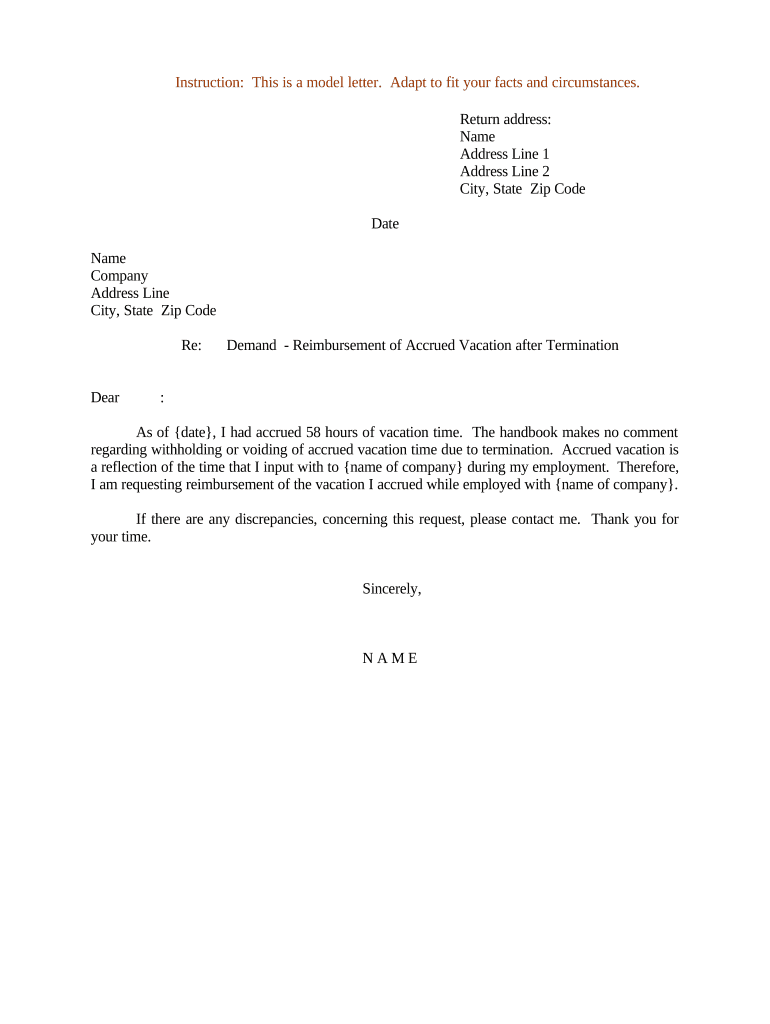
A Demand for Reimbursement of Accrued Vacation is a written request from a former or current employee asking an employer to pay unused, accrued vacation or paid time off (PTO) owed under company policy or applicable law. The document summarizes accrued balances, the calculation method, payment requested, and a deadline for payment. Employers and employees often use this demand at separation, layoff, or resignation to trigger payroll processing and preserve legal claims where state wage laws or contract terms govern payout obligations.

Why a Formal Demand Matters for Employees and Employers

A written demand creates a clear record of the amount requested and the delivery date, which is essential when state wage laws or company policy specify payout obligations. It supports timely payroll action, reduces misunderstandings about calculations, and preserves evidence if dispute resolution or administrative claims become necessary.

Why a Formal Demand Matters for Employees and Employers

Who Prepares and Reviews This Demand

Typical users include separating employees, HR professionals, payroll administrators, and employment counsel who need a clear, auditable request to initiate payout.

  • Employees seeking final wages and accrued PTO after resignation or termination, documenting amounts and deadline for payment.
  • HR and payroll teams using the demand to reconcile accrued balances and trigger final paycheck processing according to policy.
  • Employment counsel or mediators preparing or reviewing the demand to preserve legal rights and prepare potential claims.

Use the demand as part of a documented separation workflow that links to payroll records, accrued-time summaries, and any applicable company policies or signed agreements.

Primary Roles Involved

HR Manager

An HR Manager typically verifies accrual records, confirms employer policy on payout, coordinates with payroll for calculation and timing, and maintains the demand and supporting records for compliance and potential audits.

Former Employee

A former employee drafts or signs the demand to document the amount owed, the basis for calculation, and a reasonable payment deadline; keeping copies supports administrative claims or litigation if the employer fails to pay.

Core Elements to Include in Every Demand

A professionally prepared demand is concise and evidence-based: it ties the requested amount to accrued balances, cites policy or law, and provides payment instructions and a reasonable deadline.

Employee Details

Full legal name, job title, employee ID, last work date, and contact information to ensure correct identification and routing.
Accrual Summary

Detailed accrued vacation hours or days, accrual period, and how the balance was calculated, including pay rate used.

Calculation

Line-item math showing hours × rate or daily rate, overtime considerations, and any deductions or offsets.

Legal Basis

Reference to company policy, employment contract, or controlling state wage law that supports the payout claim.

Payment Terms

Requested payment method (check, direct deposit), deadline for payment, and where to remit funds or provide confirmation.

Signature Block

Employee signature and date; employer representative signature line if employer returns an acknowledgment or settlement.

Step-by-Step: Preparing and Sending the Demand

Follow this sequence to create an auditable demand and reduce processing friction between employee, HR, and payroll.

  • 01
    Gather Records: Export accrual and payroll reports for the relevant period.
  • 02
    Calculate Amount: Compute hours × rate and document each step of the math.
  • 03
    Draft Demand: Populate the form with details, legal basis, and a clear deadline.
  • 04
    Send and Confirm: Deliver via tracked method and retain proof of delivery or e-delivery audit trail.

How to Configure an Online Workflow for This Demand

Map form fields and routing rules in your eSignature or HR system to ensure consistent handling and audit trails.

Field Configuration
Accrued Balance Field Read-only numeric field linked to payroll export
Calculation Notes Multi-line text field for line-item math and source files
Employer Acknowledgment Signature field routed to HR after employee signs
Auto-Notify Payroll Automatic webhook or email to payroll on completion

Where the Demand Typically Goes After Completion

Routing varies by employer size; set clear recipients so payroll and HR act promptly.

  • Submit to HR: HR verifies policy and accrual records.
  • Route to Payroll: Payroll recalculates and schedules payment.
  • Employer Acknowledgment: HR or payroll returns signed receipt or denial.
  • Retain Records: Store signed demand with payroll and separation files.

Digital Signing and Technical Considerations

Use a secure eSignature platform that supports audit trails, access controls, and common file formats to preserve evidentiary value.

  • File Formats: PDF, DOCX supported
  • Integrations: Payroll and HRIS integrations recommended
  • Authentication: Email, SMS code, or stronger options

Ensure the chosen platform preserves a certificate of completion (timestamps, IP addresses, signer identity) and stores the record securely for retention requirements.

Required Information Fields (Checklist)

Employee Name: Full legal name
Last Day Worked: MM/DD/YYYY
Accrued Balance: Hours or days
Rate of Pay: Hourly or daily rate
Total Amount: Dollar amount
Signature: Signed and dated

Real-World Use Cases for a Demand for Accrued Vacation

Below are representative scenarios showing how the demand is used to resolve payout questions quickly and with documentation.

Separation after Resignation

An employee resigns with two weeks' notice and has 40 hours accrued

  • The employee submits a demand detailing the balance and calculation
  • The demand is attached to separation paperwork and used to confirm final payroll processing and timing.

Layoff with Accrual Dispute

A laid-off employee disputes the employer's accrual calculation

  • The employee sends a demand with payroll exports
  • The demand prompts HR to reconcile records, produce corrected math, and, where appropriate, issue payment or a written denial.

Practical Tips to Reduce Disputes and Speed Payment

Adopt consistent practices to shorten resolution time and strengthen defenses if a claim arises.

Keep Accrual Records Current and Accessible
Maintain exportable accrual ledgers that tie to pay periods; when employees request payout, provide the payroll export to avoid manual recalculation errors and support quick validation.
State Law Awareness
Understand state wage statutes affecting vacation payout obligations and final-pay timing; aligning policy with legal requirements reduces exposure to penalties and claims.
Use Clear Policy Language
Draft vacation and PTO policies that state whether accrued time is paid at termination and define accrual caps, rounding, and forfeiture rules to limit ambiguity.
Document Communications
Retain a copy of the demand, delivery confirmation, employer responses, and payroll entries. A complete file reduces friction in administrative reviews or litigation.

Timing: Deadlines and Expected Processing Windows

Timeframes vary by employer policy and state law; use the following as general guidance and verify local rules.

Employee Submission Deadline:

Send demand promptly after separation to preserve rights

Employer Response Window:

Many employers respond within one payroll cycle

Final Pay Rules:

State laws set specific final-pay timing

Record Retention:

Keep documents at least three years

Statute of Limitations:

Claims commonly limited by state-specific filing periods

Key Processing Milestones

A simplified milestone sequence helps coordinate action across HR, payroll, and the employee.

01

Accrual Reconciliation

Confirm final accruals and source payroll records.

02

Demand Sent

Employee delivers written demand with calculations.

03

Employer Review

HR and payroll validate figures and authorize payment.

04

Payment or Response

Employer issues payment or a written denial with explanation.

Common Mistakes That Delay Payment

  • Failing to attach payroll export or accrual report, which forces manual recalculation and increases the chance of arithmetic disputes and processing delays.
  • Using informal language or vague amounts rather than showing line-by-line calculations, leaving employer unsure how the total was derived.
  • Omitting preferred payment instructions, resulting in uncertainty about remittance method and additional back-and-forth with payroll.
  • Not checking state final-pay or vacation payout rules before sending the demand, which can lead to unrealistic deadlines or incorrect legal expectations.

Risks and Potential Employer Liability

Wage Law Penalties: State fines possible
Interest Charges: Accrual of interest in some states
Administrative Claims: Agency filings and investigations
Attorney Fees: Fee-shifting provisions may apply
Reputational Risk: Public complaints or reviews
Recordkeeping Exposure: Missing records increase liability

eSignature Vendor Pricing Snapshot for Document Handling

Compare common eSignature plan criteria relevant to processing and storing demands for accrued vacation; signNow is listed first for consistency.

signNow DocuSign Adobe Sign PandaDoc HelloSign
Starting Price $8/user/mo $15/user/mo $14/user/mo $19/user/mo $15/user/mo
Free Trial 7-day trial Varies Varies Varies Varies
Bulk Send Yes Yes Yes Yes No
Audit Trail Yes Yes Yes Yes Yes
HIPAA Compliant Yes Yes Yes No No

Frequently Asked Questions and Troubleshooting

Answers to common questions about preparing, delivering, and enforcing a demand for accrued vacation.


Need help? Contact support

be ready to get more
Join over 28 million airSlate SignNow users