Caption and Parties
Begin with a document caption and list full legal names, roles, and mailing addresses for claimant, debtor, servicer, and trustee to avoid later ownership or notice disputes.
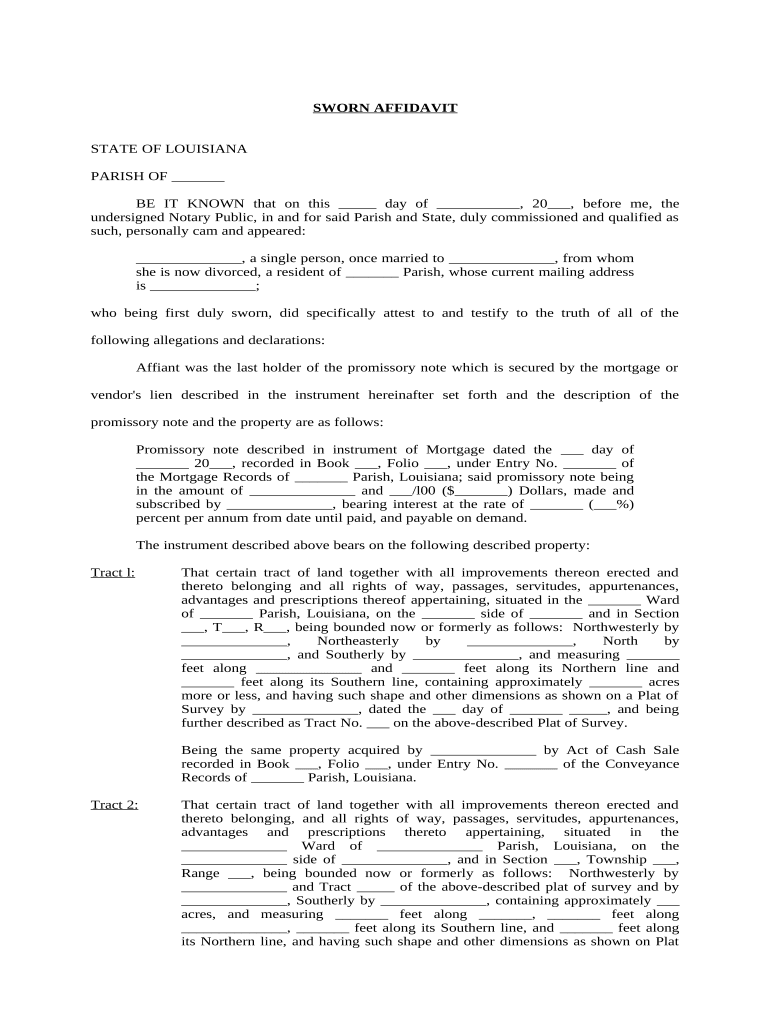
A properly drafted Affidavit of Lost Note creates a formal record of loss that supports replacement or enforcement, documents due diligence, and helps reduce title, servicing, and payment disputes while preserving remedial options.

Lenders, loan servicers, trustees, investors, and attorneys involved in enforcing or substituting debt instruments commonly prepare or review this affidavit.
Begin with a document caption and list full legal names, roles, and mailing addresses for claimant, debtor, servicer, and trustee to avoid later ownership or notice disputes.
Record principal amount, original date, maturity, interest rate, payee, endorsements, and loan identifiers so the affidavit can be cross-referenced against servicing and title records.
Provide a factual, chronological account of when and how the note was lost, stolen, or destroyed, including witness names and any loss reports or police references.
List searches, communications with custodians, and publication or notice steps taken to locate the original instrument; thorough diligence reduces insurer and court challenges.
State the specific relief sought such as issuance of a duplicate note, indemnity, or court authorization to enforce without physical delivery, and any proposed bond.
Include a state-compliant notary acknowledgement, signature lines for claimant, and witness lines where required by state law; notarization is often required for recording or court filing.
| Form Field and Configuration Settings | Field | Configuration |
|---|---|
| Signature Field Placement | Place primary signature and dated signature fields for claimant. |
| Notary Block Configuration | Include notary signature, seal image placeholder, and jurisdiction field. |
| Conditional Visibility Rules | Show indemnity clause only if duplicate is requested. |
| Recipient Routing Order | Route to servicer, trustee, then legal counsel sequentially. |
Confirm platform, file format, and authentication requirements for electronic signatures, remote notarization, and secure document storage before you send the affidavit.
Begin affidavit drafting upon discovery of loss.
Obtain notarization before sending to trustees or courts.
Inform servicers, holders, and insurers within reasonable time.
File for court authorization where statutory proof required.
Keep originals and exhibits for defined retention periods.
Document loss and evaluate remedy options.
Prepare affidavit and have counsel review.
Obtain appropriate notary and witness acknowledgements.
Submit to trustee, insurer, or court and obtain relief.
| signNow | DocuSign | Adobe Sign | PandaDoc | HelloSign | |
|---|---|---|---|---|---|
| Starting Price | $8/user/mo | $15/user/mo | $14/user/mo | $19/user/mo | $15/user/mo |
| Free Trial | 7-day free trial | Varies by vendor | Varies by vendor | Varies by vendor | Varies by vendor |
| Bulk Send | Yes | Yes | Yes | Yes | No |
| Audit Trail | Yes | Yes | Yes | Yes | Yes |
| HIPAA Compliant | Yes | Yes | Yes | No | No |
| Envelope Cap | No envelope cap | 100 envelopes/user/year cap | Varies by plan | Varies by plan | Varies by plan |
A servicer discovers the original mortgage note is missing during a loan transfer and needs enforceability assurances.
A title underwriter requires proof of chain of title after closing where the promissory note cannot be located.