Establishing secure connection… Loading editor… Preparing document…
Navigation

Fill and Sign the Cognos Employee Stock Purchase Plan Secgov Form
Fill and Sign the Cognos Employee Stock Purchase Plan Secgov Form

How it works

Open the document and fill out all its fields.
Apply your legally-binding eSignature.
Save and invite other recipients to sign it.

Rate template

4.7
43 votes
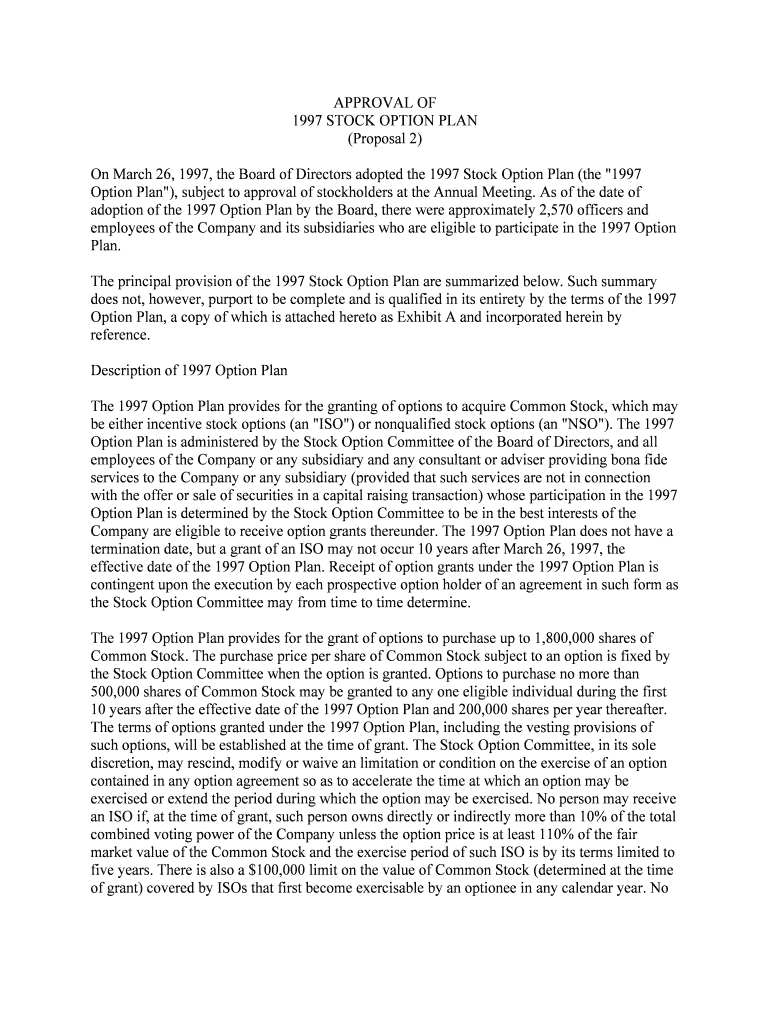
APPROVAL OF 1997 STOCK OPTION PLAN (Proposal 2) On March 26, 1997, the Board of Directors adopted the 1997 Stock Option Plan (the "1997 Option Plan"), subject to approval of stockholders at the Annual Meeting. As of the date of adoption of the 1997 Option Plan by the Board, there were approximately 2,570 officers and employees of the Company and its subsidiaries who are eligible to participate in the 1997 Option Plan. The principal provision of the 1997 Stock Option Plan are summarized below. Such summary does not, however, purport to be complete and is qualified in its entirety by the terms of the 1997 Option Plan, a copy of which is attached hereto as Exhibit A and incorporated herein by reference. Description of 1997 Option Plan The 1997 Option Plan provides for the granting of options to acquire Common Stock, which may be either incentive stock options (an "ISO") or nonqualified stock options (an "NSO"). The 1997 Option Plan is administered by the Stock Option Committee of the Board of Directors, and all employees of the Company or any subsidiary and any consultant or adviser providing bona fide services to the Company or any subsidiary (provided that such services are not in connection with the offer or sale of securities in a capital raising transaction) whose participation in the 1997 Option Plan is determined by the Stock Option Committee to be in the best interests of the Company are eligible to receive option grants thereunder. The 1997 Option Plan does not have a termination date, but a grant of an ISO may not occur 10 years after March 26, 1997, the effective date of the 1997 Option Plan. Receipt of option grants under the 1997 Option Plan is contingent upon the execution by each prospective option holder of an agreement in such form as the Stock Option Committee may from time to time determine. The 1997 Option Plan provides for the grant of options to purchase up to 1,800,000 shares of Common Stock. The purchase price per share of Common Stock subject to an option is fixed by the Stock Option Committee when the option is granted. Options to purchase no more than 500,000 shares of Common Stock may be granted to any one eligible individual during the first 10 years after the effective date of the 1997 Option Plan and 200,000 shares per year thereafter. The terms of options granted under the 1997 Option Plan, including the vesting provisions of such options, will be established at the time of grant. The Stock Option Committee, in its sole discretion, may rescind, modify or waive an limitation or condition on the exercise of an option contained in any option agreement so as to accelerate the time at which an option may be exercised or extend the period during which the option may be exercised. No person may receive an ISO if, at the time of grant, such person owns directly or indirectly more than 10% of the total combined voting power of the Company unless the option price is at least 110% of the fair market value of the Common Stock and the exercise period of such ISO is by its terms limited to five years. There is also a $100,000 limit on the value of Common Stock (determined at the time of grant) covered by ISOs that first become exercisable by an optionee in any calendar year. No option granted to a reporting person under Section 16 of the Exchange Act may be exercisable during the first six months after the date of grant.Payment for shares purchased under the 1997 Option Plan may be made: (i) in cash or in cash equivalents; (ii) if permitted by the option agreement, by exchanging shares of Common Stock with a fair market value equal to or less than the total option price plus cash for any difference; (iii) if permitted by the option agreement, by delivery of a promissory note of the person exercising the option; (iv) if permitted by the option agreement, by causing the Company to withhold shares of Common Stock otherwise issuable pursuant to the exercise of an option equal in value to the exercise price; or (V) by a combination of the foregoing. Payment in full of the option price need not accompany the written notice of exercise provided the notice directs that the stock certificate for the shares for which the option is exercised be delivered to a licensed broker acceptable to the Company as the agent for the individual exercising the option and, at the time such stock certificate is delivered, the broker tenders to the Company cash (or cash equivalents acceptable to the Company) equal to the option price. In the event of stock splits, stock dividends, recapitalizations, combinations of shares or certain other events, the 1997 Option Plan provides for adjustment of. (ij the number of shares available for option grants, including the maximum number of shares that may be granted to any one individual, and (ii) the number of shares and the per share exercise price for shares subject to unexercised options. Upon any dissolution or liquidation of the Company, the sale of substantially all of the Company's assets, a merger, reorganization or consolidation in which the Company is not the surviving corporation or any other transaction (including, without limitation, a merger or reorganization in which the Company is the surviving corporation) approved by the Board which results in any person or entity owning 80% or more of the total combined voting power of an classes of stock of the Company, the 1997 Option Plan and the options issued thereunder will terminate, unless provision is made in connection with such transaction for the continuation of the plans and/or the assumption of the options or for the substitution for such options of new options covering the stock of a successor corporation or a parent or subsidiary thereof, with appropriate adjustment as to the number and kinds of shares and the per share exercise price. Options granted under the 1997 Plan generally are non-transferable except by will or by the laws of descent and distribution upon the death of the option holder. The Board of Directors may terminate or amend the 1997 Option Plan at any time; provided, however, that any amendment by the Board which, if not approved by the Company's stockholders would cause the Plan to not comply with Sections 162(m) or 422 of the Internal Revenue Code of 1986, as amended (the "Code"), shall not be effective unless approved by the affirmative vote of stockholders who hold more than 50% of the combined voting power of the outstanding shares of voting stock of the Company present or represented, and entitled to vote thereon at a duly constituted stockholders' meeting. Based on the closing price of $28 1/8 per share on March 17, 1997, the aggregate market value of the 1,800,000 shares of Common Stock issuable under the 1997 Option Plan is $50.6 million. In addition to the 1997 Option Plan, the Company maintains two other stock options plans under which employees are eligible to receive option grants: the 1995 Stock Option Plan (1,298,065 shares reserved, of which 1,269,438 shares have been granted, net of forfeitures, as of March 17, 1997) and the 1996 Non-Incentive Stock Option Plan (1,100,000 shares reserved, of which 1,095,491 shares have been granted as of March 17, 1997). In January 1995, the Company also made a non-plan option grant to Mr. Faeder covering 450,000 shares of Common Stock.Federal Income Tax Consequences The grant of an option will not be a taxable event for the optionee or the Company. Incentive Stock Options. An optionee will not recognize taxable income upon exercise of an ISO (except that the alternative minimum tax may apply), and any gain realized upon a disposition of shares of stock received pursuant to the exercise of an ISO will be taxed as long-term capital gain if the optionee holds the shares for at least two years after the date of grant and for one year after the date of exercise (the "holding period requirement"). The Company will not be entitled to any business expense deduction with respect to the exercise of an ISO, except as discussed below. For the exercise of an option to qualify for the foregoing tax treatment, the optionee generally must be an employee of the Company or a subsidiary from the date the option is granted through a date within three months before the date of exercise of the option. In the case of an optionee who is disabled, the three-month period for exercise following termination of employment is extended to one year. In the case of an employee who dies, both the time for exercising ISOs after termination of employment and the holding period for stock received pursuant to the exercise of the option are waived. If all of the foregoing requirements are met except the holding period requirement mentioned above, the optionee will recognize ordinary income upon the disposition of the stock in an amount generally equal to the excess of the fair market value of the stock at the time the option was exercised over the option exercise price (but not in excess of the gain realized on the sale). The balance of the realized gain, if any, will be capital gain. The employer corporation will be allowed a business expense deduction to the extent the optionee recognizes ordinary income subject to Section 162(m) of the Code summarized below. If an optionee exercises an ISO by tendering shares of Common Stock with a fair market value equal to part or all of the option exercise price, the exchange of shares will be treated as a nontaxable exchange (except that this treatment would not apply if the optionee had acquired the shares being transferred pursuant to the exercise of an-ISO and had not satisfied the holding period requirement summarized above). If the exercise is treated as a tax free exchange, the optionee would have no taxable income from the exchange and exercise (other than minimum taxable income as discussed above) and the tax basis of the shares exchanged would be treated as the substituted basis for the shares received. If the optionee used shares received pursuant to the exercise of an ISO (or another statutory option) as to which the optionee had not satisfied the applicable holding period requirement, the exchange would be treated as a taxable disqualifying disposition of the exchanged shares. If, pursuant to an option agreement, the Company withholds shares in payment of the option price for incentive options, the transaction should generally be treated as if the withheld shares had been sold in a disqualifying disposition after exercise of the option, so that the optionee will realize ordinary income with respect to such shares. The shares paid for by the withheld shares should be treated as having been received upon exercise of an incentive stock option, with the tax consequences described above. However, the Internal Revenue Service has not ruled on the tax treatment of shares received on exercise of an incentive stock option where the option exercise price is paid with withheld shares. Non-Qualified Options. Upon exercising a NSO, an optionee will recognize ordinary income in an amount equal to the difference between the exercise price and the fair market value of the stock on the date of exercise (except that, if the optionee is subject to certain restrictions imposed by the securities laws, the measurement date will be deferred, unless the optionee makes a special tax election within 30 days after exercise). Upon a subsequent sale or exchange of shares acquired pursuant to the exercise of a NSO, the optionee will have taxable gain or loss, measured by the difference between the amount realized on the disposition and the tax basis of the shares (generally, the amount paid for the shares plus the amount treated as ordinary income at the time the option was exercised). If the employer corporation complies with applicable reporting requirements and with the restrictions of Section 162(m) of the Code, it will be entitled to a business expense deduction in the same amount and generally at the same time as the optionee recognizes ordinary income. Under Section 162(m) of the Code, if the optionee is one of certain specified executive officers, then, unless certain exceptions apply, the employer is not entitled to deduct compensation with respect to the optionee, including compensation related to the exercise of stock options, to the extent such compensation in the aggregate exceeds $1.0 million for the taxable year. The options are intended to comply with the exception to Section 162(m) for "performance -based" compensation. If the optionee surrenders shares of Common Stock in payment of part or all of the exercise price for NSOs, no gain or loss will be recognized with respect to the shares surrendered (regardless of whether the shares were acquired pursuant to the exercise of an incentive option) and the optionee will be treated as receiving an equivalent number of shares pursuant to the exercise of the option in a nontaxable exchange. The basis of the shares surrendered will be treated as the substituted tax basis for an equivalent number of option shares received and the new shares will be treated as having been held for the same holding period as had expired with respect to the transferred shares. The difference between the aggregate option exercise price and the aggregate fair market value of the shares received pursuant to the exercise of the option will be taxed as ordinary income. The optionee's basis in the additional shares will be equal to the amount included in the optionee's income. If, pursuant to an option agreement, the Company withholds shares in payment of the option price for NSOs or in payment of tax withholding, the transaction should generally be treated as if the withheld shares had been sold for an amount equal to the exercise price after exercise of the option. Reasons for Obtaining Stockholder Approval The Board has approved the 1997 Option Plan subject to stockholder approval at the Annual Meeting. The Company is submitting the 1997 Option Plan for stockholder approval at the Annual Meeting because stockholder approval is required to (1) qualify the 1997 Option Plan under Section 422 of the Code relating to the grant of ISOS and (ii) obtain a federal income tax deduction under Section 162(m) of the Code for compensation recognized by optionees in connection with the exercise of options granted under the 1997 Option Plan. Section 422 of the Code and applicable Treasury regulations, among other things, condition ISO treatment for option grants on stockholder approval of the stock option plan pursuant to which the ISOs are granted. Under Section 162(m) of the Code and applicable Treasury regulations, no deduction is allowed for annual compensation in excess of $1 million paid by a publicly traded corporation to its chief executive officer and the four other most highly compensated officers. Under those provisions, however, there is no limitation on the deductibility of "qualified performance-based compensation." To satisfy this definition: (1) the compensation must be paid solely on account of the attainment of one or more pre-established, objective performance goals; (ii) the performance goals under which compensation is paid must be established by a compensation committee having the authority to establish and administer performance goals and comprised solely of two or more directors who qualify as "outside directors" for purposes of the exception; (iii) the material terms under which the compensation is to be paid must be disclosed to and subsequently approved by stockholders of the corporation before payment is made in a separate vote; and (iv) the compensation committee must certify in writing before payment of the compensation that the performance goals and any other material terms were in fact satisfied. Under applicable Treasury regulations, in the case of compensation attributable to stock options, the performance goal requirement (summarized in (i) above) and the stockholder approval requirement (summarized in (iii) above) are deemed satisfied, and the certification requirement (summarized in (iv) above) is inapplicable, if: (i) the grant or award is made by a compensation committee satisfying the above requirements; (ii) the plan under which the option is granted states the maximum number of shares with respect to which options may be granted during a specified time period to an employee; (iii) under the option exercise price equals or exceeds the fair market value of the stock on the date of grant; and (iv) the stock option plan is approved by stockholders. The Company has in the past used stock options as an important device to motivate and reward its employees and employees of its subsidiaries, and believes that equity incentives represented by stock options enhance its ability to attract and retain key personnel. Required Vote The approval by the affirmative vote of the holders of a majority of the shares of Common Stock present or represented and entitled to vote at the Annual Meeting is required to approve the 1997 Option Plan. Abstentions will have the same effect as a negative vote. The Board of Directors recommends a vote FOR approval of the 1997 Option Plan. 1995 Stock Option Plan Set forth below is certain information regarding the Company's 1995 Stock Option Plan, as amended (the "1995 Option Plan"). Such information is included in this proxy statement for the purpose of satisfying the requirements of former Rule 16b-3 for options granted under the 1995 Option Plan prior to November 1, 1996. Description of 1995 Option Plan The 1995 Option Plan provides for the granting of options to acquire Common Stock, which may be either ISOs or NSOs. The 1995 Option Plan is administered by the Stock Option Committee of the Board of Directors, and all full-time employees or any other individual (including non- employee directors of, or consultants or advisors providing bona fide services to, the Company) whose participation in the 1995 Option Plan is determined by the Stock Option Committee to be in the best interests of the Company are eligible to receive option grants thereunder. The 1995 Option Plan does not have a termination date, but a grant of an ISO may not occur 10 years after May 16, 1995, the effective date of the 1995 Option Plan. Receipt of option grants under the 1995 Option Plan is contingent upon the execution by each prospective option holder of an agreement in such form as the Stock Option Committee may from time to time determine. The 1995 Option Plan provides for the grant of options to purchase up to 1,298,065 shares of Common Stock. The purchase price per share of Common Stock subject to an option is fixed by the Stock Option Committee when the option is granted. Options to purchase no more than 250,000 shares of Common Stock may be granted to any one eligible individual during the first 10 years after the effective date of the 1995 Option Plan and 50,000 shares per year thereafter. The terms of options granted under the 1995 Option Plan, including the vesting provisions of such options, are established at the time of grant. The Stock Option Committee, in its sole discretion, may rescind, modify or waive an limitation or condition on the exercise of an option contained in any option agreement so as to accelerate the time at which an option may be exercised or extend the period during which the option may be exercised. No person may receive an ISO if, at the time of grant, such person owns directly or indirectly more than 10% of the total combined voting power of the Company unless the option price is at least 110% of the fair market value of the Common Stock and the exercise period of such ISO is by its terms limited to five years. There is also a $100,000 limit on the value of Common Stock (determined at the time of grant) covered by ISOs that first become exercisable by an optionee in any calendar year. No option granted to a reporting person under Section 16 of the Exchange Act may be exercisable during the first six months after the date of grant. Payment for shares purchased under the 1995 Option Plan may be made: (i) in cash or in cash equivalents; (ii) if permitted by the option agreement, by exchanging shares of Common Stock with a fair market value equal to or less than the total option price plus cash for any difference; (iii) if permitted by the option agreement, by delivery of a promissory note of the person exercising the option; (iv) if permitted by the option agreement, by causing the Company to withhold shares of Common Stock otherwise issuable pursuant to the exercise of an option equal in value to the exercise price; or (v) by a combination of the foregoing. Payment in full of the option price need not accompany the written notice of exercise provided the notice directs that the stock certificate for the shares for which the option is exercised be delivered to a licensed broker acceptable to the Company as the agent for the individual exercising the option and, at the time such stock certificate is delivered, the broker tenders to the Company cash (or cash equivalents acceptable to the Company) equal to the option price.In the event of stock splits, stock dividends, recapitalizations, combinations of shares or certain other events, the 1995 Option Plan provides for adjustment of. (i) the number of shares available for option grants, including the maximum number of shares that may be granted to any one individual, and (ii) the number of shares and the per share exercise price for shares subject to unexercised options. Upon any dissolution or liquidation of the Company, the sale of substantially all of the Company's assets, a merger, reorganization or consolidation in which the Company is not the surviving corporation or any other transaction (including, without limitation, a merger or reorganization in which the Company is the surviving corporation) approved by the Board which results in any person or entity owning 80% or more of the total combined voting power of an classes of stock of the Company, the 1995 Option Plan and the options issued thereunder win terminate, unless provision is made in connection with such transaction for the continuation of the plans and/or the assumption of the options or for the substitution for such options of new options covering the stock of a successor corporation or a parent or subsidiary thereof, with appropriate adjustment as to the number and kinds of shares and the per share exercise price. In the event of any such termination, the option agreements entered into with optionees provide that the optionee shall have the right during such period before such termination as the Board of Directors shall determine to exercise the related option in whole or in part and whether or not the option was exercisable at the time of any such termination. Options granted under the 1995 Option Plan generally terminate upon the earliest of. (i) ten years from the date of grant; (ii) termination of employment or other relationship for any reason (to the extent the option has not vested); (iii) termination of employment or other relationship for cause (whether or not the option has vested); (iv) one year after termination of employment or other relationship due to death or disability (to the extent the option has vested); and (v) three months after the optionee's termination of employment or other relationship other than for cause, death or disability (to the extent the option has vested). Options granted under the 1995 Option Plan generally are nontransferable except by will or by the laws of descent and distribution upon the death of the option holder. The Board of Directors may terminate or amend the 1995 Option Plan at any time; provided, however, that any amendment by the Board which, if not approved by the Company's stockholders in accordance with applicable requirements of Rule 16b-3, would cause the Plan to not comply with Rule 16b-3 (or any successor rule or other regulatory requirements) or the Code, shall not be effective unless approved by the affirmative vote of stockholders who hold more than 50% of the combined voting power of the outstanding shares of voting stock of the Company present or represented, and entitled to vote thereon at a duly constituted stockholders' meeting. Plan Benefits The table below indicates options granted to date under the 1995 Option Plan. With the exception of an option grant for 6,666 shares at an exercise price of $3.75 per share, the option exercise price of options granted under the 1995 Option Plan was not less than the fair market value of the Company's Common Stock on the date of grant, as determined pursuant to the Plan. All of such options have been NSOs.Plan Benefits 1995 Option Plan Average Per Share Number Name and Position(s) Exercise Price($) of Options Paul J. Klaassen $-0- -0- Chairman of the Board, President and Chief Executive Officer David W. Faeder 16.20 41,667 Executive Vice President and Chief Financial Officer Timothy S. Smick 11.93 166,667 Executive Vice President and Chief Operating Officer Thomas B. Newell 10.65 155,002 Executive Vice President and General Counsel of the Company and President of Sunrise Development, Inc. Brian C. Swinton 20.00 120,000 Executive Vice President, Sales and Marketing Executive Group (6 persons) 13.89 483,336 Non-Executive Director Group (2 persons) 14.20 50,000 Non-Executive Officer Employee Group (212 persons) 11.34 736,177 Based on the closing price of $28 1/8 per share on March 17, 1997, the aggregate market value of the 1,298,065 shares of Common Stock issuable under the 1995 Option Plan is $36.5 million. Federal Income Tax Consequences For a description of the federal income tax consequences of the issuance and exercise of options under the 1995 Option Plan to the optionee and the Company, see "Approval of 1997 Stock Option Plan -- Federal Income Tax Consequences."

Essential tips for preparing your ‘Cognos Employee Stock Purchase Plan Secgov’ online

Are you fed up with the complications of handling paperwork? Look no further than airSlate SignNow, the premier electronic signature solution for individuals and small to medium businesses. Bid farewell to the laborious process of printing and scanning documents. With airSlate SignNow, you can effortlessly complete and sign paperwork online. Take advantage of the extensive features integrated into this user-friendly and cost-effective platform and transform your document management strategy. Whether you need to authorize forms or gather electronic signatures, airSlate SignNow simplifies the process, requiring only a few clicks.

Adhere to this comprehensive guide:

  1. Access your account or initiate a free trial with our service.
  2. Select +Create to upload a file from your device, cloud storage, or our template repository.
  3. Open your ‘Cognos Employee Stock Purchase Plan Secgov’ in the editor.
  4. Click Me (Fill Out Now) to finalize the document on your end.
  5. Add and designate fillable fields for other participants (if necessary).
  6. Proceed with the Send Invite settings to request eSignatures from others.
  7. Download, print your copy, or convert it into a multi-use template.

Don’t stress if you need to work with your colleagues on your Cognos Employee Stock Purchase Plan Secgov or send it for notarization—our platform provides everything required to accomplish such tasks. Register for an account with airSlate SignNow today and elevate your document management to a new standard!

Here is a list of the most common customer questions. If you can’t find an answer to your question, please don’t hesitate to reach out to us.

Need help? Contact Support

The best way to complete and sign your cognos employee stock purchase plan secgov form
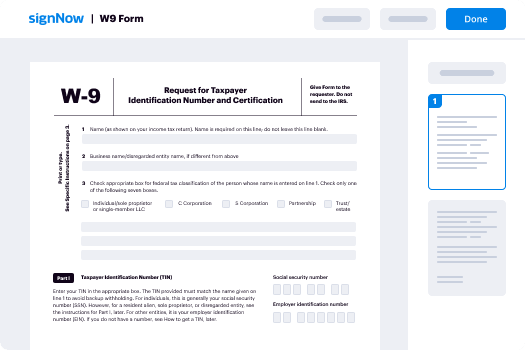
Save time on document management with airSlate SignNow and get your cognos employee stock purchase plan secgov form eSigned quickly from anywhere with our fully compliant eSignature tool.
How to Sign a PDF Online How to Sign a PDF Online

How to complete and sign forms online

In the past, coping with paperwork took lots of time and effort. But with airSlate SignNow, document management is quick and simple. Our robust and easy-to-use eSignature solution allows you to easily fill out and electronically sign your cognos employee stock purchase plan secgov form online from any internet-connected device.

Follow the step-by-step guidelines to eSign your cognos employee stock purchase plan secgov form template online:

  • 1.Register for a free trial with airSlate SignNow or log in to your account with password credentials or SSO authorization option.
  • 2.Click Upload or Create and add a form for eSigning from your device, the cloud, or our form collection.
  • 3.Click on the document name to open it in the editor and use the left-side menu to fill out all the blank fields accordingly.
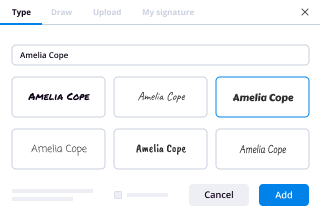
  • 4.Put the My Signature field where you need to eSign your form. Provide your name, draw, or upload a picture of your regular signature.
  • 5.Click Save and Close to finish modifying your completed document.

After your cognos employee stock purchase plan secgov form template is ready, download it to your device, save it to the cloud, or invite other individuals to electronically sign it. With airSlate SignNow, the eSigning process only requires a few clicks. Use our powerful eSignature solution wherever you are to handle your paperwork productively!
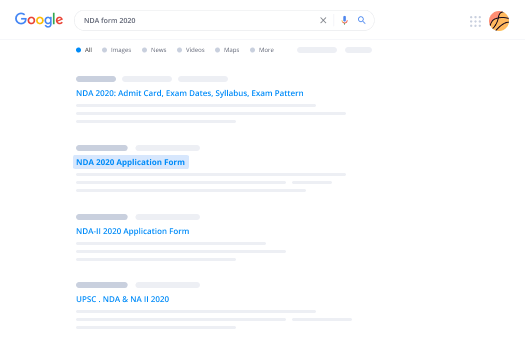
How to Sign a PDF Using Google Chrome How to Sign a PDF Using Google Chrome

How to fill out and sign forms in Google Chrome

Completing and signing documents is simple with the airSlate SignNow extension for Google Chrome. Adding it to your browser is a quick and beneficial way to deal with your forms online. Sign your cognos employee stock purchase plan secgov form sample with a legally-binding electronic signature in just a couple of clicks without switching between tools and tabs.

Follow the step-by-step guidelines to eSign your cognos employee stock purchase plan secgov form in Google Chrome:

  • 1.Go to the Chrome Web Store, locate the airSlate SignNow extension for Chrome, and add it to your browser.
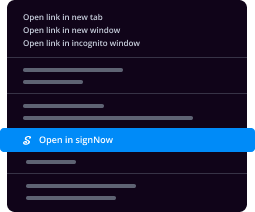
  • 2.Right-click on the link to a document you need to sign and choose Open in airSlate SignNow.
  • 3.Log in to your account with your credentials or Google/Facebook sign-in option. If you don’t have one, you can start a free trial.
  • 4.Use the Edit & Sign toolbar on the left to complete your template, then drag and drop the My Signature option.
  • 5.Add a picture of your handwritten signature, draw it, or simply enter your full name to eSign.
  • 6.Verify all information is correct and click Save and Close to finish modifying your form.

Now, you can save your cognos employee stock purchase plan secgov form sample to your device or cloud storage, send the copy to other people, or invite them to electronically sign your form with an email request or a secure Signing Link. The airSlate SignNow extension for Google Chrome enhances your document processes with minimum time and effort. Start using airSlate SignNow today!
How to Sign a PDF in Gmail How to Sign a PDF in Gmail How to Sign a PDF in Gmail

How to complete and sign paperwork in Gmail

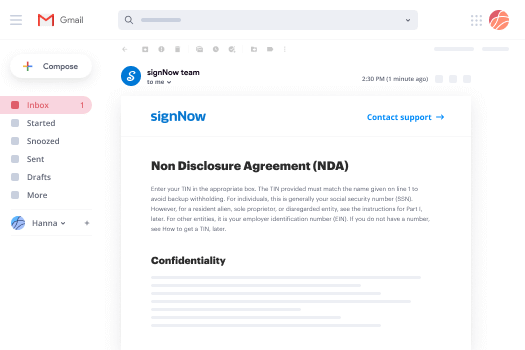
When you receive an email containing the cognos employee stock purchase plan secgov form for signing, there’s no need to print and scan a document or save and re-upload it to another tool. There’s a much better solution if you use Gmail. Try the airSlate SignNow add-on to promptly eSign any paperwork right from your inbox.

Follow the step-by-step guide to eSign your cognos employee stock purchase plan secgov form in Gmail:

  • 1.Navigate to the Google Workplace Marketplace and look for a airSlate SignNow add-on for Gmail.
  • 2.Install the program with a related button and grant the tool access to your Google account.
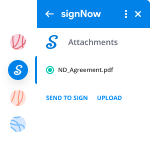
  • 3.Open an email containing an attachment that needs signing and use the S key on the right panel to launch the add-on.
  • 4.Log in to your airSlate SignNow account. Choose Send to Sign to forward the document to other parties for approval or click Upload to open it in the editor.
  • 5.Put the My Signature field where you need to eSign: type, draw, or import your signature.

This eSigning process saves efforts and only requires a few clicks. Use the airSlate SignNow add-on for Gmail to update your cognos employee stock purchase plan secgov form with fillable fields, sign paperwork legally, and invite other parties to eSign them al without leaving your inbox. Improve your signature workflows now!
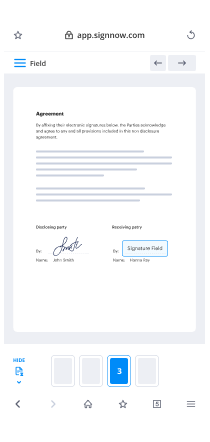
How to Sign a PDF on a Mobile Device How to Sign a PDF on a Mobile Device How to Sign a PDF on a Mobile Device

How to fill out and sign documents in a mobile browser

Need to quickly complete and sign your cognos employee stock purchase plan secgov form on a mobile phone while doing your work on the go? airSlate SignNow can help without the need to set up additional software programs. Open our airSlate SignNow tool from any browser on your mobile device and add legally-binding eSignatures on the go, 24/7.

Follow the step-by-step guide to eSign your cognos employee stock purchase plan secgov form in a browser:

  • 1.Open any browser on your device and go to the www.signnow.com
  • 2.Create an account with a free trial or log in with your password credentials or SSO authentication.
  • 3.Click Upload or Create and pick a file that needs to be completed from a cloud, your device, or our form catalogue with ready-made templates.
  • 4.Open the form and complete the blank fields with tools from Edit & Sign menu on the left.
  • 5.Place the My Signature field to the sample, then type in your name, draw, or upload your signature.

In a few simple clicks, your cognos employee stock purchase plan secgov form is completed from wherever you are. When you're done with editing, you can save the file on your device, generate a reusable template for it, email it to other people, or ask them to eSign it. Make your documents on the go fast and efficient with airSlate SignNow!
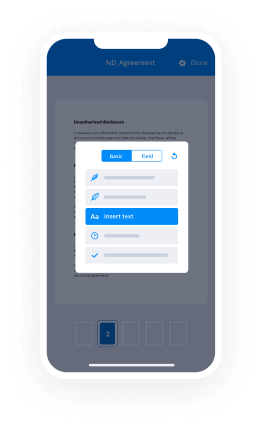
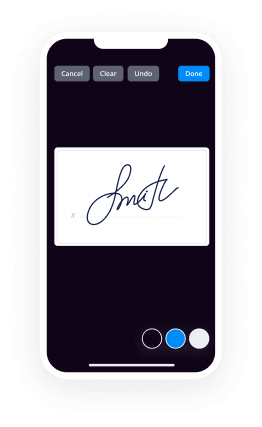
How to Sign a PDF on iPhone How to Sign a PDF on iPhone

How to complete and sign paperwork on iOS

In today’s business world, tasks must be done rapidly even when you’re away from your computer. Using the airSlate SignNow application, you can organize your paperwork and approve your cognos employee stock purchase plan secgov form with a legally-binding eSignature right on your iPhone or iPad. Set it up on your device to conclude contracts and manage forms from just about anywhere 24/7.

Follow the step-by-step guide to eSign your cognos employee stock purchase plan secgov form on iOS devices:

  • 1.Go to the App Store, find the airSlate SignNow app by airSlate, and install it on your device.
  • 2.Open the application, tap Create to add a template, and choose Myself.
  • 3.Choose Signature at the bottom toolbar and simply draw your autograph with a finger or stylus to eSign the sample.
  • 4.Tap Done -> Save right after signing the sample.
  • 5.Tap Save or use the Make Template option to re-use this paperwork later on.

This process is so easy your cognos employee stock purchase plan secgov form is completed and signed in just a couple of taps. The airSlate SignNow app works in the cloud so all the forms on your mobile device are kept in your account and are available any time you need them. Use airSlate SignNow for iOS to enhance your document management and eSignature workflows!
How to Sign a PDF on Android How to Sign a PDF on Android

How to complete and sign paperwork on Android

With airSlate SignNow, it’s simple to sign your cognos employee stock purchase plan secgov form on the go. Install its mobile app for Android OS on your device and start improving eSignature workflows right on your smartphone or tablet.

Follow the step-by-step guide to eSign your cognos employee stock purchase plan secgov form on Android:

  • 1.Go to Google Play, search for the airSlate SignNow application from airSlate, and install it on your device.
  • 2.Sign in to your account or create it with a free trial, then upload a file with a ➕ key on the bottom of you screen.
  • 3.Tap on the uploaded document and select Open in Editor from the dropdown menu.
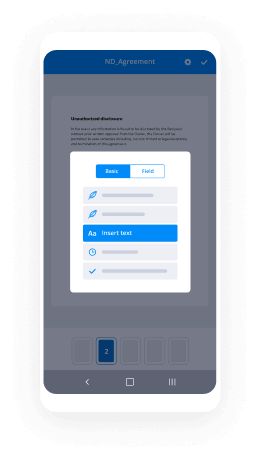
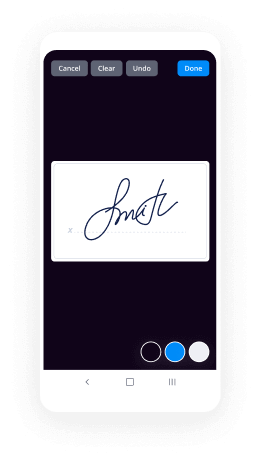
  • 4.Tap on Tools tab -> Signature, then draw or type your name to electronically sign the sample. Complete empty fields with other tools on the bottom if necessary.
  • 5.Use the ✔ button, then tap on the Save option to finish editing.

With a user-friendly interface and total compliance with main eSignature laws and regulations, the airSlate SignNow application is the perfect tool for signing your cognos employee stock purchase plan secgov form. It even works offline and updates all record adjustments when your internet connection is restored and the tool is synced. Fill out and eSign documents, send them for approval, and generate multi-usable templates whenever you need and from anywhere with airSlate SignNow.

Sign up and try Cognos employee stock purchase plan secgov form
  • Close deals faster
  • Improve productivity
  • Delight customers
  • Increase revenue
  • Save time & money
  • Reduce payment cycles