Parties
Identify the grantor and grantee using full legal names and entity type; include contact and mailing addresses to support service and record searches.
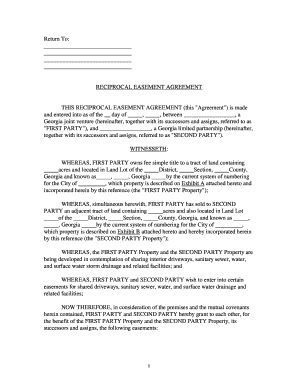
A professionally drafted Easement Agreement reduces ambiguity, preserves property values, and protects both grantor and grantee rights by documenting intent, scope, maintenance obligations, and termination events under applicable state law and recording practices.

Identify the grantor and grantee using full legal names and entity type; include contact and mailing addresses to support service and record searches.
Provide a precise metes-and-bounds or lot-and-block description tied to county parcel ID or a survey exhibit to ensure the easement area is unambiguous and recordable.
Specify express rights (egress/ingress, utilities, access) and whether the easement is exclusive, non-exclusive, appurtenant, or in gross.
Detail permitted activities, hours of use, restrictions on alterations, and liability allocation to reduce disputes and support title insurance.
Assign maintenance responsibilities, cost-sharing, seasonal access rules, and procedures for repairing damage to protect long-term use.
State whether the easement is perpetual, for a fixed term, or conditional, and include procedures for revocation, abandonment, or merger.
Each party’s role affects signatures, notary needs, and recording steps; coordinate early with title counsel or a county recorder for local practice.
Usually the fee owner or authorized representative. The grantor conveys the easement interest; the signer must appear with authority on title, or an entity officer with corporate resolution should sign.
The party receiving the easement (individual, utility, or government). Signing confirms acceptance of terms and obligations; some jurisdictions require the grantee to sign prior to recording.
Confirm county e-recording rules before e-submission; some recorders accept only PDFs while others allow specific templates or fee coversheets.
| Field | Recommended Setting |
|---|---|
| Signature Type | Signer-supplied drawn or typed signature with audit trail |
| Authentication | Email + SMS code; use ID proofing for high-risk grants |
| Notary Support | Enable RON session recording or prepare in-person notary block |
| File Output | Flattened PDF/A with certificate of completion attached |
Date parties sign; defines effective date for rights and obligations
Date of notary acknowledgment; must be current on recorded instrument
Date the county records the easement; establishes public notice and priority
Provide recorded instrument to mortgagee per loan conditions
Update title and liability policies after recording
Prepare agreement and exhibits; verify legal description
Signatures, witness attestations, and notary acknowledgment
File with county recorder; pay recording fees
Deliver recorded copies to grantor, grantee, title insurer, and lender
A homeowner granted a non-exclusive access easement to a neighbor to reach a landlocked parcel.
A utility sought a perpetual easement for underground lines across multiple parcels.
A stamped survey showing the easement area tied to monument references reduces boundary disputes and easement ambiguity for recorders.
A metes-and-bounds or lot-and-block description that exactly matches county parcel records to ensure accurate indexing.
Show existing exceptions or liens; helps identify required consents or curative steps before recording.
When an entity grants an easement, attach a resolution or power authorizing the signatory to bind the organization.