Establishing secure connection…Loading editor…Preparing document…

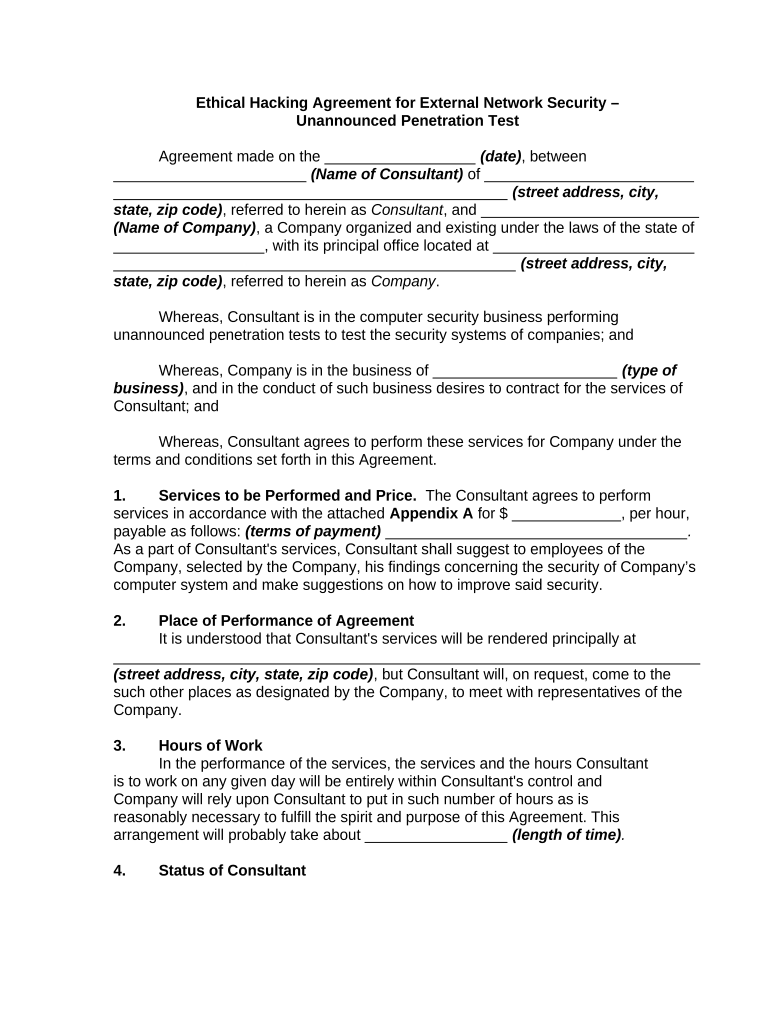
Ethical Hacking Agreement for External Network Security

This template is fully customizable. Edit the text, fill out the fields, and send it for signature. Give it a try!
Ethical Hacking Agreement for External Network Security

What the Ethical Hacking Agreement for External Network Security Is

An Ethical Hacking Agreement for External Network Security is a written contract that authorizes controlled security testing of internet-facing systems. It defines parties, permitted techniques, scope (IP addresses, domains, services), test windows, data handling, reporting requirements, and liability limits. The agreement documents rules of engagement that reduce legal and operational risk by clarifying consent, escalation paths for discovered vulnerabilities, and required remediation timelines while preserving confidentiality and preserving evidence for post-test review.

Why a Written Agreement Matters for External Security Tests

A formal agreement creates legal authorization, reduces ambiguity about permitted activity, protects both owner and tester, and documents responsibilities for discovery, disclosure, and remediation in a way that supports compliance and risk management.

Why a Written Agreement Matters for External Security Tests

Who Typically Completes This Agreement

Teams and external providers use this agreement when planning authorized external penetration tests or vulnerability assessments.

  • Internal security teams coordinating external contractors or bug bounty vendors.
  • Third-party penetration testers contracted to simulate attacks against internet-facing systems.
  • Legal, compliance, or procurement staff approving scope and indemnity terms for testing engagements.

Who Signs and What Role They Play

Security Team Lead

Typically signs on behalf of the organization to approve scope, provide target lists, and confirm internal contact and escalation procedures. They coordinate scheduling and remediation requirements before testing begins.

Contracted Tester

A representative of the external testing firm or independent researcher signs to accept rules of engagement, attest to permitted methods, commit to nondisclosure, and confirm insurance and liability coverage where applicable.

Essential Information to Include

Target Systems: IP ranges, domains
Scope Limits: Excluded assets or subnets
Testing Window: Dates and times
Allowed Methods: Tools and techniques
Contact Details: On-call contacts
Data Handling: Sensitive data rules

Core Sections Every Professional Agreement Should Contain

A thorough agreement balances technical clarity with legal protections and operational procedures so tests proceed safely and findings are actionable.

Authorization

Explicit written authorization naming tester and owner, with signature lines and scope attachment that prevents ambiguity about who is permitted to act and where testing may occur.
Scope of Work

Detailed list of targets, exclusions, allowed techniques (for example, passive reconnaissance versus active exploitation), and any systems that require special handling or are off-limits.

Rules of Engagement

Operational requirements such as test windows, throttling limits, escalation contacts, blackout periods, and procedures to pause or stop tests if stability issues arise.

Reporting Requirements

Deliverables, vulnerability classification, timelines for draft and final reports, remediation verification testing, and acceptable formats for evidence and artifacts.

Confidentiality & Data

Nondisclosure obligations, handling of sensitive data, retention limits for captured data, and permitted uses of test results for research or public disclosure.

Liability & Insurance

Indemnity clauses, limits of liability, required insurance coverages, and responsibility for third-party claims or damages arising from testing activity.

Step-by-Step: Completing and Executing the Agreement

Follow this sequence to prepare, approve, and start authorized external security testing with minimal operational disruption.

  • 01
    Prepare scope: Compile target lists and exclusions.
  • 02
    Define rules: Set allowed methods and test windows.
  • 03
    Approve internally: Obtain legal and operational sign-off.
  • 04
    Sign and schedule: Execute agreement and confirm testing dates.

Configuring a Digital Workflow for the Agreement

Set up fields and authentication in your eSignature or contract platform to automate routing and evidence capture.

Field Configuration
Signature Type Electronic signature; capture timestamp
Authentication Email + optional SMS code
Audit Trail Enable IP, timestamp, and event logs
Notifications Auto-notify signers and contacts

Typical Process Flow from Draft to Report

This high-level flow describes the typical path: create, approve, sign, test, and report, with audit trail capture at each stage.

  • Draft agreement: Author prepares scope and clauses.
  • Signatures captured: Parties sign electronically or in-person.
  • Tester executes: Testing occurs within agreed window.
  • Report delivered: Findings and remediation timeline issued.

Technical and Integration Considerations for eSigning

Choose a platform that captures a comprehensive audit trail and supports your authentication requirements.

  • Integrations: Salesforce, Microsoft 365, NetSuite
  • File formats: PDF, DOCX, and export options
  • Security: AES-256 at rest; TLS 1.2/1.3

Practical Tips for Clear and Enforceable Agreements

Adopt these practices to reduce disputes and ensure testing proceeds safely and lawfully.

Use precise technical identifiers
Specify targets using IP ranges and FQDNs rather than general descriptions. Precise targeting reduces accidental tests on unintended assets and supports forensic reconstruction if needed.
Set explicit escalation procedures
Include primary and backup contacts, acceptable response times for critical findings, and a defined process to pause tests if outages occur to limit business disruption.
Include nondisclosure and data rules
Require secure handling of captured data, limit retention, and prohibit public disclosure of exploitable findings until remediation or coordinated disclosure is complete.
Require proof of insurance
Ask testers for appropriate liability insurance and confirm coverage amounts and effective dates to ensure responsibility for accidental damages or third-party claims.

Common Timeframes and Delivery Expectations

Establish and document realistic timelines for notification, testing, reporting, and remediation verification to manage expectations.

Pre-test notice period:

Typically 48–72 hours to schedule and notify stakeholders.

Testing window:

Define exact start and end dates and daily active hours.

Initial draft report:

Delivered within 7–14 days after testing completes.

Final report and remediation verification:

Final report plus retest typically within 30–60 days.

Evidence retention for review:

Keep raw logs per retention policy in the agreement.

Key Milestones from Request to Closeout

Track these numbered milestones during the testing lifecycle to coordinate approvals and technical readiness.

01

Request Submitted

Owner provides scope and contacts for internal review.

02

Internal Approval

Legal and operations sign off on rules of engagement.

03

Testing Execution

Authorized tests run during approved windows.

04

Closeout and Verification

Final report delivered and remediation validated.

Common Mistakes to Avoid When Preparing the Agreement

  • Vague scope descriptions that lead to accidental testing of critical or third-party infrastructure and increase legal exposure.
  • Failing to list direct escalation contacts and blackout windows, causing unnecessary operational impact during peak periods.
  • Not confirming insurance or liability limits for testers, leaving owners exposed to recovery costs after accidental outages.
  • Neglecting data-handling and retention rules, which can create compliance breaches when sensitive data is captured during testing.

Primary Legal and Operational Risks from Incomplete Agreements

Unauthorized Access: CFAA exposure (18 U.S.C. §1030)
Service Disruption: Business outage and breach claims
Regulatory Exposure: HIPAA violations for PHI handling
Contract Breach: Vendor or customer claim risk
Criminal Liability: Potential prosecution risk
Insurance Gaps: Uncovered damages or costs

Representative Use Cases for External Network Testing Agreements

Examples illustrate common scenarios where a clear agreement prevented dispute and supported timely remediation.

Use Case 1

A mid-sized SaaS provider engaged a third-party tester for quarterly external scans

  • Tester used agreed scanning only
  • The signed agreement ensured prompt remediation, coordinated downtime avoidance, and a documented audit trail for compliance.

Use Case 2

A retail company contracted a penetration test before a holiday release

  • The scope specified public web assets only
  • Formal rules of engagement prevented testing of payment gateways and preserved merchant compliance with card network rules.

Typical eSignature Pricing and Feature Comparison for Agreement Execution

Compare starting price and key capabilities across common eSignature vendors; signNow is listed first per vendor ordering rules.

signNow DocuSign Adobe Sign PandaDoc HelloSign
Starting Price $8/user/mo $15/user/mo $14/user/mo $19/user/mo $15/user/mo
Free Trial 7-day trial Varies Varies Varies Varies
Bulk Send Yes Yes Yes Yes No
Audit Trail Yes Yes Yes Yes Yes
HIPAA Compliant Yes Yes Yes No No

Frequently Asked Questions About the Agreement

Answers to common legal and operational questions encountered when preparing or signing an ethical hacking agreement.


Need help? Contact support

be ready to get more
Join over 28 million airSlate SignNow users