Establishing secure connection…Loading editor…Preparing document…

Louisiana Receipt, Release and Indemnity Agreement

This template is fully customizable. Edit the text, fill out the fields, and send it for signature. Give it a try!
Louisiana Receipt, Release and Indemnity Agreement

What the Louisiana Receipt, Release and Indemnity Agreement Is

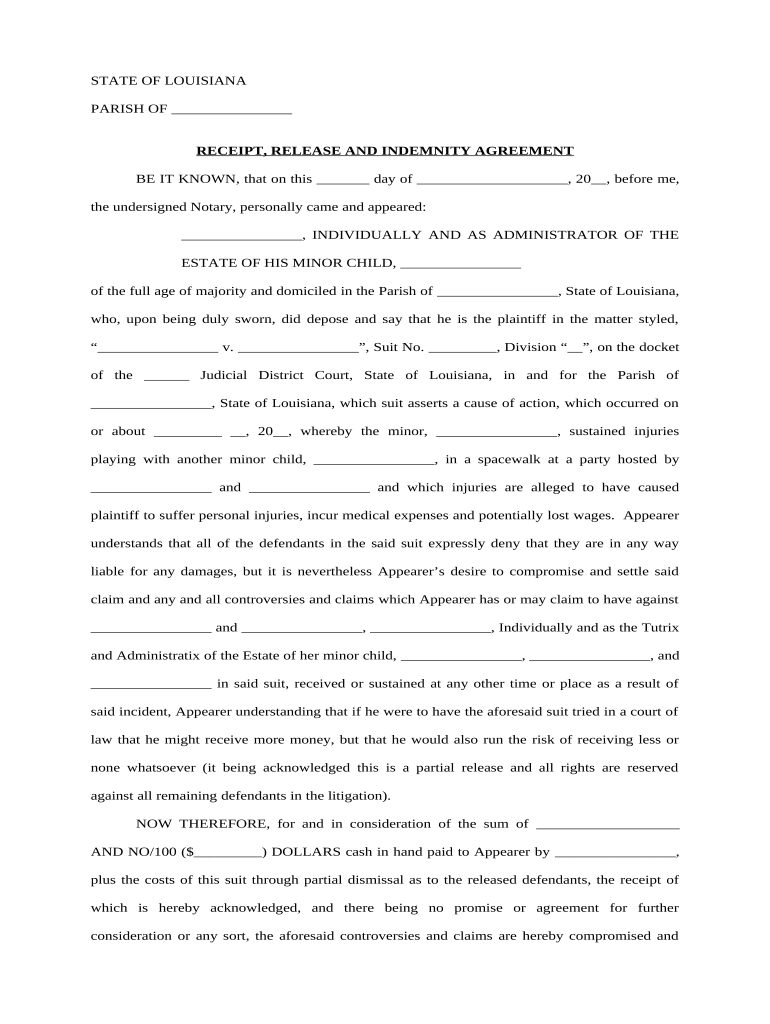
The Louisiana Receipt, Release and Indemnity Agreement is a written contract used to confirm receipt of payment or goods, release specified claims, and shift indemnity obligations between parties under Louisiana law. It typically combines a receipt clause acknowledging payment, a release clause extinguishing specified claims, and an indemnity clause allocating responsibility for third-party claims or losses. Because Louisiana follows a civil-law tradition, drafting often uses precise statutory language and clear obligations; parties frequently address governing law, damages limits, and notarization or witness practices to ensure enforceability and reduce future disputes.

Why this agreement matters for closing claims and transactions

A clear receipt, release and indemnity agreement finalizes financial exchanges, limits future liability, and documents who assumes costs of third-party claims. Well-drafted terms reduce litigation risk and help enforce the parties’ expectations in settlement, construction, property damage, or commercial dispute contexts.

Why this agreement matters for closing claims and transactions

Who typically completes and signs this form

This agreement is commonly used by individuals and entities resolving claims, contractors completing projects, insurance adjusters settling losses, and businesses closing commercial transactions.

  • Contractors and subcontractors executing final waivers after project payment.
  • Insurers and claimants finalizing settlement amounts and extinguishing claims.
  • Buyers or sellers recording receipt and transferring risk after payment.

Representative signers and their roles

Contractor — Project Manager

A company project manager signs to confirm receipt of contract payment, to release specified owner claims related to completed work, and to accept indemnity terms protecting the owner from subcontractor defects.

Claimant — Attorney

A claimant or their attorney signs to accept a settlement payment, release defined claims, and agree that the payer will be indemnified against subsequent third-party demands within the scope defined in the agreement.

Core clauses to include in a professional Louisiana agreement

A robust agreement groups key provisions: receipt acknowledgment, express release language, indemnity obligations, consideration, representations and warranties, and the signature and execution block with dates and identities.

Receipt

A clear statement of what was paid or transferred, including amount, method, and the date funds or property changed hands, to eliminate later dispute about consideration.
Release

Precise release language identifying the claims released, whether known or unknown, and any carve-outs for future claims or fraud, ensuring the scope is enforceable under Louisiana law.

Indemnity

Allocation of responsibility for third-party claims, including defense obligations, limitations on indemnity, and whether indemnity survives termination or completion.

Consideration

Statement of the agreed consideration — dollar amount or other value — and confirmation that consideration supports the release and indemnity.

Representations

Key factual assertions by the parties (authority to sign, no outstanding liens) that support enforceability and provide bases for breach remedies.

Execution

Signature blocks with printed names, titles, dates, and any required notarization or witness lines to match state or transaction-specific requirements.

Security and compliance considerations

Encryption: AES-256 at rest; TLS 1.2/1.3 in transit
Audit Trail: Timestamp, IP, and action log
HIPAA: BAA required for PHI
ESIGN / UETA: Federal and state e-sign authority
Access Controls: Role-based permissions enforced
Certifications: SOC 2 Type II, ISO 27001

Step-by-step: completing the agreement

Follow these steps to prepare, sign, and record a clear receipt, release and indemnity agreement in Louisiana.

  • 01
    Assemble facts: Confirm payment amount, dates, and parties
  • 02
    Draft clauses: Insert clear release, indemnity, and consideration language
  • 03
    Verify identities: Match legal names and TINs where required
  • 04
    Execute properly: Sign, date, notarize, and witness if needed

How execution and routing commonly proceed

Typical execution workflows use a sender–signer sequence, optionally include notarization, and produce a final signed copy with an audit trail.

  • Upload: Sender uploads the agreement PDF or DOCX
  • Place fields: Add signature, date, and initial fields
  • Signers authenticate: Signers confirm identity and sign
  • Record: System issues signed copy and audit log

Common digital workflow settings to configure

Configure authentication, field requirements, and retention so the executed document meets legal and organizational needs.

Field Configuration
Signature Authentication Email with optional SMS code
Notary Requirement Enable remote notarization when applicable
Mandatory Fields Make name, date, and payment fields required
Retention Policy Set automated archival and export settings

Delivery channels and platform technical needs

Ensure the chosen platform supports required authentication, notarization, and secure archival to preserve enforceability and compliance.

  • Formats Supported: PDF, DOCX, HTML, Excel
  • Integrations: Salesforce, NetSuite, Google Workspace
  • Authentication: Email, SMS, KBA, or advanced methods

Key timing considerations and typical deadlines

Track execution, payment, and retention timelines so releases take effect and compliance obligations are met.

Execution date:

Date the parties sign; governs when release takes effect

Payment deadline:

Specify when payment must be delivered to satisfy the receipt

Notary recording:

If notarized, note any state filing or recording deadlines

Statute of limitations:

Effective date may affect time limits to bring future claims

Record retention:

Follow retention policies tied to industry and tax rules

Milestones from negotiation through post-execution

Sequential milestones help manage obligations from initial settlement to long-term recordkeeping.

01

Negotiation and Terms

Agree on payment, scope of release, and indemnity limits

02

Drafting and Review

Prepare language and obtain legal or insurance review

03

Execution and Notarization

Sign, date, and notarize or witness as required

04

Payment and Closure

Exchange payment and archive executed documents

Common drafting and completion errors to avoid

  • Vague release language that fails to identify claims or time periods and leaves room for later interpretation.
  • Omitting exact consideration or using ambiguous payment terms that lead to disputes about whether the release was supported.
  • Mismatched party names, titles, or missing authority signatures that create grounds to challenge enforceability.
  • Skipping notarization or witness steps when state or contract-specific requirements make them necessary for recordability.

Potential legal risks and consequences

Unenforceable Release: May be voidable
Indemnity Exposure: Unexpected third-party cost
Fraud Claim: Fraud exceptions survive release
Tax Issues: Incorrect reporting triggers penalties
Notary Defect: Improper notarization can invalidate parts
Recordkeeping Failure: Loss of evidence for enforcement

eSignature pricing and capability snapshot for signing and storing releases

Compare starting prices and key capabilities among common eSignature providers; signNow is listed first per table convention.

signNow DocuSign Adobe Sign PandaDoc HelloSign
Starting Price $8/user/mo $15/user/mo $14/user/mo $19/user/mo $15/user/mo
Free Trial Yes — 7-day trial Yes — trial available Yes — trial available Yes — trial available Yes — trial available
Bulk Send Yes Yes Yes Yes No
Audit Trail Yes Yes Yes Yes Yes
HIPAA Compliant Yes Yes Yes No No

Examples of how organizations use the agreement

Real-world uses show how the form resolves payments, closes claims, and allocates risk.

Construction Closeout

A contractor accepted final payment and signed a release to close a job

  • The release included a lien waiver point to protect the owner
  • After execution and payment, both parties archived the signed agreement and the owner avoided later lien claims by subcontractors.

Insurance Settlement

An insurer paid a claimant a negotiated sum and required a release of specified tort claims

  • The release included mutual indemnity for third-party subrogation
  • The insurer retained the signed release for regulatory and audit purposes.

Frequently asked questions and practical answers

Answers to common legal and technical questions about using and enforcing a Louisiana Receipt, Release and Indemnity Agreement.


Need help? Contact support

be ready to get more
Join over 28 million airSlate SignNow users