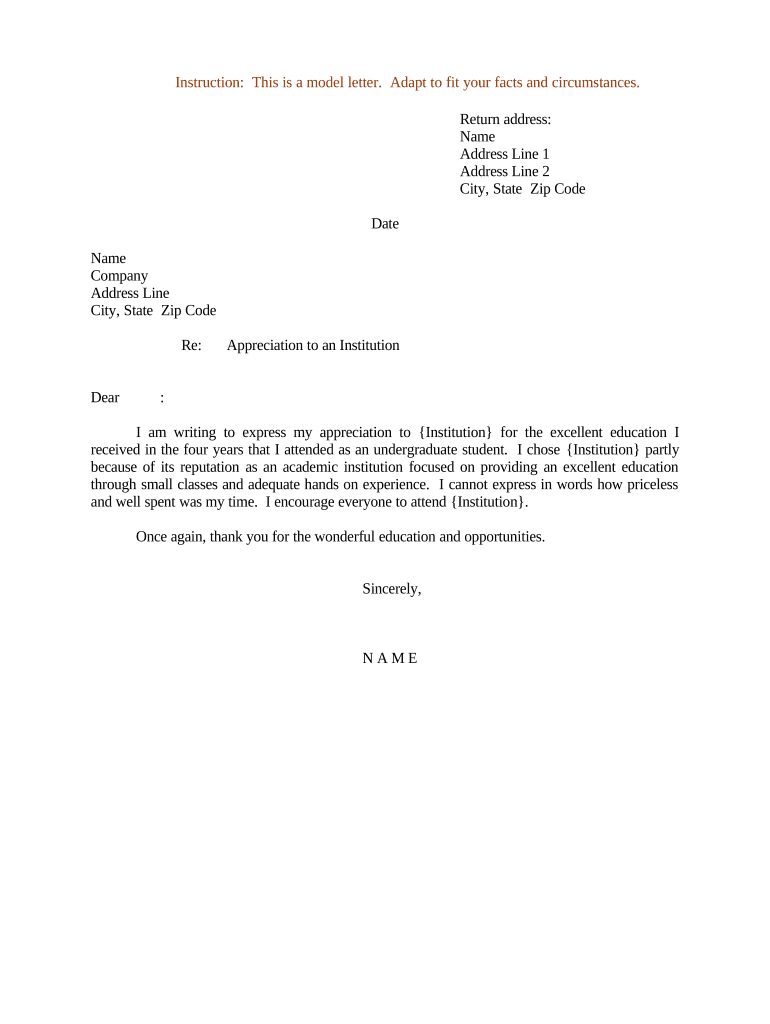
Letter of Appreciation to an Institution
What the Letter of Appreciation to an Institution Is and when to use it
Why a clear, formal letter matters
A properly drafted Letter of Appreciation preserves institutional goodwill, creates a documented acknowledgment for auditors and funders, and supports future requests or collaborative reporting. It clarifies what is being recognized and provides a concise record for internal and external stakeholders.
Who commonly prepares and sends these letters
Organizations and individuals prepare letters of appreciation when acknowledging institutional support, partnership, or services. Typical senders vary by context.
- Alumni relations officers or development staff recognizing donor support or sponsored programs.
- Department heads or program managers acknowledging partner institutions after joint events or research collaborations.
- Grant administrators or nonprofit directors documenting institutional contributions for reporting.
The recipient is usually a named institutional contact (director, department chair, or communications office); include a copy to records or development teams for institutional filing.
Step-by-step: drafting and sending the letter
-
01Draft: Write a concise opening, factual reason for thanks, and closing with contact details.
-
02Internal review: Obtain approval from program manager or legal if grant wording or privacy is involved.
-
03Sign: Authorized representative signs and dates the letter; include title and organization.
-
04Deliver: Send via the agreed institutional channel (email, official mail, or secure eDelivery).
How to configure a digital workflow for this letter
| Template name | Standardized Letter of Appreciation template |
|---|---|
| Required fields | Institution name | Recipient name | Date | Reference |
| Approval step | Program manager approval required before signature |
| Signature type | Typed or eSignature with audit trail |
| Archival | Auto-save signed copy to institutional records folder |
Delivery methods and technical considerations
Choose a delivery channel that matches institutional preferences and recordkeeping rules; some require original paper, others accept email or secure electronic delivery.
- Email (PDF): Common, fast, accepted by many offices for routine acknowledgments
- Certified mail: Provides proof of delivery and is preferred for formal institutional records
- Secure eDelivery: Use a signed PDF with an audit trail when the institution permits electronic records
Confirm the institution’s preferred channel before sending to prevent rejections and ensure proper archiving; retain delivery evidence regardless of method.
Where the completed letter typically goes next
-
Recipient office: Direct to named recipient and their administrative office
-
Communications: Send copy to communications or public affairs if publicity is authorized
-
Development: Include development/fundraising teams for donor acknowledgments
-
Internal records: Archive signed copy in your organization’s document management system
Timing expectations and typical deadlines
Send promptly:
Within 2 weeks of the event or support to maximize relevance
Grant reporting:
Align letter date with interim or final report deadlines for funders
Publicity windows:
Coordinate with communications if press or web acknowledgement is planned
Archival:
Store signed copy within 7 days of sending
Follow-up:
Schedule a thank-you follow-up 4–6 weeks after delivery if appropriate
Key milestones from draft to archive
Draft Completed
Finalized content ready for internal review and edits.
Internal Approval
Manager or grant officer confirms wording and references.
Signature Obtained
Authorized signer applies signature and dates the letter.
Delivery & Archive
Letter delivered to recipient and archived in records.
Common pitfalls to avoid when preparing the letter
- Using informal language or vague praise that fails to document specific services or dates, which weakens the letter’s usefulness for records.
- Addressing the wrong recipient or omitting a department, causing delays in institutional acknowledgment or internal misrouting.
- Neglecting to include reference numbers or grant IDs, making it difficult to reconcile the letter with financial or program reports.
- Failing to retain a signed copy and delivery proof, which can complicate audits or future verification requests.
Consequences of incorrect or incomplete letters
Two common use examples
University partnership
A community group thanks a university department for co-hosting a public forum, citing event date and scope
- Letter includes event reference and grant number to support reporting
- The institution uses the letter for its donor relations file and the sender archives the signed copy for grant reconciliation.
Hospital collaboration
A nonprofit acknowledges a hospital’s clinical training support for volunteers, noting dates and scope
- The letter avoids PHI and includes institutional contact for publicity permission
- Both parties retain the signed copy in their compliance records for six years.
eSignature vendor comparison for sending and archiving letters
| signNow | DocuSign | Adobe Sign | PandaDoc | HelloSign | |
|---|---|---|---|---|---|
| Starting Price | $8/user/mo | $15/user/mo | $14/user/mo | $19/user/mo | $15/user/mo |
| Free Trial | 7-day free trial | Check vendor site | Check vendor site | Check vendor site | Check vendor site |
| Bulk Send | Yes | Yes | Yes | Yes | No |
| Audit Trail | Yes | Yes | Yes | Yes | Yes |
| HIPAA Compliant | Yes | Yes | Yes | No | No |
Frequently asked questions about Letters of Appreciation to Institutions
-
Are electronically signed letters legally valid?
Yes. Electronic signatures are legally enforceable under the federal ESIGN Act (15 U.S.C. ch. 96) and UETA where adopted, provided the signature demonstrates intent, consent, attribution, and retention capability.
-
Who should sign on behalf of an organization?
An authorized representative—such as an executive, director, or delegated program manager—should sign. Verify internal delegation policies; an unauthorized signer can lead the institution to reject the letter.
-
Do I need notarization or witnesses?
Most letters of appreciation do not require notarization, but specific institutional policies or state laws may demand notarization or witnesses for formal acknowledgments; check the receiving institution or state notary rules first.
-
How do I correct a mistake after sending?
Issue a corrected letter referencing the original date and noting the correction. Keep both the original and corrected versions in your records. For eSigned copies, reissue and capture the new audit trail.
-
Can a letter include grant or contract details?
Yes, include grant numbers or contract IDs where relevant. Avoid including protected personal data without proper authorization, and follow institutional disclosure policies for public acknowledgments.
-
How long should I keep a signed copy?
Retain the signed letter according to applicable standards: at least three years for IRS-related records (IRC §6501(a)), and six years for HIPAA-related documentation (45 CFR §164.530(j)), or longer if required by state law.