Establishing secure connection…Loading editor…Preparing document…

Letter Transmitting Payment for Medical Bill

This template is fully customizable. Edit the text, fill out the fields, and send it for signature. Give it a try!
Letter Transmitting Payment for Medical Bill

What the Letter Transmitting Payment for Medical Bill Is

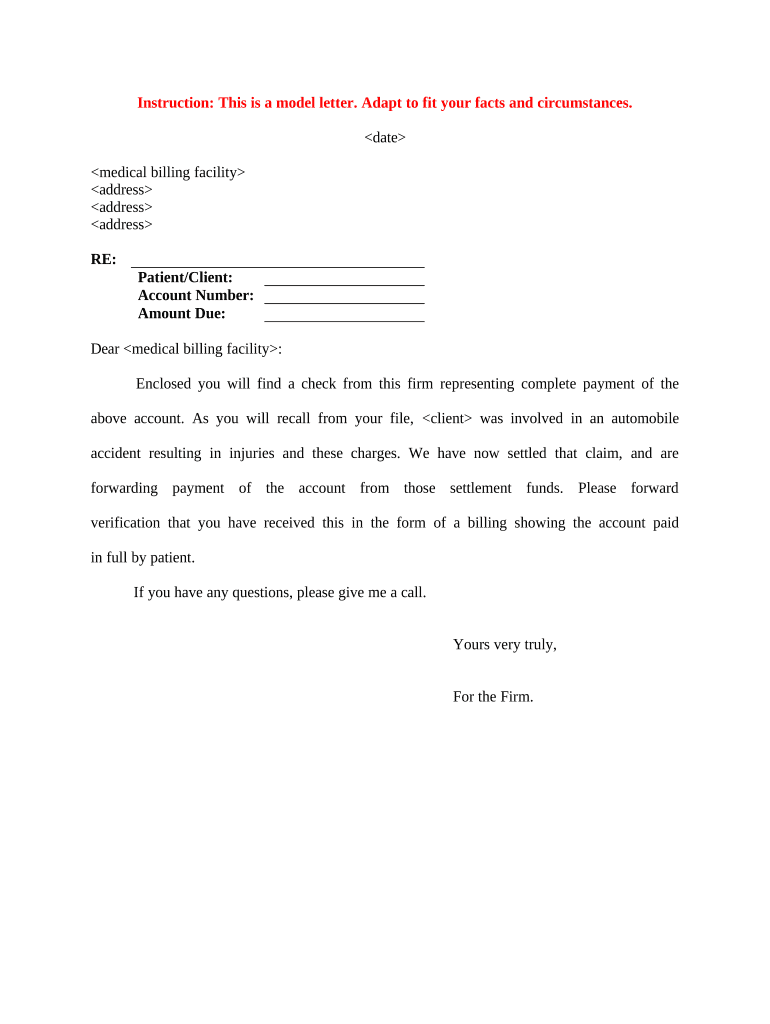
A Letter Transmitting Payment for Medical Bill is a short written cover letter sent with payment to a healthcare provider, insurer, or billing agent that identifies the invoice being paid, the payer, the payment method, and any remittance instructions. The letter creates a clear paper or electronic trail linking the payment to a particular account, claim, or statement number and documents any partial payments, disputes, or payment plans. It is routinely used by patients, employers, insurers, and third-party payers to reduce accounting errors and speed reconciliation.

Why you should include a payment transmittal letter

A concise transmittal letter reduces misapplied payments, clarifies payer intent, and preserves evidence of satisfaction or dispute. It supports accurate posting to patient accounts and can be important if later collection or insurance coordination is required.

Why you should include a payment transmittal letter

Who typically prepares or receives this letter

Use the letter when you need to document payment purpose, attach a supporting remittance stub, or create a clear audit trail for reconciliation.

  • Patients making direct payments to a provider or clinic for services rendered.
  • Employers or benefits administrators sending premium or claims payments on behalf of employees.
  • Insurance companies or third-party administrators remitting contractually required amounts.

Essential parts of a professional payment transmittal letter

A professional letter is concise, dated, and clearly links payment to the relevant invoice, account, or claim number. It identifies payer and payee, describes the payment method, and includes contact details for follow-up.

Header

Date and sender contact information placed at the top for identification and future correspondence.
Payee Details

Full name and billing address of the provider or billing service as shown on the invoice or remittance instructions.

Account Reference

State the patient name, account number, invoice number, claim number, or date of service to ensure correct posting.

Payment Details

Specify amount paid, currency, payment method (check, ACH, card), check number or transaction ID, and payment date.

Allocation Notes

If paying multiple invoices or a partial amount, list how the funds should be applied or note any disputed charges.

Signature

Include a signer name, title (if organization), and a signature or e-signature with a date to show payer authorization.

Step-by-step: prepare and send the letter

Follow these steps to create a clear, auditable transmittal when sending payment for a medical bill.

  • 01
    1. Verify: Confirm invoice details and payee information before preparing payment.
  • 02
    2. Draft: Write a short letter including date, payer, invoice number, and payment amount.
  • 03
    3. Attach: Include a copy of the invoice or remittance stub and proof of payment if electronic.
  • 04
    4. Send: Transmit via the provider's preferred channel and retain a copy for records.

How to set up an online payment-and-transmittal workflow

Configure a repeatable online process to attach transmittal letters to payment transactions and capture remittance information automatically.

Field Configuration
Upload Document Attach invoice PDF and transmittal letter to the payment record.
Auto-fill Fields Map invoice number and patient ID to the letter using template fields.
Authentication Require signer email and optional SMS code for payer identity confirmation.
Delivery Method Send combined remittance package via secure email, EDI, or provider portal.

Typical routing for a payment transmittal package

Payments and letters often pass through a few common routing steps; understanding each helps ensure timely posting.

  • Prepare: Payer generates letter and includes invoice reference.
  • Attach: Letter attaches to check or electronic payment confirmation.
  • Transmit: Sender mails or electronically sends remittance to provider billing.
  • Post: Provider posts payment to patient account using referenced invoice number.

Delivery and eSubmission options

Use secure electronic delivery when possible to speed posting; ensure the channel provides confirmation and an audit trail.

  • Mail: Paper check with attached letter
  • Secure Email: Encrypted PDF remittance
  • Provider Portal: Upload remittance to billing portal

Timing considerations and expected processing

Plan for provider-specific posting times; electronic receipts post faster than mailed checks. Allow buffer time for reconciliation.

Check Mailing Time:

Allow 5–10 business days for mailed checks to be received and processed.

Electronic Transfers:

ACH or card payments often post within 1–3 business days after confirmation.

Provider Posting:

Billing departments commonly take 3–7 business days to post payments.

Dispute Response:

Expect 30–60 days for investigation if charges are disputed.

Record Retention:

Keep proof of payment until account reconciliation is confirmed.

Key milestones from payment to reconciliation

Track these sequential milestones to confirm payment success and resolve posting issues promptly.

01

Payment Initiated

Date payer issues payment or initiates electronic transfer.

02

Receipt Acknowledged

Provider confirms receipt or posts payment to account.

03

Reconciliation

Finance team matches posted payment to invoice and updates records.

04

Dispute Closed

Any unresolved amount or credit is adjusted or refunded.

Common mistakes to avoid

  • Omitting the invoice or account number, which often causes funds to be misapplied and delays reconciliation.
  • Using inconsistent payer names or abbreviations that do not match banking or account records, triggering identity checks.
  • Failing to keep proof of delivery or transaction ID for electronic payments, complicating any subsequent dispute.
  • Not indicating allocation for partial payments, which can leave balances open or prompt collection notices.

Risks and consequences of errors

Misapplied Payment: May trigger collection activity and late fees.
Duplicate Payment: Can result in administrative delays to obtain refund.
Privacy Exposure: Unsecured transmittal may violate HIPAA rules.
Missing Documentation: Weakens audit trail for reimbursement claims.
Disputed Allocation: Prolongs reconciliation and may incur interest.
Incorrect Payee: Payment to wrong party can be difficult to recover.

Required information to include for secure processing

Payer ID: Tax ID or employer ID
Patient Details: Full name and DOB
Account Number: Provider invoice or account ID
Payment Proof: Check image or transaction ID
Contact Info: Phone and monitored email
Authorization: Signed authorization if required

Pricing and feature snapshot for eSignature vendors

Compare basic pricing and key features relevant to transmittal and remittance workflows; signNow is listed first per standard comparison ordering.

signNow DocuSign Adobe Sign PandaDoc HelloSign
Starting Price $8/user/mo $15/user/mo $14/user/mo $19/user/mo $15/user/mo
Free Trial 7-day free trial Varies Varies Varies Varies
Bulk Send Yes Yes Yes Yes Yes
Audit Trail Yes Yes Yes Yes Yes
HIPAA Compliant Yes Yes Yes No No

Frequently asked questions about payment transmittal letters

Answers to common operational and legal questions when sending payment with a transmittal letter.


Need help? Contact support

be ready to get more
Join over 28 million airSlate SignNow users