Establishing secure connection…Loading editor…Preparing document…

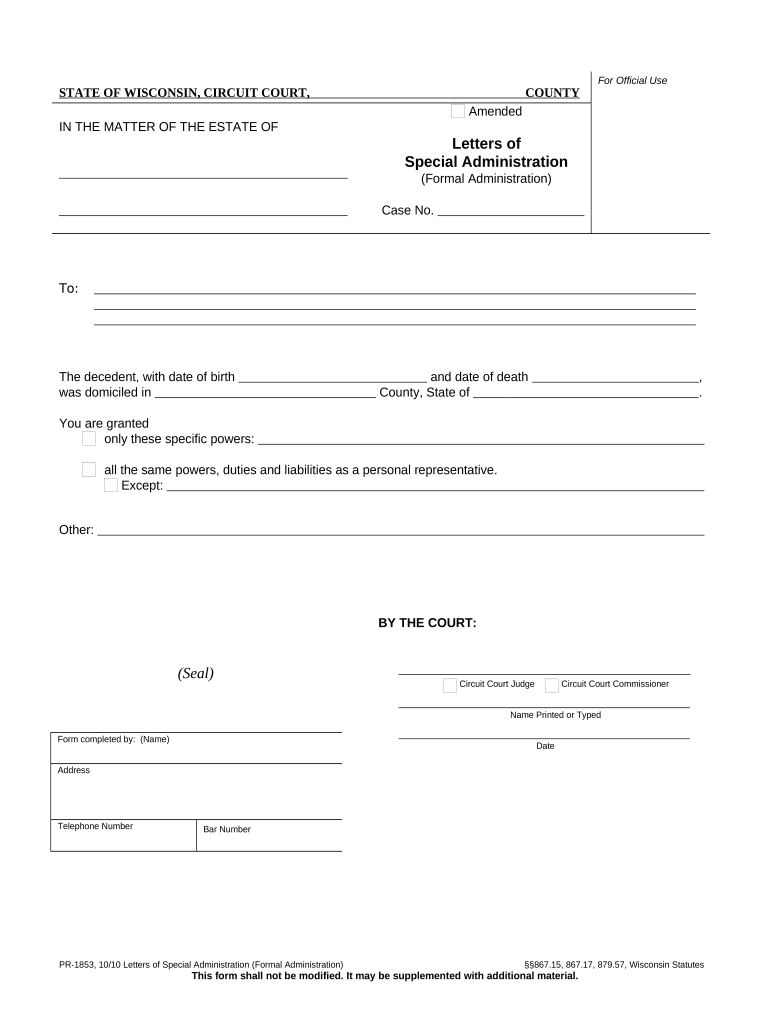
Wisconsin Letters of Special Administration

This template is fully customizable. Edit the text, fill out the fields, and send it for signature. Give it a try!
Wisconsin Letters of Special Administration

What Wisconsin Letters of Special Administration Are

A Wisconsin Letters of Special Administration is a court-issued document granting a person limited authority to manage a decedent's assets and affairs when a full probate administrator or executor is not yet appointed or when specific, short-term authority is needed. It is issued by the county probate court after a petitioner files a petition and the court determines a temporary need for administration to preserve estate property or pay urgent debts.

Why Letters of Special Administration Matter in Probate

Letters of Special Administration allow prompt, court-authorized action to protect estate assets, pay immediate bills, or prevent loss while full administration is pending; they reduce risk to heirs and preserve value during short-term or emergency estate matters.

Why Letters of Special Administration Matter in Probate

Who files and benefits from these Letters

After Letters of Special Administration expire or are superseded, actions taken under them are subject to review by the probate court and final estate administration procedures.

  • Personal representatives or nominated administrators who must secure assets immediately.
  • Creditors or bill‑paying agents seeking court authority to settle urgent debts.
  • Banks, title companies, or agents resolving locked accounts or property transfers.

Typical signers and document owners

Personal Representative

An individual (often a next of kin) who petitions for temporary authority to secure assets, pay urgent bills, or preserve property pending full probate; may be required to post bond per court order.

Probate Attorney

An attorney representing the petitioner who prepares the petition, evidentiary affidavits, and supporting documents; counsel typically appears at the hearing to explain urgency and requested scope of authority.

Security and compliance considerations for documents

Encryption: TLS 1.2/1.3 in transit; AES-256 at rest
Audit Trail: Detailed signer IP, timestamp, and action logs
HIPAA: Compliant when BAA in place
ESIGN / UETA: Meets federal and state e‑signature standards
21 CFR Part 11: Supported for regulated records where required
Access Controls: SSO, MFA, and role-based permissions available

Core components of a professional petition package

A complete petition package for Letters of Special Administration organizes petition forms, a decedent inventory, notice documents, affidavits, and any bond or surety information the court requires for temporary authority.

Petition

Completes the formal request naming petitioner, relationship to decedent, and limited powers sought; must state urgency and facts supporting temporary authority.
Affidavit

Sworn statement establishing grounds for special administration, copies of death certificate, and attestation of lack of appointed executor if applicable.

Inventory

Preliminary list of known estate assets and locations to justify immediate protective action and to inform bond calculations if required.

Notices

Proof of service or notice to heirs and interested parties per local court rules; required to protect due process rights.

Bond (if required)

Court‑ordered security to protect estate against improper acts by the temporary administrator; amount determined by the court.

Court Order

Signed judicial order that issues the Letters of Special Administration and specifies powers, duration, and reporting requirements.

Step-by-step: Filing for Letters of Special Administration

Follow these core steps to request temporary authority from the probate court; some counties provide e‑filing or local forms so verify with the clerk.

  • 01
    Prepare petition: Complete petition and attach death certificate and affidavit.
  • 02
    Serve notice: Provide required notices to heirs and interested parties.
  • 03
    Attend hearing: Appear or submit proof of service; explain urgency to the judge.
  • 04
    Receive letters: Court signs order and issues Letters of Special Administration.

Typical eSubmission and court routing workflow

Electronic workflows streamline petition assembly, signer authentication, and court submission; court acceptance varies by jurisdiction so confirm local e‑filing rules in advance.

  • Upload documents: Add petition, affidavits, and attachments in PDF or DOCX.
  • Place fields: Add signature, date, and initial fields as required.
  • Authenticate signer: Use email code or stronger ID proofing before signing.
  • Export for filing: Download signed package and submit via court e‑file or clerk.

Configuring a secure digital workflow for petitions

Set up your e-sign and document routing to match court requirements and reduce manual handoffs.

Field Configuration
Authentication Level Email code or SMS OTP; use KBA where required
Document Format PDF/A preferred for court submissions
Retention Policy Retain signed copy plus audit trail for minimum statutory period
Access Controls Use role-based access and SSO for attorneys

Digital signing and technical requirements

Verify local court e‑filing and record retention rules; keep a certified paper copy if the court requires an original for filing.

  • File types: PDF, DOCX accepted by most courts and platforms
  • Integrations: Connectors available for Microsoft 365, Google Workspace, and case management systems
  • Security: TLS, AES-256, SOC 2 and ISO 27001 controls recommended

Timing and processing expectations

Timing for hearings and issuance depends on county docket and urgency; start early to allow for notice periods and court scheduling.

File promptly:

File as soon as immediate action is needed

Notice period:

Provide notice per county rules before hearing

Hearing timeline:

Court schedules within 2–8 weeks typically

Order issuance:

Letters often issued the same day or after hearing

Expiration:

Letters expire per court order or when full administrator appointed

Common errors that cause delays

  • Incorrect petitioner name or inconsistent ID documents
  • Missing death certificate or proof of interest
  • Insufficient notice to heirs or interested parties
  • Omitting required bond or security information

Risks and legal consequences of errors

Delayed administration: Court may postpone authority
Personal liability: Administrator may be liable for improper acts
Bond forfeiture: Surety may be called if estate harmed
Creditor exposure: Unpaid debts may accrue penalties
Court sanctions: Potential sanctions for noncompliance
Tax issues: Estate tax reporting obligations remain

Download formats and supporting documents to include

Prepare a complete packet in court-preferred formats and include certified supporting documents to avoid acceptance delays.

Preferred Formats

PDF/A for final submission; DOCX for drafts and edits

Death Certificate

Certified copy required by most courts

Proof of Service

Affidavits showing notice to heirs and interested parties

Bond Documents

Surety or bond affidavit if the court orders security

Practical tips for accurate, efficient petitions

Use a checklist and local court form set; double-check names, attach certified documents, and confirm notice recipients to speed review and issuance.

Use local forms where available
Counties may provide templates; using them reduces clerk clarifications and rejections.
Attach certified documents
Attach certified death certificate and ID to avoid verification delays and save multiple requests.
Confirm service list
Verify heirs and interested parties to prevent later rehearings or contested notices.
Clarify requested powers
Specify exact temporary authorities and duration to avoid overly broad or denied requests.

How to amend or extend Letters of Special Administration

If conditions change, seek modification or extension through the probate court with supporting affidavits and notice to interested parties.

01

Prepare amendment:

Draft motion explaining changed circumstances
02

Gather evidence:

Attach affidavits and updated inventory
03

Serve parties:

Provide notice of motion per local rules
04

Court hearing:

Appear or submit papers for the court's review
05

Obtain order:

Judge signs modification or sets new limitations
06

Update records:

File amended documents and distribute certified copies

Illustrative examples of when Letters are used

These brief scenarios show typical circumstances where a court issues Letters of Special Administration to address immediate estate needs.

Emergency Asset Protection

A decedent’s home required immediate maintenance to avoid damage

  • Petitioner sought limited authority to hire contractors and pay invoices
  • The court granted short-term letters permitting repairs and bill payment pending full probate, preserving property value and preventing creditor claims.

Urgent Bill Payment

An estate had urgent utility and mortgage obligations due imminently

  • Temporary authority was needed to prevent foreclosure or service termination
  • The court issued Letters of Special Administration enabling payment of critical bills while an executor was located and full administration was arranged.

eSignature pricing comparison for handling probate documents

Comparison of typical starting prices and key features across common eSignature providers; signNow is listed first per platform naming conventions.

signNow DocuSign Adobe Sign PandaDoc HelloSign
Starting Price $8/user/mo $15/user/mo $14/user/mo $19/user/mo $15/user/mo
Free Trial 7-day free trial, no card Varies by plan Varies by plan Varies by plan Varies by plan
Bulk Send Yes (Premium) Yes Yes Yes No
Audit Trail Yes Yes Yes Yes Yes
HIPAA Compliant Yes Yes Yes No No

Frequently asked questions about Letters of Special Administration

Answers to common questions about purpose, e-signing, timing, and required attachments when petitioning for Letters of Special Administration.


Need help? Contact support

be ready to get more
Join over 28 million airSlate SignNow users