Establishing secure connection…Loading editor…Preparing document…

Limited Liability Partnership Agreement

This template is fully customizable. Edit the text, fill out the fields, and send it for signature. Give it a try!
Limited Liability Partnership Agreement

What a Limited Liability Partnership Agreement Is and Why It Matters

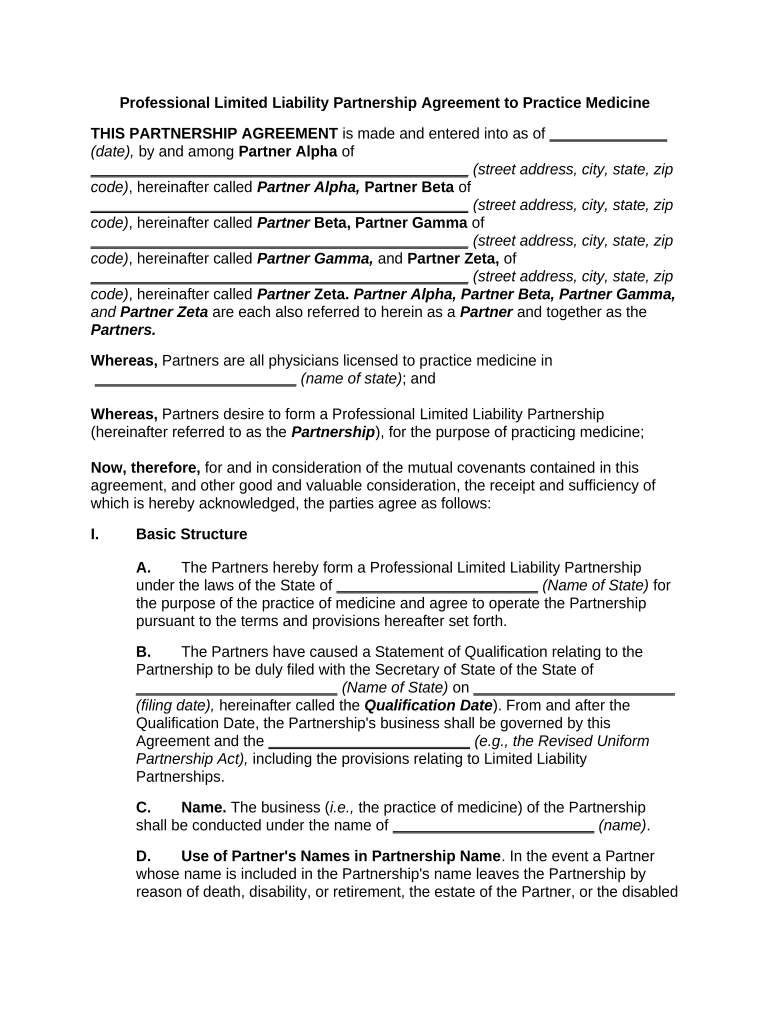
A Limited Liability Partnership Agreement (LLP Agreement) is a legal contract among partners that defines the partnership's purpose, management structure, capital contributions, profit and loss allocation, and the scope of limited liability protection. For professional practices (law, accounting, medical) and other eligible businesses, the agreement clarifies roles and reduces disputes by documenting decision‑making authority, withdrawal and admission procedures, dispute resolution mechanisms, and dissolution terms. Although states set formation and registration rules, the written agreement governs internal relations and is the primary reference for creditors, tax preparers, and courts when interpreting partners' rights and obligations.

Why a Clear LLP Agreement Benefits Partners and Third Parties

A well‑drafted LLP Agreement reduces ambiguity, limits personal liability for partner malpractice in many jurisdictions, and provides a governance framework that supports operations, banking, insurance, and tax compliance.

Why a Clear LLP Agreement Benefits Partners and Third Parties

Who Typically Prepares and Signs an LLP Agreement

LLP Agreements are prepared by partners, business attorneys, or in‑house counsel and are reviewed by accountants and compliance officers before execution.

  • Small professional firms where partners share management and professional liability.
  • Investor groups forming a partnership with limited personal liability exposure.
  • Established practices transitioning ownership or reorganizing governance.

Final execution usually requires signatures from all named partners; counsel often recommends retaining an executed original and distributing certified copies to partners and the partnership's accountant.

Key Signers and Their Roles

Managing Partner

The Managing Partner signs on behalf of the firm for operational matters and often has authority to bind the partnership under ordinary business transactions; specify limits of authority in the agreement to avoid unauthorized commitments.

Partner Signatories

Each named partner signs to acknowledge capital contributions, profit allocations, and fiduciary duties; signatures should match legal names on government ID to ensure enforceability and accurate tax reporting.

Core Elements to Include in a Professional LLP Agreement

An effective agreement balances clarity and flexibility: define parties, set capital and profit rules, designate management, include liability protections, and establish amendment and exit procedures.

Parties & Definitions

Identify the partnership name, principal place of business, and define key terms used throughout the agreement to avoid later interpretation disputes.
Business Purpose

State the partnership's permitted business activities and any professional restrictions so partners and regulators understand the scope of operations.

Capital Contributions

Describe initial and future contribution obligations, treatment of loans versus capital, and consequences for missed contributions to protect financial stability.

Profit & Loss Allocation

Specify the method of allocating profits and losses, timing of distributions, and any preferred return or guaranteed payment arrangements.

Management & Voting

Set decision‑making rules: who manages, voting thresholds for routine and major decisions, and procedures for resolving deadlocks.

Liability & Indemnification

Limit partner liability to the extent permitted by state law, include indemnity provisions, and describe insurance or bonding requirements for partners.

Stepwise Process to Complete and Execute the Agreement

Follow a consistent sequence: prepare, review, execute, and record or store the signed agreement.

  • 01
    Prepare Draft: Populate names, contributions, and governance provisions.
  • 02
    Partner Review: Circulate draft for comments and reconcile differences.
  • 03
    Sign & Authenticate: Execute with required signatures, notarize if appropriate.
  • 04
    Distribute & Store: Provide executed copies to partners and maintain a secure original.

Digital Workflow Settings to Use When eSigning

Configure fields and authentication before sending to ensure a smooth eSign process and reliable audit evidence.

Field Configuration
Signature Fields Place named signature and date fields for each partner.
Signer Order Choose sequential or parallel signing depending on approval needs.
Authentication Use email plus SMS or ID verification for higher assurance.
Storage & Retention Enable secure storage with searchable audit trail.

Typical eSigning Flow for an LLP Agreement

Digital signing follows predictable steps from upload to final audit record; set authentication and order before sending.

  • Upload Document: Add the finalized PDF or DOCX to the signing platform.
  • Place Fields: Insert signature, initials, and date placeholders for each partner.
  • Send to Signers: Deliver via email link or bulk send with signer order.
  • Capture Audit Trail: Record timestamps, IPs, and authentication method.

Technical Requirements for Secure eSigning

Choose a platform that supports standard file formats, strong encryption, and an auditable signing trail.

  • File Formats: PDF, DOCX supported
  • Integrations: Connects to CRM and cloud storage
  • Security: TLS and AES encryption

Ensure the provider supports ESIGN and UETA compliance, offers configurable authentication (email, SMS, KBA where required), and retains a verifiable certificate of completion for enforcement and audit purposes.

Security and Compliance Features to Verify

Encryption: TLS 1.2/1.3; AES‑256 at rest
Audit Trail: Timestamps, IPs, action logs
HIPAA: BAA available when required
21 CFR Part 11: Supported for regulated records
SOC 2 Type II: Independent compliance report
ESIGN/UETA: Acts recognized for eSign validity

Common Legal and Operational Risks from Errors

Tax Penalties: Incorrect filings can trigger IRS penalties
Contract Invalidity: Missing signatures may affect enforceability
Unauthorized Signatory: Invalid signature authority can void actions
Notary Omission: Some jurisdictions require acknowledgements
I‑9 Noncompliance: Employment forms must meet DHS rules
Data Breach: Poor security risks PHI or financial exposure

Frequent Preparation Mistakes to Avoid

  • Using informal or ambiguous contribution descriptions that create valuation disputes during exit events or audits.
  • Failing to document decision‑making thresholds and voting procedures, which leads to deadlocks among partners.
  • Omitting explicit signature blocks for new or incoming partners, making later admissions procedurally unclear.
  • Neglecting to address tax allocations and guaranteed payments, which can produce unexpected partner tax liabilities.

Key Dates and Ongoing Compliance Tasks

Track effective dates, state filings, tax reporting, and regular recordkeeping to maintain compliance and preserve rights.

Effective Date:

Enter as MM/DD/YYYY; governs when obligations start.

State Filings:

File any required partnership registration per state rules.

Annual Reports:

Observe state annual report and franchise tax schedules.

Tax Returns:

Partnership return (Form 1065) annual deadlines apply.

Recordkeeping:

Maintain originals and signed copies for retention periods.

Typical Execution Milestones for an LLP Agreement

A standard lifecycle from drafting to storage includes drafting, review, signing, and secure retention milestones.

01

Draft Agreement

Create initial draft reflecting partner negotiations.

02

Partner Review

Circulate for legal and tax review and finalize terms.

03

Execute and Notarize

Collect partner signatures and notarize if required.

04

Store & Distribute

File where required and distribute executed copies.

How Different Firms Use LLP Agreements in Practice

Real examples show common clauses and operational variations among professional firms.

Optica Ventures LLC

A small advisory partnership documented unequal capital contributions and profit splits during formation

  • The agreement included a clear vesting schedule
  • This reduced partner disputes and provided a transparent exit mechanism for departing partners.

Martin Properties

A property management LLP used the agreement to limit liability for specific property operations

  • The document required separate project accounts
  • It clarified indemnities and insurance minimums to protect passive partners.

Frequently Asked Questions About LLP Agreements and eSigning

Answers to common questions about validity, signatures, notarization, and storage for Limited Liability Partnership Agreements.


Need help? Contact support

be ready to get more
Join over 28 million airSlate SignNow users