Establishing secure connection…Loading editor…Preparing document…

Louisiana Interrogatories

This template is fully customizable. Edit the text, fill out the fields, and send it for signature. Give it a try!
Louisiana Interrogatories

What Louisiana Interrogatories Are and how they fit into discovery

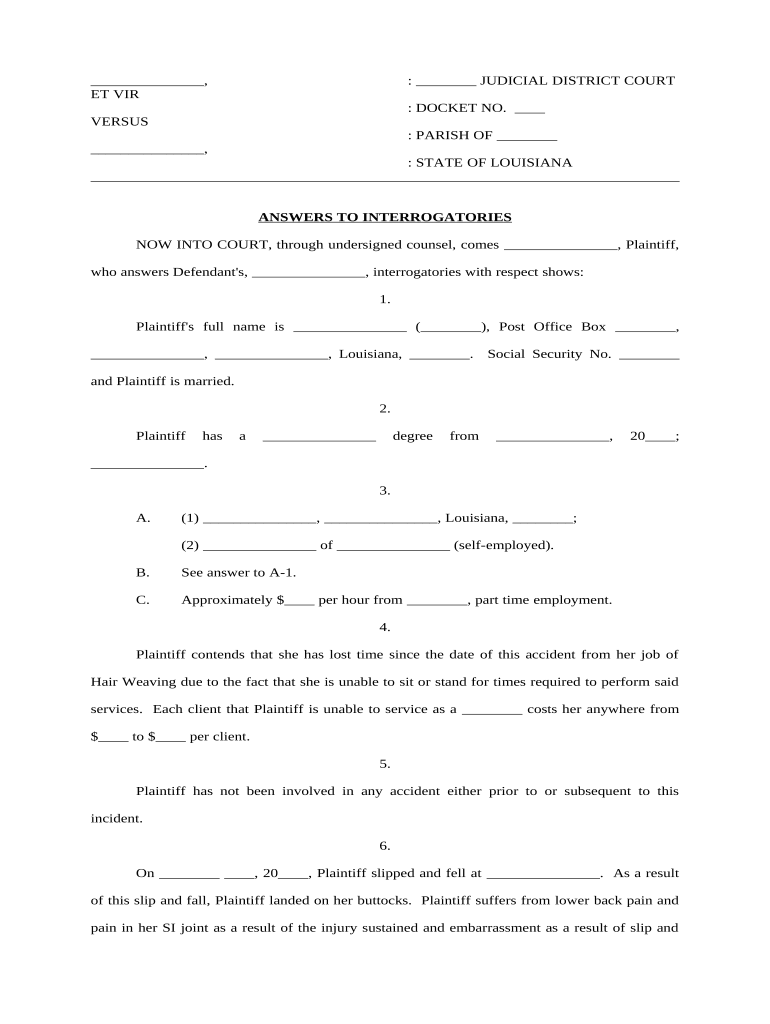
Louisiana Interrogatories are written questions one party serves on another during civil litigation to obtain facts, identify witnesses, and narrow disputed issues before trial. They form part of the discovery process under state civil procedure rules and are typically answered in writing and under oath. Responses may include admissions, objections, or a reference to produced documents. Parties often combine interrogatories with requests for production and requests for admissions to build the factual record and prepare for depositions, motions, or settlement discussions.

Why properly drafted interrogatories matter in Louisiana cases

Well-crafted interrogatories clarify facts early, reduce surprise at trial, preserve evidence, and narrow issues for motion practice; they help both sides focus discovery and manage costs while producing a written record under oath.

Why properly drafted interrogatories matter in Louisiana cases

Who prepares and responds to Louisiana Interrogatories

Cooperation between attorneys, clients, and support staff improves accuracy, reduces objections, and shortens the discovery timeline.

  • Plaintiff counsel preparing focused fact queries to support claims and damages calculations.
  • Defense attorneys using interrogatories to test plaintiff theories and narrow liability issues.
  • In-house counsel or paralegals organizing answers, coordinating documents, and tracking deadlines.

Step-by-step: preparing and serving interrogatories

Follow these practical steps to draft, serve, and manage interrogatories efficiently while preserving the record.

  • 01
    Draft Questions: Identify discrete facts you need; avoid compound questions.
  • 02
    Review Rules: Check local rules and court orders for limits and format.
  • 03
    Serve Opposing Party: Effect service per court rules — include certificate of service.
  • 04
    Track Responses: Log deadlines, objections, and follow-up document requests.

Configuring an online workflow for electronic interrogatory exchange

When using an e-filing or e-delivery workflow, set authentication, format, and retention rules to match court and opponent expectations.

Field Configuration
Authentication Email link plus SMS code or ID verification
Signature Type Typed, draw, or cryptographic signature supported
File Format PDF/A preferred for court filings
Audit Trail Capture timestamps, IP, and action history

Where interrogatories go after you finalize them

Interrogatories typically move from drafter to opposing counsel, then become part of the court record if filed; preserve copies at each transfer point.

  • Prepare: Finalize questions, numbering, and verification block.
  • Serve: Deliver to opposing counsel per service rules.
  • File (if required): File with the clerk when local rules or orders demand.
  • Archive: Retain executed copies and the service certificate.

Technical considerations for e-signatures and e-service

Use a platform that retains a detailed audit trail, stores signed records securely, and supports common integrations (case management, cloud storage) to simplify discovery logistics.

  • File Formats: PDF, DOCX accepted by many courts
  • Authentication: Email, SMS, KBA, or SSO
  • Integrations: Connects to case management and cloud storage

Typical timelines associated with interrogatory practice

Deadlines vary by court and case; the entries below represent common practice but always confirm local rules and any case-specific scheduling orders.

Response Period:

Commonly 30 days from service; confirm local rules or court order

Extension Requests:

Parties may negotiate or seek court-ordered extensions

Motion to Compel:

File after attempts to obtain complete responses and meet-and-confer

Supplementation:

Duty to supplement if new responsive information arises

Preservation:

Preserve documents and metadata from the outset

Key milestones in the interrogatory lifecycle

Track these sequential milestones to avoid waiver and to keep discovery on schedule.

01

Draft Complete

Questions finalized and verified before service.

02

Service Date

Count official days for response deadline from this date.

03

Initial Response

Responding party provides answers, objections, and documents.

04

Follow-up and Motions

Meet-and-confer, then motion to compel if necessary.

Common drafting and response mistakes to avoid

  • Asking compound or vague questions that invite objections and confusion.
  • Failing to number or label interrogatories consistently across documents and exhibits.
  • Overlooking the need to supplement responses when new information becomes available.
  • Serving or filing documents in the wrong format or missing the court's e-filing rules.

Potential consequences of deficient interrogatory practice

Motion Sanctions: Court may award costs and attorney fees
Compelled Answers: Court order to produce or answer fully
Evidentiary Limits: Incomplete discovery can limit trial evidence
Waiver: Untimely objections may be waived
Default Risks: Severe noncompliance can lead to default judgment
Credibility Harm: Inconsistent responses may hurt witness credibility

Essential metadata and tracking fields to include

Case Caption: Court/party/case title
Docket Number: Official case number
Service Date: Date served on opposing party
Interrogatory No.: Sequential question identifier
Respondent Name: Individual or entity answering
Verification: Signature and date under oath

Core sections of a professional Louisiana Interrogatories package

A complete interrogatories package combines clear instructions, definitions, numbered questions, and proper signature and service documentation to meet procedural expectations.

Instructions

Explain the scope, how to respond, and any definitions used to avoid ambiguous answers and objections during review.
Definitions

Define key terms and timeframes to ensure both parties interpret questions consistently and reduce disputes over scope.

Interrogatories

Numbered, discrete questions focused on facts, witnesses, and documents; avoid compound phrasing that invites objections.

Requests Cross-Referenced

Reference related document requests or admissions to streamline responses and reduce duplication.

Signature and Verification

Signature block with verification language showing the respondent answers under oath and includes the signer’s capacity.

Certificate of Service

Shows who served the document, how it was served, and the date — essential for deadline calculation.

Supporting documents commonly produced with interrogatory answers

Responses often accompany or reference produced documents and logs; include clear indices and privilege assertions where appropriate.

Document Production

Bates-stamped copies or native files responsive to requests referenced in answers, with clear cross-references to interrogatory numbers.

Privilege Log

Detailed log describing withheld documents, basis for privilege, date, sender, recipient, and subject matter summary.

Admissions

Answers admitting or denying factual statements when interrogatories are combined with requests for admission for efficiency.

Index or Exhibit List

Table mapping produced documents to interrogatory answers for easy reference during depositions and motions.

Practical examples of electronic workflows used alongside discovery

Below are two real-world examples showing how secure e-sign and document workflows supported legal or operational needs in other organizations.

Optica Ventures (Operations)

The interface is simple and easy-to-use for our team; more importantly, it is just as easy for our customers.

  • Streamlined external signature collection enabled remote completion of required documents.
  • Using a compliant e-sign workflow reduced turnaround time for executed forms and improved consistency of returned discovery and operational paperwork.

BIS (Legal / Compliance)

We felt most comfortable with airSlate SignNow given their SOC 2 certification and strict focus on ESIGN and UETA act compliance.

  • Chose a platform with strong audit trails and compliance certifications.
  • The organization relied on an auditable electronic record to support regulator requests and internal review without adding unnecessary procedural risk.

eSignature vendor pricing and capability snapshot for discovery workflows

Compare starting prices and basic capabilities across popular eSignature vendors; signNow is listed first per vendor ordering conventions in procurement comparisons.

signNow DocuSign Adobe Sign PandaDoc HelloSign
Starting Price $8/user/mo $15/user/mo $14/user/mo $19/user/mo $15/user/mo
Free Trial 7-day free trial Varies Varies Varies Varies
Bulk Send Yes Yes Yes Yes No
Audit Trail Yes Yes Yes Yes Yes
HIPAA Compliant Yes Yes Yes No No

Frequently asked questions about Louisiana Interrogatories

Answers to frequently asked questions address service, format, objections, electronic use, and supplementation obligations.


Need help? Contact support

be ready to get more
Join over 28 million airSlate SignNow users