Establishing secure connection…Loading editor…Preparing document…

Louisiana Succession

This template is fully customizable. Edit the text, fill out the fields, and send it for signature. Give it a try!
Louisiana Succession

What a Louisiana Succession Is and When it Applies

A Louisiana succession is the civil-law process used to transfer a deceased person’s property, clear title, and settle debts under Louisiana’s unique probate rules. It covers both testate estates where a will exists and intestate estates where no valid will is found. The succession proceeding identifies heirs, inventories assets and liabilities, resolves creditor claims, and issues documents that convey ownership of immovable and movable property to successors. Louisiana practice often involves notarial acts, an inventory, and court oversight depending on estate size and whether heirs agree.

Why a Well-Prepared Succession Matters

A clear succession record speeds title transfers, limits creditor exposure, documents heir shares, and reduces disputes by producing court- or notary-approved settlement instruments.

Why a Well-Prepared Succession Matters

Who Typically Prepares or Signs a Louisiana Succession

Parties who commonly complete succession paperwork and participate in proceedings.

  • Executors and administrators handling estate administration and filings on behalf of the decedent.
  • Heirs and beneficiaries who must sign acknowledgements, acceptances, or renunciations of succession rights.
  • Estate attorneys and notaries preparing petitions, inventories, and authentic acts for court or parish filings.

Those parties coordinate to provide identity documentation, asset schedules, and proof of authority before assets transfer.

Step-by-Step: Opening a Louisiana Succession

Follow these core steps to begin and progress through a typical succession, adjusting for notarial or judicial pathways and local parish rules.

  • 01
    Determine Testacy: Confirm whether a valid will exists or the estate is intestate.
  • 02
    File Petition: File a petition for succession or opening of the succession with the clerk of court or a notary as applicable.
  • 03
    Inventory and Appraisal: Prepare an inventory and appraisals for immovables and significant movables.
  • 04
    Distribute Assets: Obtain court or notarial instruments conveying title and complete distributions per law or will.

Succession Process Overview: From Petition to Transfer

The succession workflow moves from documentation and filing into notice, creditor resolution, and final transfer of ownership; steps may run concurrently depending on parish practice.

  • Prepare Documents: Assemble death certificate, identity documents, will, and asset schedules.
  • File with Authority: Submit the petition and inventory to the appropriate parish court or notary registry.
  • Notify Creditors: Publish required notices and allow creditor claims per local rules.
  • Close Succession: Obtain adjudication, authentic act, or other title transfer instrument and record as required.

Digital Signing and eSubmission Considerations

Many documents in a Louisiana succession can be prepared and routed electronically, but verify local court or notary acceptance before e-filing or e-signing.

  • Authentication: Use reliable signer authentication (email plus SMS or ID proofing) for attribution and audit trail.
  • Notarial Rules: Confirm whether the parish accepts remote notarial acts or requires in-person acknowledgment for specific filings.
  • File Formats: Prepare PDFs with embedded signatures and retain a tamper-evident audit record for reproducibility.

Retain records in encrypted, access-controlled storage and maintain both the signed document and the audit trail to support future title queries or disputes.

Essential Documents and Sections in a Professional Succession Package

A complete succession packet groups statutory petitions, inventories, legal declarations, and transfer instruments so courts and registries can process title changes smoothly.

Succession Petition

Formal pleading initiating the succession, identifying the decedent, the petitioner, alleged heirs, and requested relief; must state basis of jurisdiction and any will.
Inventory and Appraisal

Itemized list of assets and liabilities with estimated values and appraisals for immovable property to support distribution and creditor resolution.

Notarial Will or Testament

Original will if available; in Louisiana, notarial wills have distinctive formalities and may be executed before a notary and witnesses.

Creditor Notices

Affidavits of publication and creditor notices required by parish rules to preserve estate against late claims and to establish closing timelines.

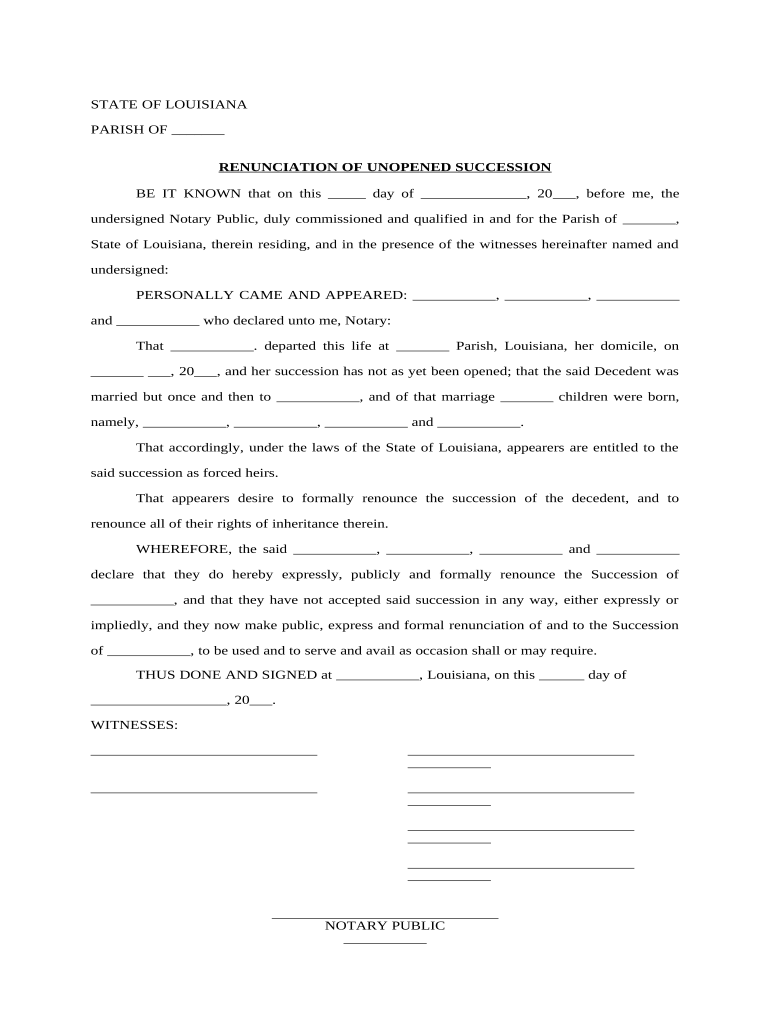
Family Agreement or Renunciation

Formal acceptances, renunciations, or agreements among heirs that affect how the estate is partitioned or whether administration proceeds.

Title Transfer Instruments

Authentic acts, court orders, or registrable deeds that convey immovable property to successors and allow recordation in the parish mortgage records.

Required Identifying Information

Decedent Data: Full name, DOB
Death Certificate: Certified copy required
Successor Identity: Name, address, ID
Asset Summary: Bank accounts, real estate
Liabilities: Mortgages, loans
Legal Authority: Will or appointment

Typical Timelines and Processing Expectations

Local parish practice determines exact deadlines; expect court or notary processing to take several weeks to many months depending on complexity and creditor claims.

Initial Filing:

File promptly; local rules control acceptance and scheduling.

Inventory Preparation:

May take weeks to assemble appraisals and valuations.

Creditor Claim Period:

Parish notice windows vary; allow months for claims to surface.

Tax Filings:

Estate tax and final individual returns follow standard IRS deadlines.

Final Distribution:

Distribution occurs after creditor resolution and court/notary orders.

Common Mistakes to Avoid When Preparing a Succession

  • Submitting incomplete inventories or omitting appraisals which delays estate closing and may trigger additional court requests.
  • Mismatching names or dates between the death certificate, will, and petition which creates identity verification issues.
  • Failing to publish required creditor notices or to allow statutory claim periods, exposing heirs to unexpected liabilities.
  • Using informal signatures without a verifiable audit trail or notary acknowledgment where the record needs an authentic act.

Risks and Consequences of Incorrect or Late Succession Filings

Delayed Transfers: Real estate title cannot transfer
Creditor Exposure: Estate remains liable for claims
Tax Penalties: Filing delays trigger IRS penalties
Personal Liability: Executors may face liability
Contest Risk: Errors invite will contests
Record Rejection: Clerk or registry may refuse recordation

Practical Examples of Succession Workflows

The examples below illustrate common, non‑technical scenarios for handling routine and contested successions.

Small Estate, Uncontested

A surviving spouse compiles an inventory and files a simple succession petition with a notary for single-parcel immovable property.

  • Heirs review the inventory digitally and sign acknowledgements.
  • The notary records the authentic act, the title transfers, and the estate closes without court litigation because creditors were resolved and heirs agreed.

Estate with Creditor Claims

An administrator opens a judicial succession when creditors file claims against the estate; an inventory and appraisals are submitted early.

  • Creditors receive published notices and submit claims.
  • After determinations and permitted payments, the court issues an order of distribution and clear title instruments for recordation.

eSignature Vendor Comparison for Succession Document Workflows

Compare baseline eSignature pricing and feature availability across common providers; signNow appears first as a cost-effective option with enterprise capabilities.

signNow DocuSign Adobe Sign PandaDoc HelloSign
Starting Price $8/user/mo $15/user/mo $14/user/mo $19/user/mo $15/user/mo
Free Trial 7-day free trial No No Yes, limited Yes, limited
Bulk Send Yes (Premium) Yes Yes Yes No
Audit Trail Yes Yes Yes Yes Yes
HIPAA Compliant Yes Yes Yes No No

Frequently Asked Questions About Louisiana Successions

Answers to common questions about preparing, signing, and filing succession documents in Louisiana.


Need help? Contact support

be ready to get more
Join over 28 million airSlate SignNow users