Establishing secure connection…Loading editor…Preparing document…

Motion to Dismiss

This template is fully customizable. Edit the text, fill out the fields, and send it for signature. Give it a try!
Motion to Dismiss

What a Motion to Dismiss Is and when it’s used

A Motion to Dismiss is a formal written request submitted to a court asking that a case or specific claims be dismissed before trial because the complaint fails to state a legally cognizable claim, lacks jurisdiction, is time-barred, or for other procedural reasons. The motion frames legal arguments, cites authority, and asks the judge to rule that the plaintiff's case should not proceed. Lawyers typically file supporting memoranda and evidence; courts evaluate the motion against pleading standards and applicable statutes or rules of civil procedure.

Why filing a Motion to Dismiss matters

A Motion to Dismiss narrows issues early, conserves resources by eliminating deficient claims, and can lead to final case termination. It clarifies legal shortcomings and forces the opposing party to show that their pleadings meet statutory and procedural requirements.

Why filing a Motion to Dismiss matters

Who typically prepares and relies on a Motion to Dismiss

Defense counsel, plaintiffs' counsel, in-house legal teams, and self-represented litigants prepare Motions to Dismiss to challenge pleadings and jurisdiction at an early stage.

  • Defense attorneys seeking dismissal for failure to state a claim, lack of jurisdiction, or other defects.
  • Plaintiffs' counsel may oppose or file alternative pleadings to preserve claims if dismissal is improper.
  • Pro se litigants file motions without counsel; courts often apply pleading standards more strictly.

Essential sections of a professional Motion to Dismiss

A professional Motion to Dismiss organizes jurisdictional objections, pleading defects, legal authority, procedural history, requested relief, and supporting exhibits for the court's review.

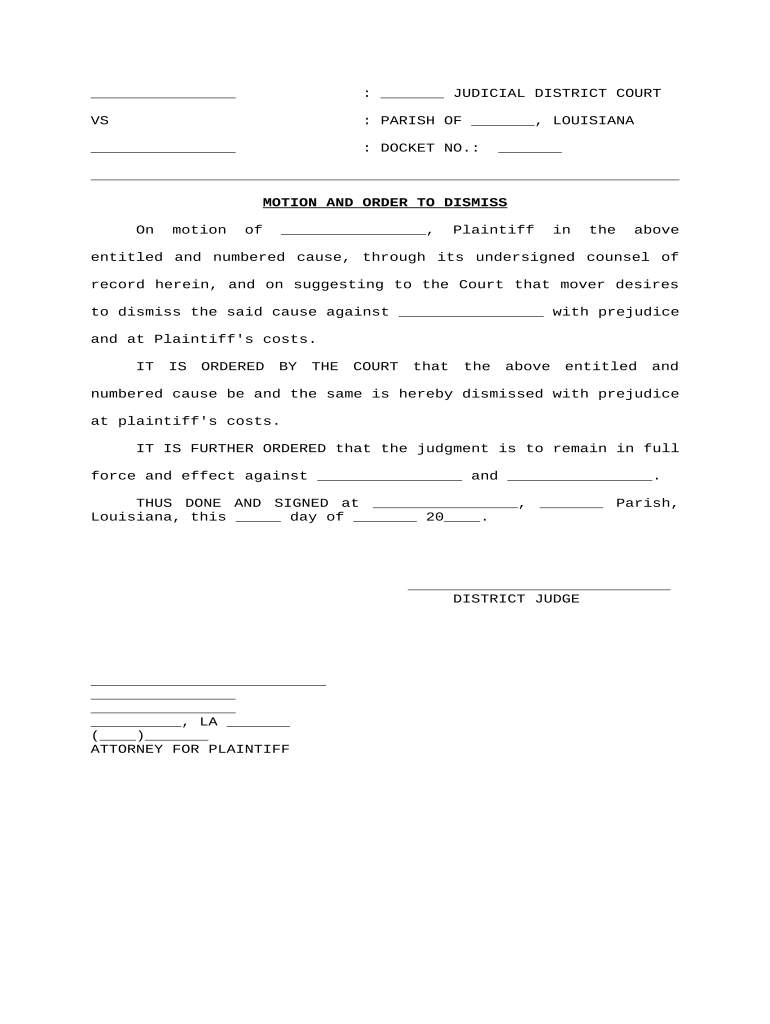
Caption

Include court name, case number, party names, and title 'Motion to Dismiss'. Accurate captioning ensures the filing is associated with the correct docket and prevents clerical rejection.
Statement of Facts

Summarize relevant allegations from the complaint concisely, emphasizing facts that the court must accept as true at the pleading stage and any contested facts alleged by the plaintiff.

Legal Grounds

State specific statutory or rule-based grounds (e.g., Fed. R. Civ. P. 12(b)(6) or 12(b)(1)), and cite controlling authority to show insufficiency of the complaint for the claims asserted.

Argument

Organize legal argument logically with headings, apply facts to law, and anticipate opposing arguments; include succinct standards of review for the judge's consideration and relevant case law.

Relief Requested

Specify the exact relief sought—dismissal with prejudice or without prejudice—and state alternative remedies, such as a motion to strike or for a more definite statement.

Exhibits

Attach relied-upon documents, such as the complaint, contracts, statutes, or key correspondence, and reference exhibit numbers in the motion to streamline judicial review for the record.

Required case identifiers and basic fields

Court Name: Exact court designation required
Case Number: Include docket number assigned
Parties: Full legal names for all parties
Relief Sought: Specify dismissal type and relief
Grounds: Cite statutory and rule bases
Signature Block: Attorney name, bar number, address

Consequences and risks of incorrect or late filings

Dismissal With Prejudice: Loss of claim permanently
Sanctions: Attorney fees or court fines possible
Waiver of Defenses: Missed deadlines can waive procedural objects
Clerical Rejection: Incorrect captioning or format returned
Delay in Case Resolution: Scheduling and calendar delays follow errors
Appeal Complexity: Interlocutory orders may complicate appeal rights

Common drafting and procedural errors to avoid

  • Failing to address jurisdictional facts or timeliness can foreclose defenses and invite immediate denial without prejudice or dismissal with prejudice in narrow circumstances.
  • Overlooking local rules on page limits, font size, or required cover sheets often results in clerical rejection or the need to refile.
  • Citing inapplicable authority or misstating pleading standards undermines credibility and wastes judicial time; align arguments with controlling precedent.
  • Neglecting to serve opposing parties correctly or to file proof of service can cause the motion to be treated as unripe or improperly noticed.

Step-by-step: preparing and filing a Motion to Dismiss

Follow a clear sequence: research grounds, draft concise arguments, attach exhibits, file with the court, serve parties, and monitor the docket for orders or hearings.

  • 01
    Research: Identify pleading defects and controlling authority
  • 02
    Draft: Write clear facts, grounds, and requested relief
  • 03
    File: Submit per court e-filing rules and local procedures
  • 04
    Serve: Provide proof of service and monitor responses

How the filing and service process typically flows

A Motion to Dismiss moves through drafting, filing, service, and judicial review; electronic tools can automate delivery and preserve an audit trail for court records.

  • Prepare: Assemble motion, memorandum, and exhibits
  • File: E-file or submit to clerk per rules
  • Serve: Serve opposing parties and file proof
  • Ruling: Judge issues order after briefing or hearing

Configuring an online workflow for a Motion to Dismiss

Configure an online workflow to place signature fields, assign signers, set authentication, and enable automatic delivery to parties and the court if permitted.

Field Configuration
Upload formats and file validation PDF and DOCX preferred; convert other file types before filing.
Signer role assignment and order Specify defendant/plaintiff counsel and signing order.
Authentication and access controls Use email or SMS codes; use KBA if required by court.
Delivery and filing options Enable download of PDF with audit trail for e-filing or service.

Technical and format requirements for electronic filings

Electronic filing and eSign workflows require court acceptance, compatible file formats, and reliable authentication for each signer before submission to the clerk.

  • File Formats: PDF/A or searchable PDF recommended
  • Authentication Methods: Email, SMS, or KBA depending on court
  • Integrations: CRM and case management connectors supported

Timing rules and response windows to track

Timing obligations for a Motion to Dismiss vary by rule and jurisdiction; adhere to service and response deadlines to avoid waiver.

Response Time Under Rule:

Typically 21 days after service under Fed. R. Civ. P. 12(a).

Motion Timing in State Court:

Local rules set response deadlines; many states allow 20–30 days.

Service Requirements:

Serve opposing counsel per civil procedure and local rules.

Extensions and Stays:

Request extensions or stays by stipulation or court order before deadline.

Hearing Scheduling:

Hearing may be scheduled weeks after filing depending on calendar.

Major milestones from filing to disposition

Key milestones in the Motion to Dismiss lifecycle track drafting through court disposition and potential appeal.

01

Draft and Review

Research authority, draft motion and supporting memorandum.

02

File and Serve

File with clerk and serve all parties promptly.

03

Court Ruling

Judge issues order granting, denying, or partially granting the motion.

04

Post-Ruling Options

Amend complaint, seek certification, or pursue appeal if permitted.

Basic pricing and feature comparison for common eSignature vendors

This table compares basic pricing and feature availability for signing platforms commonly used to prepare and execute a Motion to Dismiss.

signNow DocuSign Adobe Sign PandaDoc HelloSign
Starting Price $8/user/mo $15/user/mo $14/user/mo $19/user/mo $15/user/mo
Free Trial 7-day free trial Varies by plan Varies by plan Varies by plan Varies by plan
Bulk Send Yes Yes Yes Yes Yes
Audit Trail Yes Yes Yes Yes Yes
HIPAA Compliant Yes Yes Yes No No

Real-world examples of electronic workflows for legal filings

Real organizations use eSign platforms to handle court-related filings and client intake securely and with audit trails.

Optica Ventures

Optica Ventures used signNow to streamline document execution for filings and client agreements across mobile and desktop workflows.

  • Interface improved signer completion rates.
  • Their COO noted that simplifying signature collection reduced administrative delays, allowed faster review cycles, and made it easier to deliver pleadings and supporting affidavits to opposing counsel and the court while preserving a detailed audit trail.

Tech Data

Tech Data integrated signNow into internal workflows to accelerate internal approvals and external filings requiring signatures.

  • Faster execution and fewer in-person steps.
  • The CEO reported improved service delivery and reduced time-to-resolution for document-heavy processes, allowing legal and compliance teams to route motions, responses, and supporting exhibits without paper, maintaining audit logs for each transaction.

Frequently asked questions about Motions to Dismiss

Common questions about Motions to Dismiss include filing location, timing, service, and whether electronic signatures or notarization are required.


Need help? Contact support

be ready to get more
Join over 28 million airSlate SignNow users