1
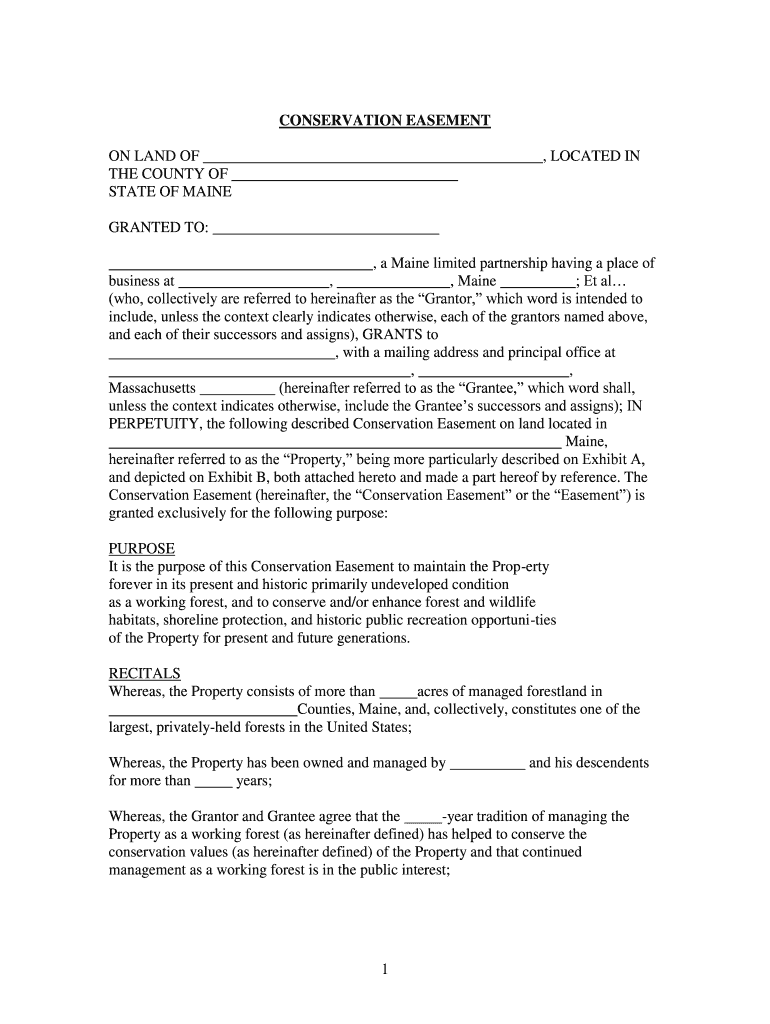
CONSERVATION EASEMENT
ON LAND OF , LOCATED IN
THE COUNTY OF
STATE OF MAINE
GRANTED TO:
, a Maine limited partnership having a place of
business at , , Maine ; Et al…
(who, collectively are referred to hereinafter as the “Grantor,” which word is intended to
include, unless the context clearly indicates otherwise, each of the grantors named above,
and each of their successors and assigns), GRANTS to
, with a mailing address and principal office at
, ,
Massachusetts (hereinafter referred to as the “Grantee,” which word shall,
unless the context indicates otherwise, include the Grantee’s successors and assigns); IN
PERPETUITY, the following described Conservation Easement on land located in
Maine,
hereinafter referred to as the “Prop erty,” being more particularly described on Exhibit A,
and depicted on Exhibit B, both attached hereto and made a part hereof by reference. The
Conservation Easement (hereinafter, the “Conservation Easement” or the “Easement”) is
granted exclusively for th e following purpose:
PURPOSE
It is the purpose of this Conservation Easement to maintain the Prop -erty
forever in its present and historic primarily undeveloped condition
as a working forest, and to conserve and/or enhance forest and wildlife
habitats, shoreline protection, and historic public recreation opportuni -ties
of the Property for present and future generations.
RECITALS
Whereas, the Property consists of more than acres of managed forestland in
Counties, Maine, and, collectively, constitutes one of the
largest, privately -held forests in the United States;
Whereas, the Property has been owned and managed by and his descendents
for more than years;
Whereas, the Grantor and Grantee agree that the -year tradition of managing the
Property as a working forest (as hereinafter defined) has helped to conserve the
conservation values (as hereinafter defined) of the Property and that continued
management as a wor king forest is in the public interest;
2
Whereas, the Grantor wishes to continue managing the Property and the forest resources
thereon for the long -term economic benefit of the owners of the Property, including,
without limitation, by ensuring that the Pr operty is managed for sustainable production of
high -quality timber products (hereinafter, a “working forest”), but in accordance with the
Landowner’s Guidelines (as hereinafter defined) that seek to conserve the conservation
values of the Property;
Wher eas, the conservation of the Property through the prohibition of further development
not associated with Forestry Activities and Permitted Non -Forestry Activities (as such
terms are defined in Section 3.1) and the continued management of the Property as a
working forest will significantly add to the protected and conserved lands in the State of
Maine and the United States of America;
Whereas, prohibition of further development not associated with Forestry Activities and
Permitted Non -Forestry Activities an d the continued management of the Property as a
working forest confers the following public benefits:
A. supports and provides incentives for management of the forest for long -term health;
B. maintains a natural resource base for a forest -based economy a nd corresponding
employment opportunities;
C. provides, maintains and protects wildlife habitat;
D. maintains and protects unique natural features;
E. provides and maintains a predominately forested area on and across which the Grantor
has traditionally provided public access for a broad range of recreational activities,
including, but not limited to, camping, hunting, skiing, snowmobiling, and enjoyment of
open space;
F. provides and maintains an extensive area for carbon sequestration, thus contributing to
clean air and national efforts to moderate the effects and pace of global warming;
G. supports further investment in local businesses and community services that de pend
directly upon, or provide ancillary services to, a forest -based economy and forest product
industry; and
H. provides a consistent, renewable and long -term source of forest products.
Whereas, it is the Grantor’s intent that, through this Easement, fu rther development of the
Property not associated with Forestry Activities and Permitted Non -Forestry Activities
shall be prohibited and the Property’s primary use shall continue to be as a working forest;
Whereas, the Grantor and Grantee agree that the con tinued and permanent conservation of
the Property as a working forest is consistent with the purpose of this Easement and will
make a lasting contribution to the State of Maine;
3
Whereas, the final recommendations of the Northern Forest Lands Council, a fed erally
sponsored governor -appointed task force representing Maine, New Hampshire, Vermont
and New York, recognized and recommended in the 1994 Northern Forest Lands Study
that conservation easements be used as a way to protect and ensure the long term inte grity,
character and productivity of the working forests of those states;
Whereas, the Grantor’s stewardship ethic and forest management practices have been
recognized and certified as “well -managed” by an independent third -party analysis from
Scientific Certification System’s Forest Conservation Program, a forest practices review
procedure that is accredited by the Forest Stewardship Council, a non -profit association
formed by environmental organizations concerned with establishing international standards
for forest management and inspection procedures;
Whereas, the Property is a predominately forested land area of significant breadth and
diversity, with outstanding natural resources, including sizeable forests of high quality,
productive soils, diverse w ildlife and plant habitat, extensive wetlands, clean rivers,
streams and water bodies, and unique natural features (hereinafter, the “conservation
values”);
Whereas, the conservation values of the Property are documented in the Baseline
Documentation prep ared by the Grantee and the Grantor (the “Baseline Documentation”),
which documentation is incorporated herein by reference, and the original of which is on
file at the offices of the Grantee and consists of descriptions, maps, and other
documentation that the parties agree provide, collectively, an accurate representation of the
Property at the time of this Easement and is intended to serve as an objective, although not
exclusive, information baseline for monitoring compliance with the terms of this
Easeme nt;
Whereas, this Easement is created pursuant to the Uniform Conservation Easement Act at
Title 33, Maine Revised Statutes Annotated, Sections 476 through 479 -B inclusive, as
amended; and
Whereas, the Grantee is qualified to hold conservation easements pursuant to Title 33,
Maine Revised Statutes Annotated, Section 476(2)B, as amended, and Sections 501(c)(3)
and 170(h) of the Internal Revenue Code of 1986, as amended, and the regulations
thereunder (as amended, the “Code”);
Whereas, the Grantor and the Grantee intend that this Easement shall qualify, to the extent
that the purchase price of the Easement received by the Grantor is less than the fair market
value of the Easement, as a “qualified conservation contribution” as that term is defined
under Sect ion 170(h)(2)(C) of the Code;
NOW THEREFORE, the Conservation Easement on the Property consists of the following
terms, covenants, restrictions and affirmative rights granted to Grantee, which shall run
with and burden the Property in perpetuity, and the Grantor and Grantee mutually agree as
follows:
4
1. STATEMENT OF PURPOSE. It is the purpose of this Conservation Easement to
maintain the Property forever in its present and historic primarily undeveloped condition as
a working forest, and to conserve and/o r enhance forest and wildlife habitats, shoreline
protection, and historic public recreation opportunities of the Property for present and
future generations.
2. GRANTOR’S RIGHT, TITLE AND INTEREST IN THE PROPERTY. The Grantor
reserves all right, title an d interest in and to the Property subject to specific restrictions on
the Grantor’s use set forth in Section 3 and subject to the specific rights granted to Grantee
set forth in Section
3. USES AND LIMITATIONS ON USE OF THE PROPERTY.
3.1. Prohibited and Permitted Uses. There shall be no residential, commercial, agricultural,
farming, ranching, or industrial uses of the Property, except the following:
3.1.1. Forestry Activities. Any such uses associated with forest management, includin g,
without limitation, the activities described in Section 4 of this Agreement
(hereinafter,.“Forestry Activities”); and 3.1.2. Permitted Non -Forestry Activities. Such
uses that either satisfy the criteria set forth in Section 3.1.3 or, subject to the rest rictions set
forth in Sections 3.2 through 3.5, satisfy each of criteria set forth in (i) and (ii) of this
sentence (each of which shall be given equal weight): (i) are specifically identified in the
Baseline Documentation, or if not identified, are activi ties which the Grantor can
demonstrate to be activities that were carried out on the Property as of or prior to the date
of this Easement and (ii) are in Grantee’s reasonable judgment not inconsistent with the
purpose of this Easement (hereinafter, “Permit ted Non -Forestry Activities”).
3.1.3. Changes in Technology. The parties acknowledge that, as technologies evolve,
commercial activities undertaken by the Grantor or its agents in connection with and
arising out of Forestry Activities and Permitted Non -Fo restry Activities and the methods of
performing such activities may emerge, the conduct of which would be suitable at or on
the Property. It is not the Grantor’s intent to prohibit such activities; rather, subject to the
restrictions set forth in Sections 3.2 through 3.5, the Grantor reserves the right to carry out
such activities that are in Grantee’s reasonable judgment not inconsistent with the purpose
of this Easement.
3.1.4. Leases.
3.1.4.1. Existing Leases. The parties acknowledge and agree that th is Easement is
conveyed subject to existing residential and commercial leases between the
Grantor and third -parties, which by their terms may be subject to amendment,
modification, extension or renewal (individually, a “Lease” and collectively, the “Leases ”).
The parties acknowledge that any portion of the Property that is subject to a Lease shall not
be subject to the terms, condition and purpose of this Easement provided that (i) the Lease
remains in effect and (ii) the Lease is not modified or amended, w ithout the consent of the
5
Grantee, to increase or expand the portion of the Property subject to the Lease (the
“premises”). Notwithstanding the foregoing, the parties agree that the premises subject to
a Lease may be increased or expanded by the minimum p racticable land area necessary for
the use of the premises to comply with then current land use, zoning or environmental
requirements, provided that the expansion is not necessitated by a change in the use of the
premises from the use existing at or prior to the grant of this Easement and prior notice of
the expansion, the area affected, and the regulatory requirement mandating such change is
given to the Grantee. Copies of the Leases with descriptions of the portions of the Property
subject thereto shall b e provided to the Grantee as part of the Baseline
Documentation.
3.1.4.2. New Leases. If a Lease terminates, within twenty -four months after termination,
the Grantor may enter into a new lease of the same premises (a “New
Lease,” which term shall include any amendments, modifications, renewals or extensions
thereof, or any lease entered into upon termination of a New Lease). A New Lease shall
not be subject to the terms, condition and purpose of this Easement, provided that (i) the
New Lease remains in eff ect; and (ii) the New Lease is not modified or amended, without
the consent of the Grantee, to increase or expand the portion of the Property subject to the
New Lease (the “premises”). Notwithstanding the foregoing, the parties agree that
the premises subj ect to a New Lease may be increased or expanded by the minimum
practicable land area necessary for the use of the premises to comply with then current land
use, zoning or environmental requirements, provided that the expansion is not necessitated
by a chan ge in the use of the premises from the use existing at or prior to the grant of this
Easement and prior notice of the expansion, the area affected, and the regulatory
requirement mandating such change is given to the Grantee. A copy of any New Lease and
a description of the premises shall be provided to the Grantee for inclusion with the
Baseline Documentation. If a New Lease is not entered into within twenty -four months
after termination of a prior lease of the premises, the portion of the Property that ha d been
subject to the terminated lease shall thereafter be subject to this Easement.
3.2. Subdivision. There shall be no subdivision or division of any of the Property in any
town -ship into tracts of less than 1,000 acres without the prior written consent of the
Grantee, which approval shall be granted only upon a determination by the Grantee, in its
reasonable judgment, that the action will not be inconsistent with the purpose of this
Easement.
3.3. Structures, Improvements and Utilities. There shall be no development, construction,
maintenance, installation, expansion, replacement and repair of structures, improvements
or utilities on the Property after the date hereof, except as follows:
3.3.1. Use of Terms. The terms “structures,” “improvements” and “ utilities” include,
without limitation, roads, dams, fences, bridges, gates, boat ramps, docks, aircraft landing
strips, communication towers, satellite dishes, campsites, checkpoints, maple sugar houses,
barns, storage facilities, trailers, sheds, outhous es, forest management camps, logging
camps, associated signs and structures, windmills, electric power lines and generation
6
facilities, septic or sewer, water storage and delivery systems, telephone and
communications cable systems, and their respective ap purtenant facilities.
3.3.2. Structures, Improvements and Utilities Used for Forestry Management Activities.
Structures, improvements and utilities that are used in connection with and for the purpose
of accomplishing Forestry Activities (hereinafter, col lectively, “Forestry Improvements”)
may be developed, constructed, maintained, installed, expanded, replaced and repaired
from time to time. Existing housing facilities that are Forestry Improvements and are used
for permanent residential use and habitatio n at the time hereof and are so described on the
Baseline Documentation may be maintained, repaired and replaced for such use. Any new
housing facilities that are Forestry Improvements shall be for temporary, periodic or
seasonal habitation and shelter and not for permanent residential use and habitation. Except
for Forestry Improvements the siting or construction of which is governed by state law or
regulations, Forestry Improvements, if newly installed or constructed, shall be sited and
constructed to the extent possible taking into consideration the function and locational
requirements of such improvements, in a manner that in the Grantee’s reasonable judgment
is not inconsistent with the purpose of this Easement.
3.3.3. Structures, Improvements and Utilities Used for Permitted Non -Forestry Activities.
Existing structures, improvements and utilities that are used in connection with
Permitted Non -Forestry Activities (hereinafter, collectively, “Non -Forestry Improve -
ments”) may be maintained, replaced and repaired from time to time, but may not be
expanded without the consent of the Grantee, which consent shall be granted only upon a
determination by the Grantee, in its reasonable judgment, that the action will not be
inconsistent with the purpose of this Easement. Non -Forestry Improvements may be
developed, constructed, and installed from time to time after the date hereof only with the
consent of the Grantee, which consent shall be granted only upon a determination by the
Grantee, in its reasonable judgment, that the action will not be inconsistent with the
purpose of this Easement. If so developed, constructed or installed, such Non -Forestry
Improvements may be maintained, replaced and repaired thereafter from time to time, but
may not be further expanded without the consent of the Grantee, which consent shall be
granted only upon a determination by Grantee, in its reasonable judgment, that the action
will not be inconsistent with the purpose of this Easement.
3.3.4. Return of Site to Natural Condition. When Forestry Improvements and Non -Forestry
Improvements cease to be used, as evidenced by the cessation of their use for a period of
years and their lack of maintenance beyond the normal period of time between harvest ing
cycles, the site of such structures, improvements and utilities shall be allowed to return to a
natural condition and the Grantor shall remove any decaying structures from the Property
at the Grantor’s cost and expense.
3.4. Excavation of Minerals, G eothermal Resources and Hydrocarbon. There shall be no
exploration for, or development and extraction of, geothermal resources, minerals and
hydrocarbon by any surface or sub -surface mining or any other method on the Property,
except as follows:
7
3.4.1. Pe rmitted Excavation or Alteration. Excavation or alteration of the Property for
removal of rock, gravel, sand, peat, sod or other substances shall be permitted in
connection with Forestry Activities and Permitted Non -Forestry Activities, but shall be
restri cted as provided in Section 3.4.2.
3.4.2. Gravel Pits. No more than one percent (1%) of the Property (and no more than one
percent of any area of the Property conveyed at any time to owners different from the
owners of such area at the time of the grant o f this Easement) shall be in active use at any
one time for production and extraction of sand, rocks or gravel (such areas are hereinafter
referred to as “Active Gravel Pits”). Active Gravel Pits shall not be greater than ten acres
in area. If the Grantor plans to expand an Active Gravel Pit to a size greater than ten acres
in area, prior to expansion, the Grantor shall reclaim an area equal to the acreage of total
use of such Active Gravel Pit that is greater than ten acres. Gravel Pit reclamation shall
follow the recommendations of the Natural Re -source Conservation Service at the time of
such reclamation, or other similar or successor agency of similar purpose. The Grantor
shall seed areas of Active Gravel Pits operated after the date of this Easement and
subsequently abandoned with a recommended conservation mixture to insure soil stability.
The Grantor specifically reserves the right to exchange or barter sand, rocks, gravel and/or
rock crushing from the Property in connection with the Forestry Activitie s and, subject to
Section 3.3.3, in connection with Permitted Non -Forestry Activities.
3.5. Waste; Hazardous Materials. There shall be no placing, filling, storing or dumping on
the Property of material amounts of rubbish, garbage, debris, waste materials or landfill
(“material” for the purposes of this section being defined as an amount exceeding ten (10)
cubic feet within a one -acre area), and there shall be no placing, filling, storing or dumping
on the Property of any Hazardous Substance (as defined in Section 13.1), except as
follows:
3.5.1. Storage and Septic Tanks, Subsurface Wastewater Disposal Systems. The Grantor
may, subject to all applicable local, state and federal laws and regulations, maintain, repair
and replace existing underground storage tanks, septic tanks and subsurface wastewater
disposal systems, and may install, maintain, replace and repair new storage tanks, septic
tanks and subsurface wastewater disposal systems in connection with Forestry Activities
and Permitted Non -Forestry Acti vities.
3.5.2. Biodegradable and Non -Biodegradable Materials. Biodegradable materials generated
on the Property, including, without limitation, biodegradable logging debris, shall not be
considered debris, waste materials, landfill, or hazardous or specia l wastes for purposes of
this Easement. Non -biodegradable materials generated on the Property in connection with
Forestry Activities and Permitted Non -Forestry Activities may be stored temporarily in
appropriate containers for removal from the Property at reasonable intervals at Grantor’s
expense, subject to all applicable local, state and federal laws and regulations.
4. FORESTRY ACTIVITIES.
8
4.1. Compliance with Law; Landowner Guidelines. Forestry Activities shall be performed
in accordance with (i) appl icable local, state and federal laws and regulations at the time
such activities occur, and (ii) the Landowner and Forestry Guidelines attached hereto and
incorporated herein as Exhibit C (the “Landowner Guidelines”).
4.2. Forest Management Plan; Annual M eetings.
4.2.1. Forest Management Plan. Forestry Activities shall be conducted in accordance with
a written plan setting forth the Grantor’s long -term plan for management of the Property as
a working forest (the “Forest Management Plan”). The Forest Manag ement Plan shall be
prepared by one or more professional foresters (a “professional forester” shall be defined,
for purposes of this Easement, as a licensed forester in the State of Maine) and adopted by
the Grantor.
4.2.2. Sharing of Information; Annual Meetings. To assist the Grantee in fulfilling its
responsibilities under the terms of this Easement, the Grantor agrees to provide
Grantee with a copy of the Forest Management Plan in existence at the time of the grant of
the Easement, and thereafter, to provide Grantee with any subsequent revisions to such
plan or any new Forest Management Plan at Grantee’s cost for copying and maili ng
promptly following completion. Prior to delivery of the Forest Management Plan or any
amendments thereto, and any other non -public, confidential and proprietary information
provided by Grantor to Grantee, the Grantee shall execute such documents relatin g to the
confidential and proprietary nature of the Forest Management Plan and such additional
confidential and proprietary information provided by Grantor to Grantee as are satisfactory
to the Grantor. The Grantor and the Grantee shall meet no less often than annually at a date
and time convenient for both parties but not to exceed one business day in duration (unless
both parties mutually agree that a shorter or longer, or no meeting at all, is necessary), at
the offices of the Grantor (or another locatio n convenient to both the Grantor and the
Grantee) to share the information collected by Grantee as a result of its visits to the
Property for the purposes of monitoring the Easement and to provide an opportunity for
both parties to discuss any questions or concerns regarding the information collected by the
Grantee in the monitoring process. Either party may request up to four meetings each year
(which shall not preclude additional meetings if the other party agrees) at such a location
upon at least three w eeks’ prior written notice to discuss any questions or concerns that
may arise regarding any of the above.
4.3. Forestry Activities. Forestry Activities shall mean all forest management practices
allowable under law and the harvesting and removal of any and all forest products by any
and all current and future harvesting and removal techniques allowable under law and shall
include, but not be limited to, the following activities: reforestation, planting, growing,
cutting, and harvesting trees, forest prod ucts, and other vegetation; construction, use, and
maintenance of skid trails, skid roads, log yards, landing and staging areas, winter haul
roads or other paths, roads, or trails used to provide pedestrian, domestic animal and
vehicular access to and from and within the Property; clearing for reforestation; harvesting,
pruning, girdling, or trimming trees and other vegetation; harvesting forest products with
domestic animals or mechanical equipment; maintenance of existing fields and meadows;
9
conducting ti mber cruising, forest management planning, forest crop selection, forest
research, and other forest resource evaluation activities; cutting and removing forest
products, including but not limited to trees, logs, poles, posts, pulpwood, firewood, chips,
see ds, pinestraw, stumps, seed cones, bark, shrubs, lesser vegetation, biomass and all sugar
maple products; conducting fire control and other activities to prevent or control losses or
damage to forest crops or forest products; identifying and marking bounda ries; salvaging
forest crops or forest products; marking timber and performing other activities to identify
trees or areas for harvest; performing commercial and pre -commercial silvicultural
treatments; disposing of harvesting debris and conducting post -ha rvest or site recovery
activities; applying in accordance with applicable statutes and regulations herbicides,
pesticides, fungicides, rodenticides, insecticides, and fertilizers; removing, loading, and
transporting timber and other forest crops and produc ts; processing forest products with
portable or temporary equipment designed for in -woods processing; trimming, cutting,
removing, burning, or otherwise dispose of any trees or vegetation which are diseased,
rotten, damaged, or fallen; trimming, cutting, r emoving, or otherwise disposing of any
trees or vegetation as is necessary to construct or maintain fire lanes, footpaths, and roads.
5. PUBLIC ACCESS AND USE OF THE PROPERTY. The parties acknowledge that the
Grantor does not grant any right of public acc ess to, on or across, or public use of, the
Property through this Easement, and the Grantor does not expand or extend through this
Easement any privilege or license provided by the Grantor to the public to access or use the
Property. It is the Grantor’s in tent and objective (but the Grantor does not impose by this
Easement any obligation upon the Grantor or its successors or assigns) to allow public
access on and across and use of significant portions of the Property for the historic
recreational uses that are described in the Baseline Documentation. Notwithstanding
anything to the contrary herein, the Grantor or its designated agent may in its sole
discretion prohibit, limit or expand access to any area of the Property at any time and from
time to time, inc luding by way of illustration only, for the purpose of fulfilling the
Grantor’s resource management plans, for safety reasons, to protect and enhance water
quality, fish and wildlife resources, or to protect, maintain and perpetuate those areas of the
Prop erty that contain rare, unusual and culturally significant plants and plant communities,
unusual natural features, or historic or archaeological resources. The Grantor reserves the
right to charge reason -able fees for access on and across and use of the Pr operty.
6. RIGHTS AND OBLIGATIONS OF GRANTEE. To accomplish the purpose of this
Easement, the following rights are conveyed to and obligations imposed upon the Grantee:
6.1. Access. The Grantor hereby grants to the Grantee reasonable and non -exclusive ac cess
in common with the Grantor and others entitled thereto at reasonable times (i) across the
Property and all of its parts, and (ii) across other lands of the Grantor as described and
depicted on Exhibit F attached hereto and incorporated herein by this reference
(collectively, the “Grantee’s Access Rights”). The Grantee may exercise Grantee’s Access
Rights solely for the purposes of fulfilling the Grantee’s obligations under this Easement
and exercising its affirmative rights under this Easement, includi ng those specifically set
forth in Section 6.2, subject, however, to the following limitations:
10
6.1.1. Vehicular access shall be only over existing roads. Grantor may at Grantor’s
discretion close or abandon such roads, after which closure or abandonment v ehicular
access over the closed or abandoned road shall cease.
6.1.2. Grantor is under no obligation to create or maintain vehicular access for Grantee.
6.1.3. Grantee’s rights of access do not include any rights of construction or maintenance
related to vehicular access or any other affirmative right to undertake site alteration or to
place access -related structures or improvements on the Property or on any other lands of
Grantor.
6.1.4. Grantee shall comply with all policies of Grantor with respect t o road and gate use.
6.1.5. Grantee access shall not interfere with any use or activity of Grantor, and such use
by Grantee shall not interfere with any other person’s lawful use of the Property or of any
other lands of Grantor. 6.1.6. Grantee shall not u se roads in a manner which could
reasonably be anticipated to result in damage.
6.1.7. Grantee’s Access Rights are not assignable except in connection with the permitted
assignment by Grantee of this Easement under the provisions of Section 18.
6.2. Affi rmative Rights and Obligations of Grantee. Grantee shall have the right and
obligation to:
6.2.1. Assure compliance with the terms of this Easement. In connection with such right
and obligation, Grantee shall have the right to enter the Property at any re asonable time
and in any reasonable manner, subject to the provisions of Section 6.1, for the purposes of
inspecting and monitoring compliance with the terms of this Easement and for
enforcement and remedying the violations of this Easement in accordance w ith Section 8,
and each entry shall be in a manner that will not disturb the Forestry Activities and
Permitted Non -Forestry Activities and the Grantor’s quiet enjoyment of the Property.
6.2.2. Keep on file and provide to Grantor reports made in connection with Grantee’s
inspections of the Property in order to monitor compliance with the terms of this
Easement.
7. GRANTOR’S NOTICE OF INTENTION TO UNDERTAKE CERTAIN ACTIONS;
CLARIFICATION OF EASEMENT TERMS.
7.1. Purpose of Provision; Notice by Grantor. The parties acknowledge that under specific
circumstances set forth in Section 3, the Grantor is required to obtain the consent of the
Grantee prior to undertaking certain activities or taking certain actions. The parties
acknowledge that the purpose of requiring such consents is to afford the Grantee an
opportunity to ensure that the activities in question are designed and carried out in a
manner consistent with the terms, conditions or purpose of this Easement . Whenever such
consent is required, or if the Grantor has a question as to whether an activity is consistent
11
with the terms, conditions or purpose of this Easement, the Grantor shall notify the Grantee
in writing when possible at least sixty days and in n o event less than thirty days prior to the
date Grantor intends to undertake the activity in question. The notice shall describe the
nature, scope, design, location, timetable, and any other material aspects of the proposed
activity in sufficient detail to permit Grantee to make an informed judgment of the activity
as to its consistency with the terms, conditions or purpose of this Easement.
7.2. Grantee’s Response. The Grantee shall give written response of its determination
within fifteen business days a fter the receipt of the Grantor’s written request. In the event
the Grantee fails to respond to the Grantor’s written request within said fifteen business
day period, such request shall be deemed approved. The consent of the Grantee obtained in
one circums tance shall not be deemed or construed to be a waiver by the Grantee for any
subsequent activities by the Grantor under this Section 7.
7.3. Mediation. If the parties disagree as to the consistency of any proposed use or activity
with the terms, condition s or purpose of this Easement and the parties are unable to resolve
such disagreement through unassisted consultation between themselves, and the Grantor
agrees not to proceed with, or shall discontinue, the use or activity pending resolution of
the disput e, either party may refer the dispute to mediation by request made in writing
upon the other. Within ten days of the receipt of such a request, the parties shall select a
single trained and impartial mediator. Mediation shall then proceed in accordance wit h the
following guidelines:
7.3.1. Purpose. The purpose of the mediation is to: (i) promote discussion between the
parties; (ii) assist the parties to develop and exchange pertinent information concerning the
issues in dispute; and (iii) assist the partie s to develop proposals which enable them to
arrive at a mutually acceptable resolution of the controversy. The mediation is not intended
to result in any express or de facto modification or amendment of the terms, conditions or
restrictions of this Easemen t.
7.3.2. Participation. The mediator may meet with the parties and their counsel jointly or ex
parte. The parties agree that they will participate in the mediation process in good faith and
expeditiously, attending all session scheduled by the mediator. Representatives of both
parties with settlement authority will attend mediation sessions as requested by the
mediator.
7.3.3. Confidentiality. All information presented to the mediator shall be deemed
confidential and shall be disclosed by the mediator on ly with the consent of the parties or
their respective counsel. The mediator shall not be subject to subpoena by any party. No
statements made or documents prepared for mediation sessions shall be disclosed in any
subsequent proceeding or construed as an a dmission of a party.
7.3.4. Time Period. Neither party shall be obligated to continue the mediation process
beyond a period of ninety days from the date of receipt of the initial request or if the.11
mediator concludes that there is no reasonable likeliho od that continuing mediation will
result in a mutually agreeable resolution of the dispute.
12
7.3.5. Costs. The costs of the mediator shall be borne equally by Grantor and Grantee; the
parties shall bear their own expenses, including attorney’s fees, indivi dually.
7.4. Arbitration. In the event that Grantee and Grantor are unable to agree upon a mediator
or otherwise fail to resolve their disagreement through mediation, then the Grantee or the
Grantor may request arbitration pursuant to the Commercial Arbit ration Rules of the
American Arbitration Association, or such other arbitration procedure as to which the
parties may agree in writing, provided however that (i) any arbitration shall involve a
single arbitrator, (ii) the arbitrator shall be bound by and f ollow the substantive law of
Maine as if the dispute were tried in a court of law and (iii) all issues that may in any
manner relate to the controversy or dispute shall be resolved in the arbitration. Costs shall
be borne by the parties in accordance with Section 8.5 below.
8. GRANTEE’S REMEDIES.
8.1. Notice of Violation; Corrective Action. In the event that the Grantee becomes aware of
a violation of the terms of this Easement, the Grantee shall give written notice to the
Grantor of such violation and re quest that the Grantor take corrective action sufficient to
cure the violation, and, where the violation involves injury to the Property resulting from
any use or activity that the Grantee determines, in its reasonable judgment, to be
inconsistent with the purpose of this Easement, that the Grantor restore, to the extent
practicable, the portion of the Property so injured to a condition substantially similar to that
which existed prior to the violation.
8.2. Inju nctive Relief. If the Grantor does not cure the violation within thirty (30) days
after receipt of notice thereof from the Grantee, or under circumstances where the violation
cannot reasonably be cured within said period, does not begin curing such violati on within
said period, and/or does not continue diligently to cure such violation until finally cured,
the Grantee may, after seven (7) days advance written notice to the Grantor, (i) request
arbitration pursuant to the Commercial Arbitration Rules of the American Arbitration
Association, or such other arbitration procedure as to which the parties may agree in
writing, provided however that (x) any arbitration shall involve a single arbitrator, (y) the
arbitrator shall be bound by and follow the substantive law of Maine as if the dispute were
tried in a court of law and (z) all issues that may in any manner relate to the controversy or
dispute shall be resolved in the arbitration; or (ii) bring an action at law or in equity in
court of competent jurisdiction to enforce the terms of this Easement, to enjoin the
violation by temporary or permanent injunction, and to require the restoration of the
Property to the condition substantially similar to that which existed prior to injury to the
extent such restoration is practicable.
8.3. Damages. The Grantee will be entitled to recover reasonable damages for violation of
the terms of this Easement.
8.4. Emergency Enforcement. If the Grantee, in its reasonable discretion, determines that
circumstances require immedia te action to prevent or mitigate significant damage to the
13
conservation values of the Property resulting from a violation of the terms of this
Easement, Grantee may (i) with at least twenty -four (24) hours’ prior notice to the Grantor,
enter upon the Prope rty for the purpose of assessing damage or threat to the conservation
values thereon resulting from a violation of the terms of this Easement and determining the
nature of curative or mitigation actions that should be taken; and (ii) pursue its remedies
un der this Section 8 with at least twenty -four (24) hours’ prior notice to the Grantor, but
without waiting for the period provided under Section 8.2 for cure to expire or the period
required under Section 8.2.12 for advance notice to the Grantor to expire.
8.5. Costs of Enforcement. In the event that an event or circumstance of intentional
noncompliance with the Easement is corrected through negotiation and voluntary
compliance, the party who was intentionally not complying shall reimburse the other party
for all reasonable costs incurred in investigating the non -compliance and securing its
correction. In the event that a dispute is resolved through arbitration or judicial
enforcement and the decision -maker determines that: (i) the Easement has been breached
as a result of an event or circumstance of intentional non -compliance, the Grantor shall
reimburse the Grantee for any reasonable costs of enforcement, including reasonable costs
incurred in investigating any non -compliance and securing its correction, an d arbitrators or
court costs (in the case of injunctions), reasonable attorneys’ fees and any other payments
ordered by such decision -maker; or (ii) this Easement has not been breached and that the
Grantee has initiated arbitration or litigation without re asonable cause, or in bad faith, then
the Grantee shall reimburse the Grantor for any reasonable costs of defending such action,
including confirmation of compliance, arbitrators or court costs and reasonable attorneys’
fees and any other payments ordered by such decision -maker. In all other circumstances,
each party shall bear its own costs of dispute resolution.
8.6. Grantee’s Discretion. Enforcement of the terms of this Easement shall be at the
discretion of the Grantee, and any forbearance by the Grant ee to exercise its rights under
this Easement in the event of any breach of any term of this Easement by the Grantor shall
not be deemed or construed to be a waiver by the Grantee of such term or of any
subsequent breach of the same or any other term of th is Easement or of any of the
Grantee’s rights under this Easement. No delay or omission by the Grantee in the exercise
of any right or remedy upon any breach by the Grantor shall impair such right or remedy or
be construed as a waiver.
8.7. Waiver of Cer tain Defenses. The Grantor hereby waives any defense of laches,
estoppel, or prescription.
8.8. Acts Beyond the Grantor’s Control. The Grantor shall be responsible for, and the
Grantee shall have the right to enforce the terms of this Easement against the Grantor with
respect to violations of the terms of this Easement caused by the Grantor, its successors or
assigns, or their respective officers, directors, trustees, members, employees, contractors
and agents or by any person or entity who enters or occup ies the Property with the express
written permission of the Grantor or pursuant to a contractual relationship with the
Grantor, such as a lessee. Notwithstanding any provision of this Easement to the contrary,
the Grantor shall not be responsible or liable for any remediation, restoration, damages,
14
cost and/or expenses in any way caused by third parties (except those described in the
preceding sentence) or the public, except as required by state or federal laws or regulations.
Nothing contained in this Ease ment shall be construed to entitle the Grantee to bring any
action against the Grantor for any injury to or change in the Property resulting from causes
beyond the Grantor’s control, including without limitation, government action, fire, flood,
storm, chan ges in climatic condition, catastrophic insect infestation, disease, acid rain or
other airborne pollutants introduced into the atmosphere by third parties, naturally
occurring earth movement and other similar natural events, or from any prudent action
tak en by the Grantor under what Grantor reasonably and in good faith perceives to be
emergency conditions to prevent, abate, or mitigate significant injury to the Property
resulting from such causes. The terms of this paragraph shall not be construed to super sede
the provisions of Sections 15 and 17 of this Easement concerning extinguishment and
condemnation of the Easement and the Grantee’s entitlement to a portion of amounts
recovered in connection therewith. Nothing contained in this Easement shall be const rued
to entitle the Grantee to bring any action against the Grantor for any injury to or change in
the Property or any injury to any person or property resulting from the actions of the
Grantee or resulting from the actions of any person whose presence on the Property arises
out of the exercise of Grantee’s affirmative rights.
9. OTHER RIGHTS NOT IMPAIRED OR ENLARGED.
9.1. No Other Enforcement Rights. This Easement shall not be construed to entitle any
person or entity other than Grantee or its duly auth orized agents to enforce any of the terms
or conditions of this Easement against Grantor, except in connection with the permitted
assignment by Grantee of this Easement under the provisions of Section 18.
9.2. No Additional Assumption of Responsibility. N othing in this Easement shall be
interpreted as an assumption of responsibility by the Grantor for any injury to person or
damage to property or loss of life sustained by any person while on the Property or
sustained by any person as a result of any entry on or use of the Property by any other
person. Furthermore, this Easement shall not be a basis for liability on the part of the
Grantor for any injury to person or damage to property or loss of life sustained by any
person while on the Property or sustaine d by any person as a result of any entry on or use
of the Property by any other person. The Grantor specifically retains all the protections
provided under Maine law to owners of land, including, without limitation, the protections
contained in 14 M.R.S.A . §159 -A.
9.3. Private Action. Actions taken by the Grantor on the Property after the date of this
Easement shall continue to be treated as private action and not public action (in other
words, not the action of the federal, state, or local government) fo r the purposes of laws
and regulations governing public lands, including, but not limited to, the Endangered
Species Act, 16 U.S.C.A. §§ 1531, et seq., and the National Environmental Policy Act, 42
U.S.C.A. §§ 4321, et seq. In the event that any interests acquired by the Grantee are
subject to compliance with any law or regulation, said compliance shall not limit, delay, or
otherwise interfere with the rights of the Grantor as set forth in this Easement.
15
9.4. No Enlargement or Extension of Grantee’s Rights . No right granted to the Grantee and
no right or restriction enforceable by the Grantee arising under this Easement shall be
enlarged, extended, or otherwise altered in any manner adverse to the right, title and
interest of the Grantor through prescriptio n, adverse use, waiver, laches, or any failure of
the Grantor to enforce its rights.
9.5. Rights Against Third -Parties. Nothing contained in this Easement shall be construed to
preclude the Grantor’s and Grantee’s rights to recover damages from any third party for
trespass or other violation of their respective rights in this Easement and the Property.
10. AGENTS. All rights granted to the Grantee hereunder may be exercised by its duly
authorized agents, provided that if the exercise of Grantee’s rights i nvolves entry by
Grantee’s agents onto the Property for the purpose of carrying out the rights and
obligations set forth in Section 6, Grantee shall provide five business days’ prior notice to
the Grantor of the identities of Grantee’s agents. Should Grant or object to the agents
designated by Grantee, the Grantor shall notify Grantee immediately. If the parties are
unable to resolve any issues regarding the choice of agents through unassisted consultation
between themselves, then either party may refer the disagreement to mediation by request
made in writing upon the other in accordance with Section 7.
11. COSTS, LEGAL REQUIREMENTS AND LIABILITIES. The Grantor retains all
responsibilities and shall bear all costs and liabilities of any kind related to the o wnership,
operation, upkeep, and maintenance of the Property, including, the maintenance of
adequate liability insurance coverage. The Grantor remains solely responsible for obtaining
any applicable governmental permits and approvals for any activity or us e permitted by
this Easement and for undertaking any such activity or use in accordance with all
applicable federal, state and local laws, regulations and requirements. The Grantee shall
maintain liability insurance coverage for its activities in administr ation of this Easement.
12. TAXES. Unless the Grantor has duly filed for an abatement or a review of the validity
of the tax, the Grantor shall pay or cause to be paid before delinquency all taxes,
assessments, fees, and charges of whatever description le vied on or assessed against the
Property by competent authority (collectively “taxes”), including any such taxes, including
the Grantor’s share of any transfer taxes pursuant to 36 M.R.S.A. § 4641 -A, imposed upon,
or incurred as a result of, this Easement, and shall furnish the Grantee with satisfactory
evidence of payment upon request. The Grantee is authorized, but in no event obligated, to
make or advance any payment of taxes, upon 15 days prior written notice to Grantor, in
accordance with any bill, sta tement or estimate procured from the appropriate authority,
without inquiry into the validity of the taxes or the accuracy of the bill, statement or
estimate, and the obligation caused by such payment shall bear interest until paid by the
Grantor at the ra te of interest published in The Wall Street Journal as the Prime Rate.
13. ENVIRONMENTAL MATTERS.
13.1. Hazardous Substance. The term “Hazardous Substance” means (1) any chemical,
compound, material, mixture or substance that is now or hereafter defined o r listed in, or
otherwise classified pursuant to any federal, state or local laws regulations and ordinances,
16
as a “hazardous substance,” “hazardous material,” “hazardous waste,” “extremely
hazardous waste,” “infectious waste,” “toxic substance,” “toxic po llutant,” or any other
formulation intended to define, list or classify substances by reason of deleterious
properties such as ignitability, corrosivity, reactivity, carcinogenicity, toxicity,
reproductive toxicity, or “PE toxicity” and (2) any petroleum, natural gas, natural gas
liquid, liquefied natural gas, synthetic gas usable for fuel (or mixtures of natural gas and
such synthetic gas), ash produced by a resource recovery facility utilizing a municipal solid
waste stream, and drilling fluids, produced waters, and other wastes associated with the
exploration, development or production of crude oil, natural gas, or geothermal sources.
13.2. Non -Responsibility. The Grantee shall have no responsibility whatsoever for the
operation of the Property, the moni toring of hazardous conditions thereon, or the
protection of the Grantor, the public, or any third parties from risks relating to conditions
on the Property. Notwithstanding any other provision of this Easement to the contrary, the
parties do not intend a nd this Easement shall not be construed such that: (1) it creates in the
Grantee the obligations or liabilities of an “owner” or “operator” as those words are
defined and used in the environmental laws, as defined below, including without
limitation, the C omprehensive Environmental Response, Compensation and Liability Act
of 1980, as amended (42 United States Code, sections 9601 et seq.); (2) it creates in the
Grantee obligations or liabilities of a person described in 42 United States Code section
9607 (a) (3); (3) the Grantee has the right to investigate and remediate any hazardous
substances associated with the Property; or (4) the Grantee has any control over the
Grantor’s ability to investigate and remediate any hazardous materials associated with the
Pr operty. The Grantor represents, warrants and covenants to the Grantee that the
Grantor’s use of the Property shall comply with all environmental laws. The term
“environmental laws” includes, without limitation, any federal, state, local, or
administrative agency statute, regulation, rule, ordinance, order or requirement relating to
environmental conditions or hazardous substances.
14. EXTINGUISHMENT. If circumstances arise in the future which render the purpose of
this Easement impossible to accomplish, th is Easement can only be terminated or
extinguished, whether in whole or in part, by judicial proceedings in a court of competent
jurisdiction. Unless otherwise required by applicable law at the time, in the event of any
sale of all or a portion of the Prop erty (or any other property received in connection with
any exchange or involuntary conversion of the Property) after such termination or
extinguishment, and after satisfaction of any prior claims and net of any costs or expenses
associated with such sale, Grantor and Grantee shall divide the proceeds from such sale so
that Grantee receives the stipulated fair market value of the Easement as determined in
accordance with Section 15. All such proceeds received by Grantee shall be used by
Grantee in a manner consistent with Grantee’s conservation purposes. This paragraph shall
not apply, and there will be no division of proceeds with respect to any sale, exchange or
transfer of the Property where the transferred Property remains subject to the Easement
whether explicitly or by operation of law.
15. VALUATION. This Easement constitutes a real property interest immediately vested
in Grantee, which, for purposes of Section 14, the parties stipulate to have a fair market
17
value determined by multiplying the fair ma rket value of the Property unencumbered by
the Easement (minus any increase in value after the date of this grant attributable to
improvements, including, without limitation, Forestry Improvements and Non -Forestry
Improvements, which amount is reserved to the Grantor) by the ratio of the value of the
Easement at the time of this grant to the value of the Property, without deduction for the
value of the Easement, at the time of this grant. The values at the time of this grant shall be
those values used to ca lculate the deduction for federal income tax purposes allowable by
reason of this grant, pursuant to Section 170(h) of the Code. For the purposes of this
paragraph, the ratio of the value of the Easement to the value of the Property
unencumbered by the Eas ement shall remain constant. The parties shall include the ratio
described in the preceding sentence with the Baseline Documentation on file at the office
of the Grantee and shall amend such values, if necessary, to reflect any final determination
thereof by the Internal Revenue Service or court of competent jurisdiction.
16. CONDEMNATION. If all or any part of the Property is taken by exercise of the power
of eminent domain, or acquired by purchase in lieu of condemnation, whether by public,
corporate or other authority, so as to terminate this Easement, in whole or in part, Grantor
and Grantee shall act jointly to recover compensation for their respective interests in the
Property and Easement, and all direct or incidental damages resulting therefrom, in
accordance with applicable law. All expenses reasonably incurred by Grantor and Grantee
in connection with the taking or in lieu purchase shall be paid out of the amount recovered.
Grantee’s share of the balance of the amount recovered shall be in proporti on to the ratio
set forth in Section 15. If only a portion of the Property is subject to such exercise of the
power of eminent domain, this Easement shall remain in effect as to all other portions of
the Property.
17. AMENDMENT. If circumstances arise un der which an amendment to or modification
of this Easement would be appropriate, Grantor and Grantee may jointly amend this
Easement; provided that no amendment shall be allowed that will affect the qualification of
this Easement or the status of Grantee u nder any applicable laws, including Title 33, Maine
Revised Statutes Annotated, Sections 476 through 479 -B inclusive, or Section 170 (h) of
the Code, and any amendment shall be consistent with the purpose of this Easement and
shall not affect its perpetual duration. Any such amendment shall be in writing, shall refer
to this Easement by reference to its recordation date, shall be signed by the Grantor and
Grantee, and shall be recorded in the Registries of Deeds of , , , ,
Counties, Maine. This paragraph shall not be construed to require Grantor or
Grantee to agree to any amendment or consult or negotiate regarding any amendment to
this Easement.
18. ASSIGNMENT. This Easement and the rights and obligations of Grantee hereunder
are transferable only to an organization that is qualified at the time of transfer under
Section 170 (h) of the Code, and the applicable regulations promulgated thereunder, and
authorized t o acquire and hold conservation easements under Title 33, Maine Revised
Statutes Annotated, Section 476(2)B (or any successor provision then applicable), or the
laws of the United States (the “Alternative Qualified Holder”). In addition, an assignment
of t he Easement under this Section 18 may occur (i) only with the prior written consent of
18
the Grantor and (ii) only upon the condition that any funds held by the Grantee for the
purpose of monitoring and enforcing this Easement are transferred with identical
restrictions on use to such Alternative Qualified Holder. As a condition of such transfer,
Grantee shall require that the conservation purposes this grant is intended to advance,
continue to be carried out. Grantee agrees to give written notice to the Gran tor of a
proposed assignment. The Grantor shall respond in writing to the Grantee’s request within
ninety (90) days after the receipt of the proposed assignment and if the proposed
Alternative Qualified Holder is not acceptable to Grantor, the Grantor shal l propose an
Alternative Qualified Holder of the Easement who is acceptable to the Grantor. In the
event that the parties are unable to agree upon an Alternative Qualified Holder through
discussion and/or mediation in accordance with the guidelines set for th in Section 7.3,
either party may seek to have an assignee of the Easement determined through arbitration
(in which case such party shall request arbitration pursuant to the Commercial Arbitration
Rules of the American Arbitration Association, or such ot her arbitration procedure as to
which the parties may agree in writing, provided however that (i) any arbitration shall
involve a single arbitrator, (ii) the arbitrator shall be bound by and follow the substantive
law of Maine as if the dispute were tried in a court of law and (iii) all issues that may in
any manner relate to the controversy or dispute shall be resolved in the arbitration) or by a
court of competent jurisdiction.
19. EXECUTORY LIMITATION. If Grantee shall cease to exist or to be a qualifie d
organization to hold conservation easements under Section 170(h) of the Code, or to be
authorized to acquire and hold conservation easements under Title 33, Maine Revised
Statutes Annotated, Section 476(2)B (or any successor provision then applicable), a nd a
prior assignment is not made pursuant to Section 18, then the rights and obligations under
this Easement shall vest in such organization as a court of competent jurisdiction shall
direct pursuant to the applicable state law and with due regard to the requirements for an
assignment pursuant to Section 18.
20. SUBSEQUENT TRANSFERS. Except as specifically provided in Section 3.2, nothing
in this Easement shall be construed to prevent Grantor, or any party constituting Grantor,
from selling or otherwise c onveying or transferring the Property or any in common and
undivided interest in the Property to a third party, subject to the terms of this Easement.
Grantor agrees to incorporate the terms of this Easement by reference in any deed or other
legal instrume nt by which Grantor divests itself of any interest in all or a portion of the
Property, including, without limitation, a leasehold interest. Grantor further agrees to give
written notice to Grantee of the transfer of any interest in the Property at least t wenty (20)
days prior to the date of such transfer. Grantor shall provide a complete copy of this
Easement to its transferee prior to any such transfer and shall provide Grantee with a copy
of any transfer documentation upon completion of such transfer. N otwithstanding
anything to the contrary herein, the terms of this paragraph regarding incorporation of the
terms of this Easement and notice to the Grantee of any transfer shall not apply to those
leases described in Section 3.1.4 of this Easement. The fai lure of Grantor to perform any
act required by this paragraph shall not impair the validity of this Easement or limit its
enforceability in any way.
19
21. FUTURE ENCUMBRANCES. Grantor has the right to use the Property as collateral to
secure the repayment of debt, provided that the right of the Grantee to enforce the terms,
restrictions and covenants created under this Easement shall not be extinguished by
foreclosure of any mortgage or any publicly or privately placed lien, regardless of date.
The restrictio ns of this Easement and Grantee’s right to enforce them shall be superior to
any mortgage or lien, except with respect to Grantee’s right to monetary damages based
upon a violation that occurs subsequent to recording of such mortgage or lien. Grantee
shall execute a limited subordination to this effect upon request by Grantor.
22. ESTOPPEL CERTIFICATES. Upon request by Grantor, Grantee shall, as soon as
possible and not later than thirty (30) days after receipt of such request, execute and deliver
to Gra ntor, or to any party designated by Grantor, any document, including an estoppel
certificate, which certifies, to the best of Grantee’s knowledge, Grantor’s level of
compliance with any obligation of Grantor contained in this Easement and/or otherwise
evid ences the status of this Easement as may be reasonably requested by Grantor. Such
documentation shall speak to the condition of the Property as of the Grantee’s most recent
inspection. If Grantor requests more current documentation, Grantee shall conduct a n
inspection at Grantor’s cost within forty -five (45) days of receipt of Grantor’s written
request therefor.
23. NOTICES. Any notice, demand, request, consent, approval, or communication that
either party desires or is required to give to the other shall be in writing and shall be
deemed to have been duly given if delivered by hand or sent by mail, postage prepaid,
certified or registered mail, return receipt requested, and addressed as follows:
To Grantor:
To Grantee:
Notice of change of address shall be effective only when given in accordance with this
paragraph. All notices, demands and other communications made in compliance with this
paragraph shall be deemed to have been received on the earlier to occur of the date of
delivery or on the third busine ss day after mailing.
24. BASELINE DOCUMENTATION. The original of the Baseline Documentation is on
file at the offices of the Grantee and consists of descriptions, maps, and other
documentation that the parties acknowledge and agree provide, collectively, an accurate
representation of the Property upon the execution of this Easement. The Baseline
Documentation is intended to serve as an objective, although not exclusive, information
baseline for monitoring compliance with the terms of this Easement.
25. R ECORDATION. Original counterparts of this instrument shall be recorded by
Grantee in the Registries of Deeds of , , , , Counties,
Maine. Grantee may re -record this instrument at Grantee’s expense at any time as may be
required to preserve its rights i n this Easement.
26. GENERAL PROVISIONS.
26.1. Controlling Law. The interpretation and performance of this Easement shall be
governed by the laws of the State of Maine.
20
26.2. Liberal Construction. Any general rule of construction to the contrary
notwithst anding, this Easement shall be liberally construed in favor of the grant to effect
the purpose of this Easement and the policy and purpose of Title 33, Maine Revised
Statutes Annotated, Sections 476 through 479 -B inclusive, as amended. If any provision in
this instrument is found to be ambiguous, an interpretation consistent with the purpose of
this Easement that would render the provision valid shall be favored over any
interpretation that would render it invalid.
26.3. Severability. If any provision of this Easement, or the application thereof to any
person or circumstance, is found to be invalid, the remainder of the provisions of this
Easement, or the application of such provision to persons or circumstances other than those
as to which it is found to be invalid, as the case may be, shall not be affected thereby so
long as the purposes of this Easement can still be carried out.
26.4. Entire Agreement. This instrument sets forth the entire agreement of the parties with
respect to the Easement and supers edes all prior discussions, negotiations, understand