Establishing secure connection…Loading editor…Preparing document…

Letter of Invitation to Product Demonstration

This template is fully customizable. Edit the text, fill out the fields, and send it for signature. Give it a try!
Letter of Invitation to Product Demonstration

What the Letter of Invitation to Product Demonstration Is

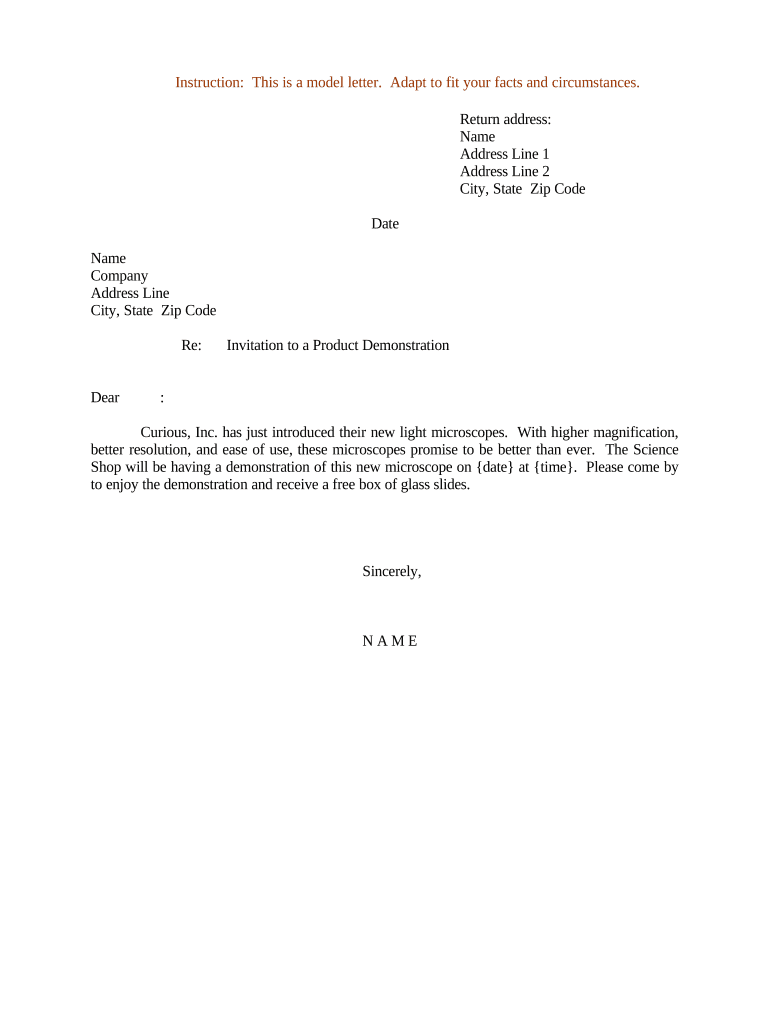
A Letter of Invitation to Product Demonstration is a formal business communication that invites a client, partner, or prospect to attend a product demonstration. It sets expectations by describing the product, objectives, date, time, location or virtual access, expected attendees, and RSVP instructions. The letter can be used for one-to-one demos, group sessions, trade-show follow-ups, or partner briefings and often includes logistical details, confidentiality notes, and next-step guidance for attendees.

Why a Clear Invitation Matters

A well-constructed invitation clarifies objectives, reduces scheduling friction, and documents consent to demo logistics. It supports professional coordination, enables accurate headcounts, and creates an audit trail that helps teams follow up consistently and measure outreach effectiveness.

Why a Clear Invitation Matters

Who Typically Sends and Receives These Invitations

Teams that manage product outreach, sales enablement, and partner relations commonly prepare these letters; recipients are prospects, customers, resellers, or internal stakeholders.

  • Sales teams coordinate demos with prospects to advance pipeline and gather requirements.
  • Product and marketing managers invite target users for feature walkthroughs and feedback sessions.
  • Channel partners and distributors schedule joint demonstrations to support reseller enablement.

Issuers should ensure the sender has authority to schedule demos and include a clear RSVP mechanism to confirm attendance and collect any access requirements.

Essential Elements to Include in Every Invitation

A professional invitation contains specific details that remove ambiguity and reduce follow-up. Include the product name, scope, audience, logistics, host contact, and action items so recipients can respond and prepare.

Product Overview

One-paragraph summary of the product, key capabilities, and demo focus so attendees know what to expect.
Objective

Clear statement of the demo goal (e.g., evaluate integration, validate performance, procurement decision).

Date & Time

Include timezone and duration estimate; note if multiple time options or sessions are available.

Location / Access

Physical address with parking or virtual meeting link, dial-in numbers, and access codes when applicable.

Attendees

List required or recommended attendees and their roles to ensure appropriate representation.

RSVP & Next Steps

Provide RSVP deadline, contact details, and actions required before the demo (e.g., pre-work, datasets).

Required Information and Short Field Checklist

Host Name: Organizer full name
Product Name: Official product title
Demo Date/Time: MM/DD/YYYY and timezone
Location/Link: Physical address or URL
RSVP Deadline: MM/DD/YYYY or relative period
Contact Info: Email and phone number

Risks When Invitations Are Incorrect or Incomplete

Scheduling Conflicts: Missed meetings or attendee no-shows
Reputational Harm: Perceived unprofessionalism with prospects
Privacy Exposure: Sharing attendee data without consent
Contractual Confusion: Misunderstood deliverables or follow-up commitments
Operational Delays: Late logistics or resource allocation
Data Loss: Untracked changes or missing communications

Common Preparation Mistakes to Avoid

  • Failing to include timezone information causes missed sessions and extra coordination work for both hosts and attendees.
  • Omitting attendee roles produces unclear expectations about who should attend or approve next steps after the demo.
  • Using vague objectives like 'overview' makes it difficult for prospects to judge relevance, reducing attendance rates.
  • Not providing RSVP options and reminders increases no-show rates and complicates capacity planning for live demos.

Step-by-Step: Drafting an Effective Invitation

Follow these steps to create a clear, actionable letter that supports attendance and downstream tracking.

  • 01
    Draft core details: Write product summary, objective, and logistics first.
  • 02
    Specify attendees: List required roles and stakeholder expectations.
  • 03
    Add RSVP instructions: Include deadline and contact for confirmations.
  • 04
    Send and track: Distribute via preferred channel and record responses.

Where and How to Send the Invitation

Choose a distribution method that matches recipient preferences and preserves tracking. Document the sending channel to maintain an audit trail.

  • Email: Send personalized invitations and use read receipts or tracking pixels.
  • Calendar Invite: Attach the agenda and meeting link inside the calendar event.
  • Secure Portal: Publish invitations to a controlled customer portal for large accounts.
  • eSignature Platform: Route for confirmation and signatures if agreements are attached.

Configuring an Online Invitation Workflow

When automating invitations, configure authentication, reminders, and conditional fields to reduce manual follow-up and ensure compliance.

Field Configuration
Authentication Email token or SMS code as needed
Reminders Set automated reminders 48 and 24 hours prior
Conditional Fields Show access details only after RSVP
Attachments Include NDA or product brief PDFs

Technical Considerations for Digital Invitations

Ensure your platform supports required file types, authentication methods, and integrations so the invitation process is reliable and auditable.

  • File Formats: PDF, DOCX accepted
  • Integrations: CRM and calendar systems
  • Authentication: Email, SMS, or KBA

Choose an eSignature or distribution platform that records timestamps and identities, preserves attachments, and integrates with your CRM for follow-up tracking.

Recommended Timelines and Deadlines

Use standard lead times to maximize attendance and give hosts time to prepare resources and environment.

Invitation Lead Time:

Send at least 7 days before the demo to allow scheduling.

RSVP Deadline:

Set RSVP cutoff at least 48 hours before the demo.

Pre-Demo Confirmation:

Send a confirmation 24 hours before the session.

Follow-Up Window:

Plan follow-up within 3 business days after the demo.

Archive Date:

Store final materials immediately after follow-up is complete.

Key Milestones from Draft to Demonstration

Track these milestones to ensure invitations move from draft to confirmed event without bottlenecks.

01

Draft Completed

Finalize content and required attachments before review.

02

Approval and Sign-off

Obtain internal approvals for attendees and materials.

03

Invitation Sent

Distribute via selected channels and record sends.

04

RSVP Close

Confirm attendee list and prepare resources.

Typical eSignature Pricing and Feature Comparison

Compare common vendor pricing and capabilities for invitation distribution and signature workflows. signNow appears first to show a competitive baseline without implying endorsement.

signNow DocuSign Adobe Sign PandaDoc HelloSign
Starting Price $8/user/mo $15/user/mo $14/user/mo $19/user/mo $15/user/mo
Free Trial 7-day free trial Varies by vendor Varies by vendor Varies by vendor Varies by vendor
Bulk Send Yes Yes Yes Yes No
Audit Trail Yes Yes Yes Yes Yes
HIPAA Compliant Yes Yes Yes No No
Envelope Cap No cap 100 envelopes/user/year Varies Varies Varies

Examples: How Organizations Use Invitation Letters

Real customers use formal invitations to schedule demos, capture approvals, and document follow-up responsibilities in a single record.

Optica Ventures — COO

Optica used standardized invitations to reduce confusion around demo scope and attendees.

  • The result improved alignment for technical and procurement stakeholders.
  • Brian Fitzgibbons, COO, noted the interface is simple and easy-to-use and that consistent invitations helped customers prepare and engage more effectively.

Martin Properties — Founder

Martin Properties moved events online and standardized invites for walkthroughs and vendor demos.

  • Centralized templates reduced scheduling errors and improved attendance tracking.
  • Tim Martin, Founder, reported processing and executing documents online with full compliance and better efficiency for mobile and offline scenarios.

Practical Tips for Accurate, Efficient Invitations

Follow these practical practices to reduce rework and improve attendee experience when sending demonstration invitations.

Use a standard template consistently
Create and maintain a template that includes all required fields and attachments so senders do not omit key details; store it in a shared library.
Include timezone and duration
Always state the timezone and estimated duration to avoid mis-scheduling across regions; add calendar attachments to reduce friction.
Attach required documents
If the demo requires an NDA, datasheet, or sample data, attach them and note any pre-demo actions to ensure participants arrive prepared.
Track responses and preserve audit trail
Use a platform that records sends, opens, RSVPs, and confirmations to enable accurate follow-up and maintain compliance records.

Frequently Asked Questions

Answers to common questions about digital invitations, e-signing, notarization, and recordkeeping for product demonstrations.


Need help? Contact support

be ready to get more
Join over 28 million airSlate SignNow users