Establishing secure connection…Loading editor…Preparing document…

Letter of Recommendation Offer

This template is fully customizable. Edit the text, fill out the fields, and send it for signature. Give it a try!
Letter of Recommendation Offer

What a Letter of Recommendation Offer Is

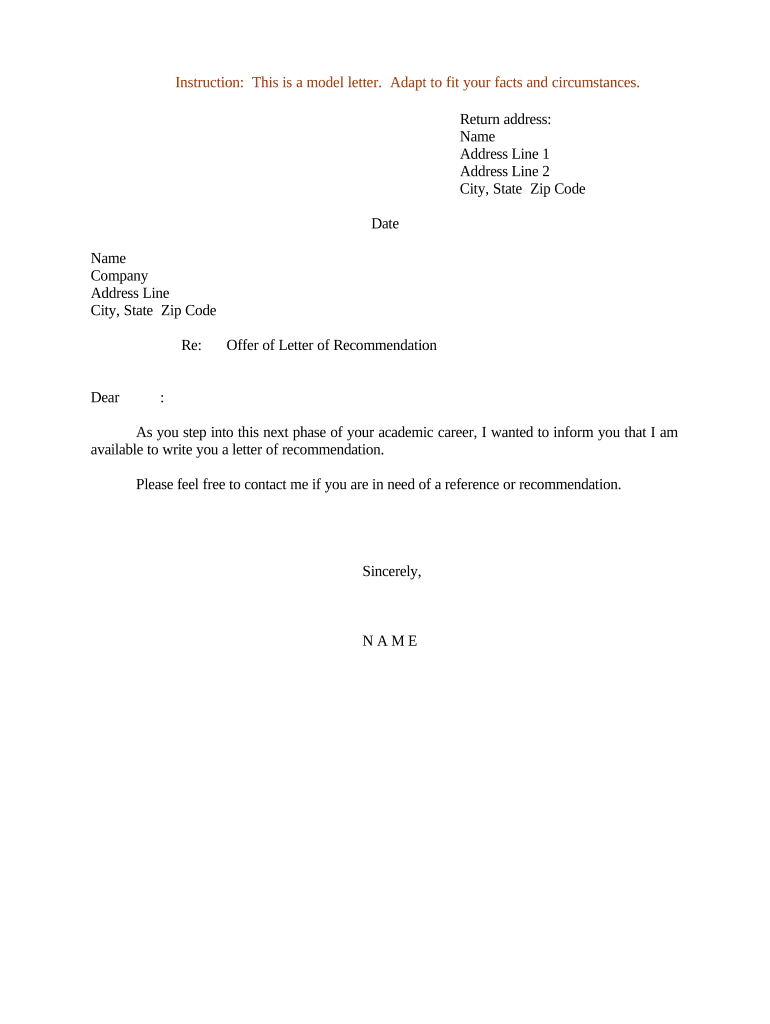
A Letter of Recommendation Offer is a formal written statement from an individual or organization offering to provide a recommendation for a named person for employment, admission, licensure, or other opportunity. The document typically states who will provide the recommendation, the scope or subject matter, any conditions or deadlines, and contact information for follow-up. It can be used to obtain consent from the candidate, outline reference limits, and record the recommender's willingness. Electronically executed offers are generally enforceable under ESIGN (15 U.S.C. ch. 96) and state UETA laws when intent and consent are documented.

Why a Clear Offer Letter Matters

A clear Letter of Recommendation Offer sets expectations, documents consent, limits liability, and speeds processing for hiring or admissions. It protects both recommender and candidate by specifying scope, timelines, and privacy considerations.

Why a Clear Offer Letter Matters

Who Typically Issues or Receives This Offer

Common users include supervisors, faculty, institutional HR teams, and candidates seeking formalized references.

  • Supervisors and managers provide professional context and endorse skills relevant to a job or promotion.
  • Academic faculty offer subject- or program-specific recommendations for admissions and fellowships.
  • HR or talent teams formalize reference offers to meet internal hiring policies and compliance.

Clear role alignment reduces misunderstandings and helps recipients know who will be contacted and why.

Core Elements to Include in the Offer

A professional Letter of Recommendation Offer contains specific sections so recipients understand the scope, timeline, and how to accept or decline.

Provider Identity

Full name, title, affiliation, and professional contact details so recipients can verify the recommender and follow up if needed.
Candidate Details

Candidate full legal name and identifying details to avoid ambiguity and ensure the recommendation is associated with the correct person.

Scope and Purpose

A concise description of what the recommendation will address, such as job role, program admission, licensure, or character reference.

Delivery and Timing

How the letter will be delivered, expected completion date, and any deadlines requested by the recipient or applicant.

Consent and Limits

Statement that the candidate consents to the recommendation and any limits on what will be disclosed, such as performance details.

Signature Block

Recommender signature, printed name, date, and optional electronic signature metadata or audit trail reference.

Step-by-Step: Prepare and Send the Offer

Follow these sequential steps to draft, obtain consent, and deliver a Letter of Recommendation Offer efficiently.

  • 01
    Draft the offer: Write provider, candidate, scope, and deadlines clearly.
  • 02
    Obtain candidate consent: Confirm candidate agrees and notes any disclosure limits.
  • 03
    Select delivery method: Choose email, secure portal, or eSignature platform.
  • 04
    Record completion: Save signed copy and audit trail for retention.

Where to Send or File the Completed Letter

Routing depends on the recipient's requirements; common destinations and methods are listed below.

  • Direct to Employer: Email or upload to employer HR portal per instructions.
  • Admissions Office: Send to the program's application system or admissions email.
  • Candidate Copy: Provide the candidate with a signed copy when appropriate.
  • Archived Record: Store a copy in organizational records per retention policy.

Configuring an Online Workflow for Offers

Set up fields and routing in your e-signature or document platform to collect consent and signature reliably.

Field Configuration
Provider Details Required text fields, validated name entry
Candidate Details Required text fields, email verification
Consent Checkbox Single-checkbox with timestamp capture
Signature Electronic signature field with audit trail

Sharing Options and Platform Considerations

Choose a distribution method that matches recipient requirements and preserves evidence of consent.

  • Delivery Formats: PDF and DOCX supported; PDF recommended for immutable copy.
  • Authentication: Email link or SMS code; stronger auth reduces risk of misattribution.
  • Integrations: Integrate with CRM or HR systems like Salesforce or Microsoft 365 for recordkeeping.

Use a platform that produces an audit trail and stores signed copies securely to meet legal and organizational retention requirements.

Typical Timelines and Turnaround Expectations

Letters of Recommendation Offers often follow predictable timing; set realistic deadlines and confirm candidate availability.

Offer Creation Time:

Draft and review within 1–3 business days.

Candidate Response:

Ask for consent within 3–7 calendar days.

Recommender Completion:

Allow 5–14 days depending on complexity.

Expedited Requests:

Use 48–72 hour turnaround only when agreed.

Record Retention:

Store signed copy immediately after completion.

Common Mistakes to Avoid

  • Using initials or informal names instead of full legal names can create identity ambiguity and delay processing for verification.
  • Failing to document candidate consent or disclosure limits may create privacy disputes or FERPA issues for student records.
  • Omitting delivery instructions or recipient contact details often leads to misrouted letters or missed deadlines.
  • Relying on informal email confirmations without a retained signed copy risks loss of proof and future disputes.

Key Risks and Consequences

Defamation Risk: False statements can create legal exposure.
Privacy Breach: Unauthorized disclosure may trigger FERPA or state claims.
Invalid Signature: Missing intent or consent undermines enforceability.
Processing Delay: Incomplete offers can cause missed deadlines.
Recordkeeping Gaps: Loss of audit trail hinders dispute resolution.
Misidentification: Incorrect candidate details cause misattribution.

Security and Compliance Essentials

Encryption: TLS 1.2/1.3 in transit; AES-256 at rest
Audit Trail: Timestamped actions, IP address logging
Access Control: Role-based permissions and MFA options
Certifications: SOC 2 Type II, ISO 27001 available
Legal Frameworks: ESIGN and UETA compliant for e-signatures
HIPAA Support: BAA available where required

Real-World Uses and Examples

Organizations and individuals use an Offer Letter template to formalize recommendations across hiring and academic settings; these examples show typical scenarios.

Case Study — Martin Properties

As a small real estate firm, the manager prepared a standardized offer to recommend leasing agents for certification.

  • The document clarified scope and timeline.
  • Using a signed offer ensured candidate consent and produced a retained copy tied to the recommender for audit and HR records.

Case Study — Optica Ventures

A venture services COO documented offers to provide investor references for portfolio founders.

  • The offer limited topics to professional performance.
  • Recording the offer and signed consent reduced follow-up questions and preserved compliance with internal reference policies.

Practical Tips for Accurate Offers

Follow these best practices to reduce risk, ensure clarity, and speed recipient processing when preparing a Letter of Recommendation Offer.

Use full legal names
Always enter full legal names for recommender and candidate to avoid misidentification. Include professional affiliation and a direct business email. Confirm spelling with the candidate before finalizing the offer to prevent verification delays and ensure the reference attaches to the correct file.
Specify scope clearly
State exactly what the recommendation will address and any exclusions. Avoid vague phrasing that could be interpreted broadly. Limiting scope reduces defamation risk and sets realistic expectations for both candidate and recipient about content and purpose.
Document consent explicitly
Include a clear consent line signed by the candidate. For student records or other protected categories, reference applicable privacy rules. Explicit consent helps comply with FERPA and demonstrates the candidate authorized disclosure of their information.
Retain the signed record
Store the signed offer and associated audit trail in a secure records system. Maintain retention per federal and organizational rules to support future inquiries or disputes; secure storage also helps demonstrate compliance with ESIGN and internal policies.

How This Offer Differs from Related Documents

Compare common reference-related documents so you use the correct format and set proper expectations for recipients and candidates.

Document Type Letter of Recommendation Offer Reference Letter
Purpose offer intent provides endorsement
Initiated by recommender or hr recommender
Recipient candidate or organization hiring committee
Formality administrative record substantive content

eSignature Vendor Comparison for Delivering Offers

Pricing and feature differences matter when you select a platform for electronic delivery and signature of recommendation offers. signNow is listed first for direct comparison.

signNow DocuSign Adobe Sign PandaDoc HelloSign
Starting Price $8/user/mo $15/user/mo $14/user/mo $19/user/mo $15/user/mo
Free Trial Yes, 7-day trial Varies Varies Varies Varies
Bulk Send Yes Varies Varies Varies Varies
Audit Trail Yes Yes Yes Yes Yes
HIPAA Compliant Yes Varies Varies Varies Varies

Frequently Asked Questions and Troubleshooting

Answers to common questions about drafting, delivering, and keeping a Letter of Recommendation Offer, including e-signature concerns and privacy.


Need help? Contact support

be ready to get more
Join over 28 million airSlate SignNow users