Establishing secure connection…Loading editor…Preparing document…

Letter Requesting Employee List for ADHD Testing

This template is fully customizable. Edit the text, fill out the fields, and send it for signature. Give it a try!
Letter Requesting Employee List for ADHD Testing

What this Letter Is and When to Use It

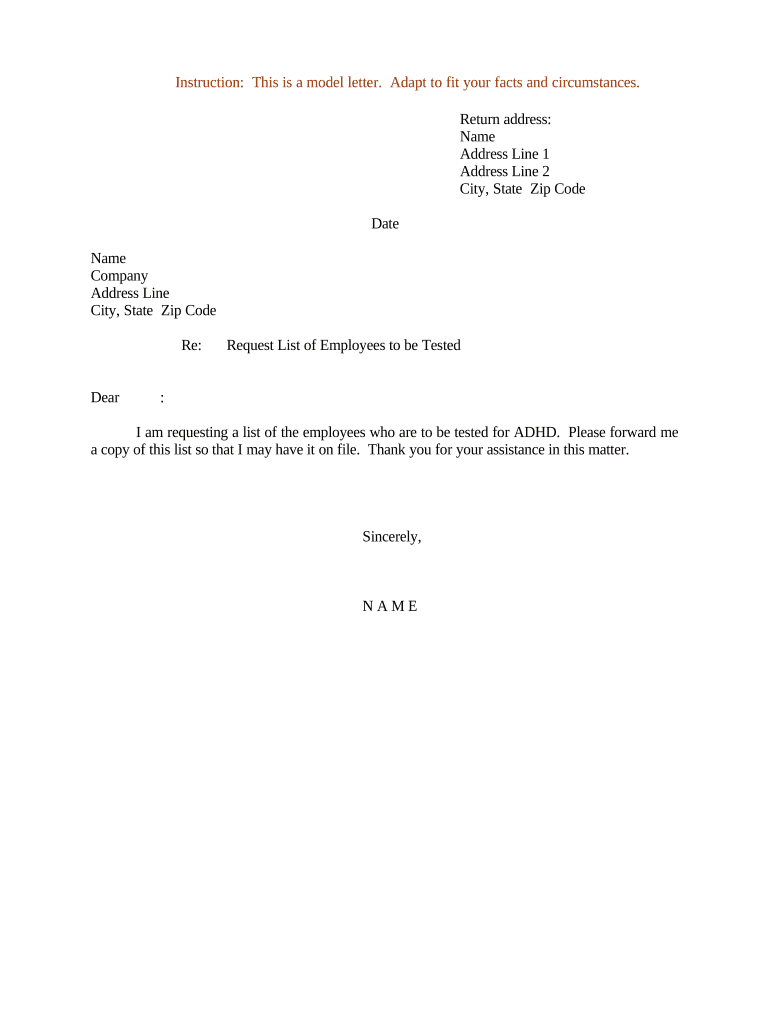
A Letter Requesting Employee List for ADHD Testing is a formal written request from an employer, HR representative, or authorized medical evaluator asking a specific department, manager, or third-party contractor to provide a roster of employees who meet defined criteria for ADHD screening or assessment. The letter defines scope, purpose, data elements requested, required employee consent, and how results will be used. It also explains confidentiality safeguards and delivery instructions. Drafting the letter carefully helps meet ADA, HIPAA, and internal privacy obligations while ensuring clear, auditable communication between organizational stakeholders.

Why a Clear Request Letter Matters

A precise letter protects employee privacy, documents the legitimate need for testing, and creates a consistent, auditable process for accommodating neurodiversity while reducing ambiguity across HR, medical, and management teams.

Why a Clear Request Letter Matters

Who Typically Prepares and Receives This Letter

Typical originators and recipients include HR, occupational health, managers, and external evaluators involved in testing coordination.

  • HR business partners coordinating accommodation processes and recordkeeping.
  • Occupational health or third-party medical providers overseeing testing logistics.
  • Line managers or department admins responsible for producing rosters.

Key Roles and Who Signs

HR Manager

An HR Manager or HR Director usually prepares and approves the request, ensuring it aligns with accommodation policies and data-minimization principles. They confirm that consent protocols are in place before sending or sharing any employee lists with evaluators.

Medical Reviewer

An Occupational Health Director or authorized clinician may receive and acknowledge the list, confirm testing criteria, and sign to attest that access will be limited to authorized personnel and used only for diagnostic or accommodation purposes.

Essential Data Elements to Include

Protected Health Info: Limit to necessary PHI
Employee Identifiers: Full name and DOB
Job Information: Title and department
Contact Details: Work email and phone
Consent Record: Signed consent indicator
Retention Note: Storage and deletion term

Potential Risks of a Flawed Request

HIPAA Violation: Unauthorized PHI disclosure
ADA Exposure: Improper accommodation handling
Discrimination Risk: Perceived singling out
Data Breach: Insecure transmission
Legal Challenge: Records used in litigation
Operational Delay: Missing or vague scope

Common Preparation Pitfalls to Avoid

  • Requesting overly broad employee data without documented clinical or business justification increases privacy and legal risk and complicates compliance with HIPAA and ADA principles.
  • Failing to include a clear consent mechanism and explanation of use can result in refusal by employees or complaints to HR or regulators.
  • Sending employee lists to multiple recipients or personal email accounts increases chance of unauthorized access or accidental disclosure.
  • Not specifying retention and deletion policies leads to indefinite retention and greater exposure in the event of a data subject request or audit.

How to Prepare and Send the Letter — Step-by-Step

Follow these sequential steps to prepare a compliant, concise request letter that protects privacy and documents authority.

  • 01
    Draft Purpose: State testing rationale and legal basis
  • 02
    Define Scope: Specify the exact employee criteria
  • 03
    Attach Consent: Include signed employee consent forms
  • 04
    Send Securely: Transmit using encrypted or eSigned channels

Typical Submission and Response Flow

A predictable workflow reduces delays and preserves an auditable record from request to receipt to testing.

  • Request Issued: Sender creates and signs letter
  • Recipient Acknowledges: Recipient confirms receipt and timeline
  • List Prepared: Authorized admin compiles roster securely
  • Secure Delivery: Roster delivered with access controls

Core Components to Include in the Letter

A professional request letter should be concise, legally grounded, and explicit about scope, consent, and handling to reduce ambiguity and protect privacy.

Header

Include sender name, title, organization, and contact details so recipients can verify authority and follow up with questions.
Purpose

Concise statement of why the employee list is needed, the testing authority, and how results will be used for accommodations or clinical evaluation.

Scope

Precise inclusion criteria such as job roles, locations, or date ranges to limit data collection to what is necessary.

Consent Statement

Confirm that employees have provided written consent or describe the consent process and attach consent forms when required.

Security Instructions

Specify delivery method, encryption requirements, recipient limits, and storage controls to prevent unauthorized disclosures.

Signature Block

Include printed name, title, signature, and date; indicate who has authority to sign on behalf of the organization.

Configuring an Electronic Workflow for the Request

Set up a repeatable digital workflow to collect, approve, and transmit employee lists while maintaining an audit trail.

Field Configuration
Request Template Use a standard letter template with conditional fields
Approval Route Require HR approval before release
Authentication Use two-factor or corporate SSO for signers
Audit Trail Enable timestamps, IP logging, and version history

Technical Requirements for Secure Sharing

Choose platforms that support encrypted transmission, audit trails, and role-based access controls.

  • File Formats: PDF or DOCX preferred
  • Authentication: SSO, SMS, or KBA options
  • Integrations: Supports HRIS and storage connectors

Verify integrations with HR systems, and ensure any eSignature provider used can meet HIPAA or organization-specific compliance agreements.

Typical Timelines and Response Expectations

Establish reasonable deadlines and communicate them clearly in the letter to avoid delays and set expectations for all parties.

Initial Response Time:

Request acknowledgment within 3 business days

Roster Preparation:

Deliver compiled list within 7–14 days

Escalation Window:

Escalate unresolved issues after 10 business days

Testing Schedule:

Propose testing dates within 14–30 days

Record Retention:

Specify retention period in the letter

Key Milestones from Request to Results

Track these sequential milestones to maintain momentum and an auditable record of actions taken during the testing process.

01

Request Sent

Letter created, approved, and transmitted securely to recipient

02

Acknowledgment Received

Recipient confirms receipt and planned delivery date

03

List Compiled

Authorized administrator compiles roster and validates consent

04

Testing Completed

Evaluations scheduled and final reports returned to authorized parties

eSignature Pricing and Capability Comparison

Compare common eSignature criteria to select a platform that meets security and volume needs; signNow is listed first per comparisons.

signNow DocuSign Adobe Sign PandaDoc HelloSign
Starting Price $8/user/mo $15/user/mo $14/user/mo $19/user/mo $15/user/mo
Free Trial 7-day free trial Varies by vendor Varies by vendor Varies by vendor Varies by vendor
Bulk Send Yes Yes Yes Yes No
Audit Trail Yes Yes Yes Yes Yes
HIPAA Compliant Yes Yes Yes No No
Envelope Cap No envelope cap 100 envelopes/user/year Varies Varies Varies

Frequently Asked Questions and Practical Answers

Answers to common questions about preparing, sending, and safeguarding a Letter Requesting Employee List for ADHD Testing.


Need help? Contact support

be ready to get more
Join over 28 million airSlate SignNow users