Scope of Supply
Precisely describe goods or materials, part numbers, technical specifications, acceptable substitutes, and any applicable standards to avoid delivery disputes and ensure consistent quality.
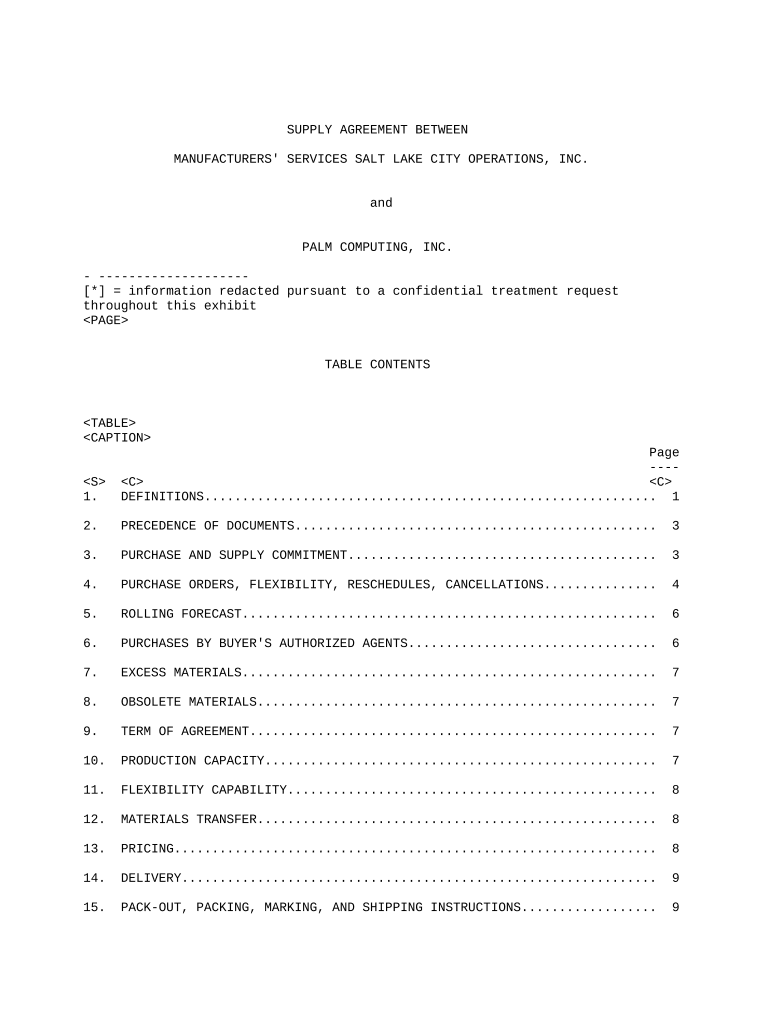
A well-drafted Supply Agreement reduces delivery disputes, clarifies payment obligations, and allocates risk between buyer and supplier. It establishes performance metrics and remedies, making enforcement and operational planning more predictable while helping organizations comply with procurement, tax, and regulatory requirements.

Procurement, operations, legal teams, and vendors commonly prepare or review supply agreements before execution.
Final signature authority often rests with executives or delegated contracting officers specified in company policy.
A senior procurement officer or director who negotiates key commercial terms and signs on behalf of the buyer; they ensure terms align with company purchasing policies and budgets and may require legal sign-off for nonstandard clauses.
An authorized officer or contract manager for the supplier who accepts contractual obligations and warranties; their signature binds the supplier to delivery schedules, quality standards, and payment terms.
Precisely describe goods or materials, part numbers, technical specifications, acceptable substitutes, and any applicable standards to avoid delivery disputes and ensure consistent quality.
State firm prices or pricing formulas, currency, invoicing schedule, payment terms (for example Net 30), late fees, and provisions for taxes or duties to prevent billing disagreements.
Specify delivery terms (Incoterms or equivalent), delivery schedule, point of title transfer, risk of loss allocation, and acceptance testing procedures for shipped goods.
Define supplier warranties, remedy processes for nonconforming goods, return procedures, and limitations of liability to make corrective actions and recoveries predictable.
Set termination rights for convenience and for cause, cure periods, obligations on termination, and any post-termination supply or transition support required.
Include representations about regulatory compliance, export controls, privacy protections for shared data, and any required addenda such as HIPAA business associate agreements where applicable.
| Field | Configuration |
|---|---|
| Signer order | Buyer first | Supplier second |
| Required fields | Effective date, signature, printed name |
| Authentication | Email link or SMS code |
| Audit trail | Capture IP, timestamp, and actions |
Choose a platform that supports secure signing, audit trails, and the integrations your teams need.
Also confirm regulatory compliance (e.g., ESIGN, UETA, HIPAA if applicable) and available authentication methods before selecting a provider.
Tim Martin used a standardized supply agreement to consolidate vendor terms across five projects into one template, reducing negotiation time by 30%
John Butler integrated a supply agreement with an electronic signature workflow to manage purchased medical supplies across clinics, simplifying approvals
| Criteria | Supply Agreement | Purchase Order |
|---|---|---|
| Typical use | long-term relationship | single purchase |
| Formality | high | low |
| Key terms | comprehensive | limited |
| Payment obligation | contractual schedule | order-level payment |
| signNow | DocuSign | Adobe Sign | PandaDoc | HelloSign | |
|---|---|---|---|---|---|
| Starting Price | $8/user/mo | $15/user/mo | $14/user/mo | $19/user/mo | $15/user/mo |
| Free Trial | 7-day free trial | Varies | Varies | Varies | Varies |
| Bulk Send | Yes | Yes | Yes | Yes | No |
| Audit Trail | Yes | Yes | Yes | Yes | Yes |
| HIPAA Compliant | Yes | Yes | Yes | No | No |