Establishing secure connection…Loading editor…Preparing document…

Warrant for Common Stock Purchase

This template is fully customizable. Edit the text, fill out the fields, and send it for signature. Give it a try!
Warrant for Common Stock Purchase

What a Warrant for Common Stock Purchase Is

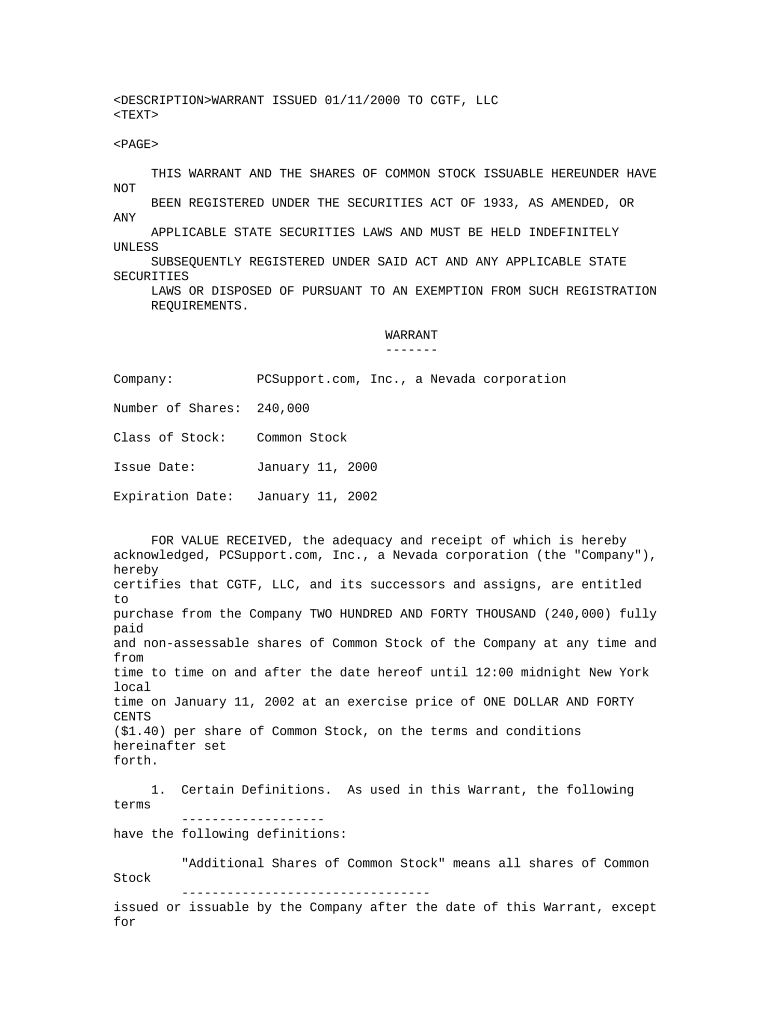
A Warrant for Common Stock Purchase is a contractual security granting the holder the right, but not the obligation, to buy a specified number of shares of a company's common stock at a predetermined price within a defined period. Warrants are issued in financing, compensation, or conversion transactions and are separate from existing shares. The document sets exercise price, vesting and expiration terms, adjustment mechanisms for corporate events, transfer restrictions, notice and payment mechanics, and any conditions precedent for issuance or exercise.

Why a Clear Warrant Matters

A precisely drafted Warrant for Common Stock Purchase reduces disputes, clarifies exercise mechanics, protects both issuer and holder rights, and supports enforceability under federal e-signature laws when properly executed.

Why a Clear Warrant Matters

Who Prepares and Signs These Warrants

Parties who prepare or sign warrants include startups, investors, corporate counsel, and transaction agents responsible for securities issuance and recordkeeping.

  • Startup founders and finance teams negotiating capital raises or convertible instruments.
  • Angel investors, venture funds, and secondary buyers evaluating dilution and exercise terms.
  • Corporate and securities attorneys drafting investor protections, registration clauses, and transfer restrictions.

Core Sections to Include in a Professional Warrant

A complete Warrant for Common Stock Purchase should specify parties, shares, exercise price, term, adjustment formulas, transfer restrictions, exercise mechanics, and remedies to avoid ambiguity.

Parties

Identify issuer and holder by full legal names, entity type, and address; clarify whether affiliates or subsidiaries are included under the instrument.
Grant

Specify the total shares issuable on exercise, fractional-share rules if any, and conditions limiting issuance such as pre-emptive rights or required approvals.

Exercise Price

State the per-share price or formula, including adjustment triggers for stock splits, dividends, recapitalizations, and the calculation method for changes.

Term

Define the exercise window, expiration date, vesting schedule if applicable, and early-termination events such as insolvency or change of control.

Transfer Restrictions

Describe assignment rules, legend requirements, right of first refusal, and conditions ensuring compliance with securities laws and registration exemptions.

Mechanics

Detail notice procedures to exercise, payment methods, share issuance steps, required corporate approvals, and recordkeeping responsibilities.

Essential Information to Include

Issuer Name: Full legal corporate name as filed.
Holder Name: Exact legal name of the warrant holder.
Number of Shares: Total shares subject to the warrant.
Exercise Price: Price per share, stated in USD.
Expiration Date: Use MM/DD/YYYY exact date format.
Governing Law: State chosen for dispute resolution.

Step-by-Step: Completing the Warrant

Follow these core steps to complete the warrant accurately and minimize legal risk during issuance and exercise.

  • 01
    Prepare Draft: Populate parties, shares, price, and term.
  • 02
    Internal Approval: Obtain board and counsel approvals if required.
  • 03
    Execution: Have authorized signatories sign and date.
  • 04
    Record Issuance: Update stock ledger and notify transfer agent.

How to Configure an Online Signing Workflow

When completing online, configure fields, signer order, and authentication to match corporate approval workflows and securities compliance.

Field Configuration
Signer Authentication Level Email link plus SMS code verification.
Signer Order and Roles Set issuer then holder signing order.
Conditional Fields Show exercise form only after signature.
Audit Trail Settings Enable full audit trail and timestamps.

Typical Execution and Delivery Flow

Typical routing covers document upload, field placement, signer notification, authentication, signing, and delivery of executed copies with audit evidence.

  • Upload Document: Upload final warrant PDF or Word file.
  • Place Fields: Add signature, date, and numeric fields.
  • Send to Signers: Enter signer emails and optional message.
  • Complete Audit: Platform captures IP, timestamps, and log.

Platform Capabilities for eSigning and Compliance

Choose a platform that supports PDF/DOCX, robust audit trails, and secure signer authentication to maintain enforceability and compliance.

  • Formats Supported: PDF, DOCX, HTML supported.
  • Integrations: CRM and storage integrations available.
  • Authentication: Email, SMS, or KBA options.

Key Deadlines and Timing Considerations

Key timing items include exercise windows, notice periods, transfer restriction durations, and any filing deadlines for securities or tax reporting obligations.

Exercise Period Deadline:

Observe expiration date stated in MM/DD/YYYY format.

Notice of Exercise:

Deliver notice per contract within specified days.

Share Issuance Timing:

Issuer must issue shares after payment and acceptance.

Tax Reporting Obligations:

Report stock-based compensation per IRS rules.

Recordkeeping Requirements:

Update ledgers immediately and retain copies.

Common Preparation Mistakes to Avoid

  • Using ambiguous exercise price formulas that lack adjustment methods leads to disputes and valuation differences, increasing negotiation costs and possibly litigation.
  • Failing to obtain board or shareholder approvals where required can render issuance void and create legal exposure under state corporate law.
  • Incorrect beneficiary or holder naming, or mismatched entity names, can prevent exercise and trigger compliance or tax complications.
  • Not aligning transfer restrictions with securities laws and company bylaws risks unlawful transfers and potential rescission or buyer liability.

Penalties and Risks of Errors

Tax Risk: Possible withholding or reporting.
Securities Liability: Rescission or fines possible.
Invalid Issuance: Board approval absent invalidates.
Delayed Transfer: Holders unable to exercise.
Contract Dispute: Litigation and costs follow.
Regulatory Penalty: SEC enforcement risk.

Practical Examples of How Organizations Use Warrants

Real-world examples show how organizations use warrants for financing or compensation, and the operational steps they followed for issuance and execution.

Optica Ventures LLC

Optica Ventures used warrants to provide investor upside without immediate dilution during a seed funding round.

  • Transaction accompanied a convertible note.
  • The company documented exercise mechanics, updated its stock ledger promptly, provided notice procedures to holders, and relied on counsel to confirm compliance with state securities rules and investor consent provisions prior to any exercise.

Martin Properties

Martin Properties executed warrants to streamline property joint venture equity conversions and to enable remote investor signing processes.

  • They used eSignature workflows for investor signatures.
  • Using an online execution process allowed faster funding milestones, clear audit trails for each exercise, and simplified record transfer between counsel, escrow, and transfer agent to expedite issuance.

Comparing eSignature Vendors for Warrant Execution and Tracking

The table compares typical plan starting prices and core features relevant to executing and tracking Warrant for Common Stock Purchase documents across eSignature vendors.

signNow DocuSign Adobe Sign PandaDoc HelloSign
Starting Price $8/user/mo $15/user/mo $14/user/mo $19/user/mo $15/user/mo
Free Trial 7-day free trial Varies Varies Varies Varies
Bulk Send Yes Yes Yes Yes Yes
Audit Trail Yes Yes Yes Yes Yes
HIPAA Compliant Yes Yes Yes No No
Envelope Cap No cap 100 envelopes/user/year Varies Varies Varies

FAQs: Common Questions About Warrant Execution and eSigning

Answers to common questions about execution, e-signing, enforceability, and recordkeeping for a Warrant for Common Stock Purchase.


Need help? Contact support

be ready to get more
Join over 28 million airSlate SignNow users