Case Identification
Court name, docket or case number, and judgment date so the writ ties directly to the underlying judgment and avoids ambiguity when presented to a garnishee or clerk.
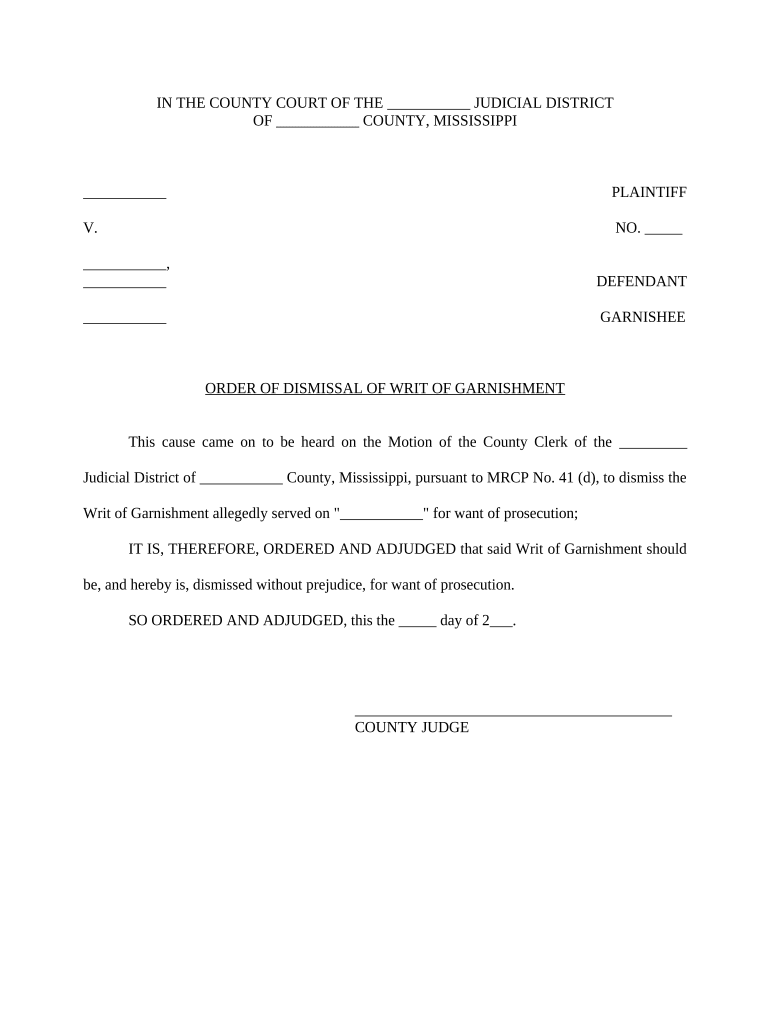
A Writ of Garnishment provides a statutory, court-authorized path to satisfy a money judgment by reaching third-party assets, reduces the need for direct collection suits against the debtor, and creates a structured process for withholding and remittance while preserving legally exempt funds.

Creditors, collection attorneys, clerks, and process servers commonly prepare or manage the Writ of Garnishment Form.
A party awarded a money judgment who seeks post-judgment collection. Typically instructs counsel to prepare the writ, identifies garnishee(s), provides supporting judgment documentation, and monitors compliance until funds are collected or exemptions resolved.
A third party (employer, bank) served with the writ; responsible for freezing or withholding specified funds, completing the statutory answer or return, and remitting payments to the court while preserving any legally exempt amounts.
Court name, docket or case number, and judgment date so the writ ties directly to the underlying judgment and avoids ambiguity when presented to a garnishee or clerk.
Full legal names and contact details for judgment creditor, judgment debtor, and garnishee; accuracy avoids service failures and mismatched record problems at the court or garnishee institution.
Specify the total amount sought, itemized fees or interest if permitted, and whether the writ targets wages, bank accounts, or other property to guide proper withholding.
Statutory or model notice that informs the garnishee and debtor of rights, exemptions, and required responses; many states prescribe exact wording or attachments.
How to serve the writ (personal service, certified mail, sheriff/process server), where to file proof of service, and who to notify for garnishee compliance or release.
Court clerk block for filing stamp, judge signature or clerk attestation, and dates required to validate the writ and begin statutory response timelines.
| Field | Configuration |
|---|---|
| Authentication | Email + SMS code or stronger KBA for signer verification. |
| Document Format | Use PDF/A or PDF to preserve formatting and signatures. |
| Conditional Fields | Show exemption questionnaires only when applicable. |
| Archival Storage | Retain signed copies and audit log for required retention periods. |
Use secure eSignature platforms that support audit trails, strong encryption, and configurable authentication when electronic signing is allowed.
Often 20–30 days from service; varies by state.
Court may set a hearing within weeks to months after filing.
Garnishee typically remits withheld funds by a court-ordered date.
Withholding continues until satisfaction, release, or court order.
Some writs expire by statute or local rule if not enforced promptly.
Court enters final judgment; creates right to pursue garnishment.
Clerk issues or signs the writ enabling service on the garnishee.
Garnishee is served and required to respond per statute.
Garnishee withholds and remits funds to court or creditor.
Affidavits supporting the writ commonly require sworn statements by the creditor or agent.
Many courts require a notary acknowledgment for affidavits or service proofs.
RON may be accepted where state law permits remote notary acts.
Witness signatures are rarely required for writs but may be needed for affidavits in some states.
If RON is used, retain audio-video proof per state RON rules.
Clerk may require original or certified copies for filing.
Affidavit of service typically needs signature and notary per local rule.
Keep notarized documents and journals to satisfy audit or appeal.
| signNow | DocuSign | Adobe Sign | PandaDoc | HelloSign | |
|---|---|---|---|---|---|
| Starting Price | $8/user/mo | $15/user/mo | $14/user/mo | $19/user/mo | $15/user/mo |
| Free Trial | 7-day free trial | Varies | Varies | Varies | Varies |
| Bulk Send | Yes | Yes | Yes | Yes | No |
| Audit Trail | Yes | Yes | Yes | Yes | Yes |
| HIPAA Compliant | Yes | Yes | Yes | No | No |
| Envelope Cap | No cap | 100 envelopes/user/year | Varies | Varies | Varies |
A creditor obtains a monetary judgment and seeks collection from a bank account
An employer is served with a wage garnishment for a former employee's child support arrears