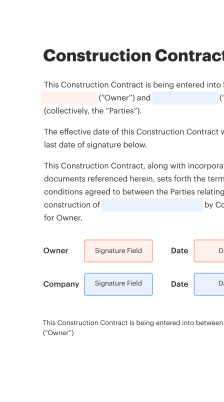
Deposit Title Deed with SignNow's Secure eSignature Solution

Award-winning eSignature solution

What a deposit title deed is and how digital processes apply

A deposit title deed is a legal instrument used to evidence ownership or the transfer of real property rights, often held in escrow during a sale or financing. When handled digitally, the document lifecycle includes document preparation, identity verification, signature capture, secure storage, and audit records. Using an eSignature platform that supports ESIGN and UETA helps ensure signatures are legally recognized in the United States while preserving chain-of-custody and evidentiary records for later title searches or disputes. Proper digital workflows reduce manual handling and centralize records for real estate professionals, lenders, and title insurers.

Why digital management matters for deposit title deeds

Digitizing deposit title deed workflows reduces errors and centralizes provenance, making it easier to validate signatures, track transfers, and maintain compliance with U.S. e-signature laws.

Why digital management matters for deposit title deeds

Common challenges when processing deposit title deeds

  • Incomplete signer verification can lead to contested deeds and delays in recording at the county office.
  • Poor version control results in multiple conflicting deed drafts and uncertainty about the effective signed document.
  • Inadequate audit trails make it difficult to prove the sequence of signatures and acceptance in disputes.
  • Noncompliant signature capture risks invalidation under ESIGN or UETA, depending on execution and evidence provided.

User roles and responsibilities in deposit title deed workflows

Closing Agent

Closing agents coordinate document assembly, manage escrow conditions, and confirm that all required signatures are captured and recorded. They need tools for signer sequencing, identity verification, and a clear audit trail to support recording and later title searches.

Title Officer

Title officers review chain of title, clear liens and exceptions, and ensure the deposit title deed accurately reflects the conveyance. They rely on secure storage, version history, and tamper-evident records for compliance and to respond to post-closing inquiries.

Typical users involved with deposit title deeds

Title companies, escrow officers, lenders, closing attorneys and property owners all participate in preparing and finalizing deposit title deeds.

  • Title companies managing searches, encumbrances, and recording requirements for clear transfer.
  • Escrow officers coordinating funds, conditions, and simultaneous document exchange during closings.
  • Lenders and closing attorneys ensuring deed instruments meet loan and legal covenants.

Each participant needs auditable records and reliable signer authentication to maintain chain-of-title integrity and satisfy post-closing audits.

Additional capabilities that streamline deposit title deed workflows

Beyond core features, automation, integrations, and developer access accelerate repeatable deed preparation and reduce administrative overhead for real estate teams.

Bulk Send

Send standardized deed packages to multiple recipients efficiently for high-volume closings or investor transactions with consistent fields and reminders.

Templates

Create record-ready deed templates to enforce formatting, required clauses, and signature positions across recurring transaction types and closing workflows.

API Access

Integrate deed generation and signature capture directly into title or loan origination systems for automated document population and status updates.

Third-Party Integrations

Connect with CRMs, cloud storage, and county recording services to centralize records and reduce manual uploads and transcription errors.

Multi-Factor Authentication

Add verification layers such as SMS or knowledge-based checks to strengthen signer identity and reduce fraud risk.

Comprehensive Audit Trail

Maintain detailed logs of every action, timestamp, and verification step to support legal admissibility and internal compliance reviews.

be ready to get more

Choose a better solution

Core features for managing deposit title deeds

Effective digital handling of deposit title deeds depends on secure storage, controlled access, clear audit records, and mobile-capable signing that meets U.S. legal standards.

Secure Storage

Encrypted document repositories maintain version history and tamper evidence while enabling controlled access for closing teams, escrow, and title professionals.

Role Fields

Role-based fields ensure only designated signers can complete specific sections, reducing errors and preserving the intended legal obligations in the deed instrument.

Compliance Log

Immutable audit trails record timestamped signer actions, IP addresses, and verification steps to support admissibility and defend chain-of-title assertions in disputes.

Mobile Signing

Optimized signing on phones and tablets lets remote parties complete execution without sacrificing identity verification or document integrity required for recording.

How digital signing of deposit title deeds typically works

A typical digital signing flow combines document setup, identity checks, signature capture, and storage to maintain legal validity and evidentiary clarity.

  • Document Setup: Map signature and notary fields
  • Identity Check: Verify signer credentials
  • Signature Capture: Apply compliant eSignatures
  • Archival: Store with audit metadata
Collect signatures
24x
faster
Reduce costs by
$30
per document
Save up to
40h
per employee / month

Step-by-step: completing a deposit title deed online

A concise procedure for preparing, signing, and storing a deposit title deed using an eSignature workflow designed for real estate transactions.

  • 01
    Prepare Document: Create record-ready deed PDF
  • 02
    Upload: Add to secure workspace
  • 03
    Set Signers: Assign roles and order
  • 04
    Finalize: Apply signatures and seal
be ready to get more

Why choose airSlate SignNow

  • Free 7-day trial. Choose the plan you need and try it risk-free.
  • Honest pricing for full-featured plans. airSlate SignNow offers subscription plans with no overages or hidden fees at renewal.
  • Enterprise-grade security. airSlate SignNow helps you comply with global security standards.
illustrations signature

Recommended workflow settings for deposit title deed processing

These configuration settings represent practical defaults to support secure signing, proper sequencing, and retention for deposit title deeds.

Setting Name Configuration
Reminder Frequency 48 hours
Signer Order Sequential
Require ID Verification Enabled
Retention Policy 7 years
Auto Notifications Enabled

Platform and device requirements for handling deposit title deeds

Ensure signers and administrators have supported browsers and devices to minimize signing errors and preserve evidentiary metadata.

  • Desktop Browsers: Chrome, Edge, Safari
  • Mobile Devices: iOS and Android
  • PDF Support: Flattening and metadata

Regularly update browsers and mobile apps, and confirm PDF rendering settings to preserve formatting, embedded fields, and the metadata required for accurate recording and archival.

Security and compliance features relevant to deposit title deeds

ESIGN & UETA: Federal and state legal coverage
Audit Trail: Complete signature history
Encryption at Rest: 256-bit encryption
Transport Encryption: TLS during transit
Multi-Factor Auth: Optional extra verification
Access Controls: Role-based permissions

Industry examples of digital deposit title deed handling

Two illustrative scenarios show common ways deposit title deeds are digitized and the typical benefits realized by stakeholders.

County Recorder Submission

A title company digitizes a deposit title deed for a residential sale and prepares the record-ready PDF with metadata and notarization fields

  • Uses identity verification and tamper-evident sealing
  • Reduces manual courier time and recording errors

Resulting in faster acceptance at the county recorder and clearer chain-of-title evidence for the buyer.

Escrow for Purchase-Finance

An escrow officer coordinates signatures from buyer, seller, and lender using a secure eSignature workflow

  • Implements signer ordering and built-in reminders
  • Ensures all parties sign in the correct sequence and supporting documents are attached

Leading to a coordinated closing with auditable records for loan underwriting and future audits.

Best practices for secure and accurate deposit title deed processing

Adopt standardized procedures and controls to protect title certainty and reduce downstream disputes when digitizing deposit title deeds.

Verify signer identity consistently
Use reliable identity verification methods before signature to prevent fraudulent transfers and to support enforceability under ESIGN and UETA.
Use standardized, record-ready templates
Predefine deed templates that include required legal language, notarization fields, and metadata to ensure consistent formatting and easier county recording.
Enforce signer order and conditional approvals
Configure workflows so that lender conditions, title exceptions, and escrow instructions are satisfied before final signature to avoid rework.
Retain immutable audit records
Store final executed deeds with full audit trails and tamper-evident seals to support future title searches, litigation defense, and regulatory review.

FAQs About deposit title deed processing and eSignatures

Common questions and practical answers about legal validity, identity verification, notarization, storage, and error resolution for digital deposit title deeds.

Feature comparison: signNow versus other eSignature providers

A concise comparison of common capabilities relevant to deposit title deed workflows across leading eSignature providers.

Feature signNow (Recommended) DocuSign Adobe Sign
ESIGN/UETA Compliance
API Availability REST API REST API REST API
Bulk Send
Mobile App iOS & Android iOS & Android iOS & Android
be ready to get more

Get legally-binding signatures now!

Potential risks and legal consequences

Invalid Signature: Contract unenforceable
Chain-of-Title Gaps: Recording disputes
Data Breach: Confidentiality loss
Noncompliance: Regulatory exposure
Delayed Recording: Closing postponement
Fraudulent Transfer: Title litigation

High-level pricing and plan features across providers

Key plan attributes and availability of core features from major eSignature platforms to inform selection for deposit title deed workflows.

Plan signNow (Recommended) DocuSign Adobe Sign Dropbox Sign PandaDoc
Free Trial Yes Yes Yes Yes Yes
API Access Included Yes Yes Yes Yes Yes
ESIGN/UETA Coverage Yes Yes Yes Yes Yes
Mobile Apps Yes Yes Yes Yes Yes
Common Integrations Google/CRM Google/CRM Google/CRM Google/CRM Google/CRM

How to Deposit title deed For Free

Deposit title deed feature gets easily available when you make use of airSlate SignNow's complete eSignature platform. Use this solution for your business irrespective of the sector you’re doing work in. The set of features presented by airSlate SignNow perfectly suits for people who attempt to make their enterprise strategies more productive and streamline their workflow.

Be assured that your contracts will always be organized properly, filled out by the appropriate parties and signed digitally using the digital signature that complies with the ESIGN Act and also other governmental requirements. Integrate fillable fields to make any document interactive, collect signatures from many persons and apply receiver authentication to make sure that the document was received by the appropriate individual. All this you are able to do when working either from the desktop computer or from the mobile gadget to save lots of time and close essential deals on-the-go.

walmart logo
exonMobil logo
apple logo
comcast logo
facebook logo
FedEx logo
be ready to get more

Get legally-binding signatures now!