Billing Statement Format for Organizations

Billing statement format for organizations helps ensure accuracy and compliance. Explore how signNow's secure eSignature solution supports your billing needs.

Award-winning eSignature solution

What a billing statement format for organizations is and why it matters

A billing statement format for organizations defines the structured layout, required fields, and presentation used when issuing invoices and statements to customers, partners, or internal stakeholders. It standardizes line items, account and billing identifiers, dates, tax details, payment terms, and contact information so statements are consistent, auditable, and machine-readable. For organizations, a clear format reduces disputes, accelerates reconciliation, simplifies integration with accounting systems, and supports regulatory or contractual obligations for records retention and financial reporting across departments.

Why a consistent billing statement format benefits your organization

Consistent formats reduce payment delays, simplify accounting automation, and improve clarity for recipients while supporting compliance and reporting needs.

Why a consistent billing statement format benefits your organization

Common challenges organizations face when standardizing billing statements

  • Diverse legacy systems create multiple competing formats that complicate reconciliation and automation across departments.
  • Inconsistent field naming or placement causes import errors and manual correction in accounting or ERP systems.
  • Varying tax rules across jurisdictions make template consolidation difficult without conditional logic and locale-aware fields.
  • Manual assembly and distribution of statements increases staff time, introduces errors, and slows payment cycles.

Representative user profiles for billing statement format management

Finance Manager

Responsible for overseeing invoicing accuracy and reconciliation, this user manages template approval, enforces required fields like invoice numbers and tax IDs, and coordinates with IT to ensure exported statements map correctly to the general ledger.

Billing Administrator

Handles day-to-day statement generation, customizes templates for client contracts, schedules batch deliveries, and resolves mismatches with customers; often the primary contact for vendors and integrations supporting electronic delivery.

Typical teams and roles that rely on billing statement formats

Finance, billing, and accounts receivable teams use standardized formats to streamline invoicing and collections.

  • Accounts receivable professionals who prepare and reconcile customer statements for timely payment.
  • Billing operations staff who maintain templates, field mappings, and delivery schedules across client segments.
  • IT and integration teams that map statement fields to ERP or accounting systems for automated processing.

Standardized formats also support auditability and cross-functional workflows between finance, legal, and customer success teams.

Additional tools that enhance billing statement workflows

Beyond core features, these capabilities help scale operations, ensure compliance, and speed collections for organizations producing large volumes of statements.

Conditional Logic

Conditional logic enables templates to include or hide sections based on account type, jurisdiction, or contract terms, ensuring that recipients see only relevant charges and legal language.


Multi-format Export

Support for PDF, CSV, XML, and EDI export allows statements to be consumed by different downstream systems for posting, archival, or electronic claim submission without reformatting.

Notifications

Automated notifications and reminders inform customers of new statements and upcoming due dates, reducing late payments and manual outreach by collections teams.

Custom Branding

Custom branding options preserve corporate identity and provide recipients with recognizable, professional-looking statements that include contact and support information.

Localization

Locale-aware templates adapt date, number, and tax display to recipient regions, ensuring compliance and clarity for international or multi-state customers.

Reporting and Analytics

Built-in reporting tracks delivery status, open rates, disputes, and aging to inform process improvements and collections prioritization.

be ready to get more

Choose a better solution

Core features to look for when implementing billing statement formats

Select features that support structured data, conditional logic, integration, and secure delivery to scale billing processes across an organization.

Template Engine

A robust template engine lets you create reusable billing statement layouts with dynamic placeholders, conditional sections for taxes or discounts, and exportable formats for PDF or CSV to match recipient needs.

Field Mapping

Field mapping tools connect ERP, CRM, or billing systems to template placeholders so data is auto-inserted and aligned with accounting schemas for automated reconciliation and reduced manual edits.

Batch Delivery

Batch send capability schedules and distributes large volumes of statements securely, supports per-recipient formats, and logs deliveries for auditability and dispute resolution.

Access & Permissions

Granular role-based permissions control who can edit templates, view sensitive financial fields, or trigger distribution, ensuring separation of duties and compliance with internal controls.
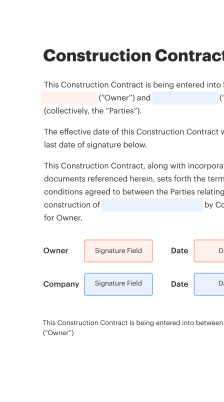
How online templates and automation produce final statements

A concise overview of the template-to-delivery process for digital billing statements, including integration and validation steps.

  • Template creation: Author reusable templates with placeholders for dynamic data
  • Data injection: Populate templates from accounting or CRM records
  • Validation step: Run rules to ensure required fields are present
  • Delivery: Send statements by email, portal link, or EDI
Collect signatures
24x
faster
Reduce costs by
$30
per document
Save up to
40h
per employee / month

Step-by-step: Setting up a billing statement format for organizations

Follow these concise steps to define, test, and deploy a standardized billing statement format that supports automation and compliance.

  • 01
    Define required fields: List invoice number, date, items, amounts, and tax details
  • 02
    Design layout: Arrange fields logically for readability and parsing
  • 03
    Map to systems: Create field mappings to ERP and accounting systems
  • 04
    Test and validate: Run sample statements and reconcile with ledgers

Audit trail setup and verification for billing statement transactions

Maintain an audit trail to capture creation, modification, delivery, and access events for every billing statement to support compliance and dispute resolution.

01

Enable event logging:

Record template edits, generation, and export events
02

Capture delivery receipts:

Log successful sends and bounce or delivery failures
03

Record access history:

Track who viewed or downloaded statements
04

Preserve tamper evidence:

Store cryptographic hashes with statements
05

Retain logs:

Keep audit logs per retention policy
06

Regular audits:

Schedule periodic log reviews for anomalies
be ready to get more

Why choose airSlate SignNow

  • Free 7-day trial. Choose the plan you need and try it risk-free.
  • Honest pricing for full-featured plans. airSlate SignNow offers subscription plans with no overages or hidden fees at renewal.
  • Enterprise-grade security. airSlate SignNow helps you comply with global security standards.
illustrations signature

Suggested automation settings for billing statement workflows

Below are recommended workflow settings to automate validation, reminders, and delivery while preserving control and auditability.

Setting Name and Configuration Header Value
Automatic reminder email frequency (in hours) 48 hours
Signature authentication level required for approvals Email code
Batch generation window and schedule Daily at 02:00
Template approval workflow and review steps Two approvers
Retention policy enforcement and archival actions 7 years

Supported platforms for preparing and sending billing statements

Billing statement templates and delivery tools are typically accessible via web, desktop integrations, and mobile apps to support hybrid workflows.

  • Web Browser: Chrome, Edge, Safari supported
  • Mobile Apps: iOS and Android available
  • Desktop Integrations: Integrates with common accounting software

Ensure browsers and OS versions meet vendor requirements and keep integrations updated to maintain secure, consistent statement generation across devices.

Security and document protection relevant to billing statement formats

Encryption At Rest: AES-256 encryption for stored statement files
Encryption In Transit: TLS 1.2 or higher for network transfer
Access Controls: Role-based permissions and account policies
Audit Trails: Immutable logs for document lifecycle events
Data Segmentation: Tenant separation for multi-organization setups
Secure Backup: Encrypted backups with retention controls

Industry examples showing formatted billing statements in action

Two concise case examples illustrate how a standardized billing statement format solves common operational needs across industries.

Healthcare billing workflow

A hospital standardized statement templates and required CPT and insurance fields to align with claims systems

  • Template validation and conditional tax/treatment fields
  • Faster insurer reconciliation and fewer denied claims

Resulting in reduced billing rework and improved cash flow.

SaaS subscription invoicing

A software provider implemented a single invoice layout that included usage line items and subscription metadata

  • Dynamic placeholders for usage and discounts
  • Clearer customer billing and automated ERP mapping

Leading to lower dispute rates and faster month-end close.

Best practices for accurate, secure billing statements

Adopt these practices to minimize errors, maintain compliance, and improve recipient acceptance of statements.

Use consistent field names and structured identifiers across systems
Establish a canonical field naming convention that matches accounting and ERP schemas, including invoice IDs, customer IDs, tax codes, and GL mappings; document the schema to reduce mapping errors and speed integrations.
Automate validation and reconciliation before distribution
Build automated checks for completeness, math accuracy, and tax calculations in the template workflow; reconcile sample batches with ledgers to catch discrepancies before sending to customers.
Protect PII and financial data with least-privilege access
Apply role-based access controls, redact or mask sensitive fields in non-secure delivery channels, and limit template edit rights to reduce risk and support audit requirements.
Retain versioned templates and maintain change logs
Version control templates and record who changed layouts or rules; store historical templates for audits and to reproduce statements for past billing periods when needed.

FAQs and troubleshooting for billing statement format issues

Common questions and solutions for template errors, delivery failures, and reconciliation mismatches when using a standardized billing statement format.

Feature comparison for billing statement format capabilities

A concise comparison of key capabilities across popular eSignature and document workflow providers relevant to billing statement formats.

Feature or Capability Compared Across Vendors signNow (Recommended) DocuSign Adobe Sign
Advanced field calculation support for invoices
Bulk send or batch invoice delivery
Template library with customizable placeholders Extensive Extensive Extensive
HIPAA-compliant document handling options for healthcare billing
be ready to get more

Get legally-binding signatures now!

Document retention and key timelines for billing statements

Establish retention schedules and deadlines that comply with accounting rules, contract terms, and applicable regulations for recordkeeping.

Statutory retention period for financial records:

Seven years

Internal retention for billing dispute evidence:

Three years

Invoice correction window and adjustments:

30 days

Regular template review cadence:

Annually

Backup and archival verification schedule:

Monthly

Risks and potential penalties from incorrect statement formats

Regulatory fines: Monetary penalties
Contract disputes: Delayed resolution
Loss of revenue: Payment delays
Audit failures: Remediation costs
Data breaches: Reputational harm
Operational inefficiency: Increased labor

Pricing snapshot across providers for organizations managing statements

High-level plan comparisons and starting price indicators to evaluate recurring costs for billing statement management and e-signature workflows.

Plan tiers and monthly costs overview signNow (Featured) DocuSign Adobe Sign Dropbox Sign PandaDoc
Starting monthly price (approx.) $8/user/mo $10/user/mo $9.99/user/mo $15/user/mo $19/user/mo
Included templates and automation Yes, templates and Bulk Send Yes, templates and workflows Yes, templates Yes, basic templates Yes, templates and docs
Advanced API access Available Available Available Available Available
Enterprise-grade security features Included Included Included Available Included
Free trial or demo availability Trial available Trial available Trial available Trial available Trial available
walmart logo
exonMobil logo
apple logo
comcast logo
facebook logo
FedEx logo
be ready to get more

Get legally-binding signatures now!