Create Receipt for Financial Services with SignNow

Effortlessly generate and eSign receipts with our user-friendly platform. Unlock seamless document management and save time on every transaction.

Award-winning eSignature solution

What creating a receipt for financial services involves

Creating a receipt for financial services means producing a verifiable record of a payment or service transaction that includes transaction details, payer and payee information, amounts, dates, and any service descriptions. In digital workflows this often includes an auditable signature or acknowledgement, a timestamped audit trail, and secure storage. For regulated financial contexts the receipt should also support retention policies, consent records, and access controls that align with applicable U.S. regulations such as ESIGN and UETA, while enabling integrations with accounting and CRM systems to maintain ledger accuracy and reconciliation.

Why standardized receipts matter for financial services

Standardized digital receipts reduce reconciliation errors, maintain regulatory records, and provide customers with clear proof of payment, improving operational efficiency and audit readiness.

Why standardized receipts matter for financial services

Common operational challenges when creating financial receipts

  • Inconsistent data fields across systems cause reconciliation delays and manual correction needs.
  • Insufficient audit trails make dispute resolution and regulatory reviews time-consuming.
  • Weak access controls increase the risk of unauthorized viewing or tampering with receipts.
  • Lack of integration with accounting ledgers forces duplicate entry and tracking errors.

Typical users and their needs

Accountant

Manages payment records and reconciliations for multiple clients, requiring receipt formats that export to accounting systems and include itemized charges, tax data, and verifiable timestamps for audit trails.

Client Service Manager

Handles client billing and inquiries, needs clear receipt templates that display service descriptions, payment method, and contact references while ensuring secure delivery and proof of acknowledgment.

Who typically issues and receives financial service receipts

Financial firms, payment processors, lenders, and fee-based service providers issue receipts while clients, accountants, and compliance teams receive them.

  • Banks and credit unions that document fees and service charges for customers.
  • Advisors and wealth managers tracking client payments and retainer drawdowns.
  • Small businesses and merchants reconciling transactions and tax records.

Clear, consistent receipts serve operational, tax, and compliance needs across internal and external stakeholders.

Essential tools and controls for receipts in financial workflows

A secure receipt process relies on template controls, audit capabilities, and user permissions to preserve data integrity and support compliance.

Prebuilt templates

Save industry-specific receipt templates that include required fields such as tax identifiers, service codes, and transaction references to ensure consistent documentation across transactions.


Auto-fill fields

Map fields to data sources like payment gateways and CRMs to automatically populate payer details, amounts, and invoice numbers, reducing manual errors and saving time.

Audit logs

Maintain immutable logs of each action taken on a receipt, including who viewed, edited, or acknowledged the document and precise timestamps for regulatory review.

Role-based access

Assign granular permissions so only authorized staff can create, modify, or void receipts, helping to prevent unauthorized changes and support internal controls.

Delivery options

Offer secure delivery by email, secure link, or direct upload to client portals, while recording delivery method and recipient acknowledgements in the receipt record.

Export and reporting

Export receipts in common formats for accounting import and generate reports that aggregate transactions by client, date, or service type for reconciliation.

be ready to get more

Choose a better solution

Integrations and template features that simplify receipt creation

Key integrations and template capabilities reduce manual entry, enforce data consistency, and ensure receipts are export-ready for accounting.

Google Docs integration

Populate receipt templates from Google Docs content to maintain consistent formatting and allow collaborative edits before finalizing a receipt for signature or delivery.

CRM connection

Sync payer and account data from popular CRMs to prefill receipts, reduce duplicate entry, and keep customer financial records aligned for reconciliation.

Dropbox storage

Automatically archive finalized receipts in Dropbox folders with organized naming conventions and permissioned access for record retention and team sharing.

Template customization

Create reusable receipt templates with conditional fields, tax calculations, and line-item tables to standardize output across services and clients.
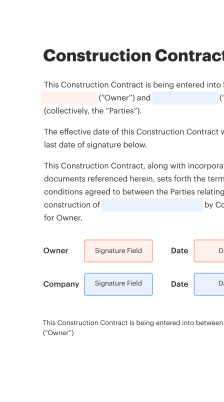
How online receipt creation works in practice

Digital receipt workflows combine templates, signing or acknowledgement steps, and secure delivery to produce verifiable transaction records.

  • Template population: Auto-fill fields from CRM or payment gateway.
  • Signer verification: Confirm identity via email or SMS challenge.
  • Generate receipt: Embed payment details and timestamp.
  • Retention and access: Archive with access controls and searchability.
Collect signatures
24x
faster
Reduce costs by
$30
per document
Save up to
40h
per employee / month

Quick step-by-step: create a receipt for financial services

Follow these core steps to generate a compliant, auditable digital receipt for a financial transaction.

  • 01
    Gather details: Collect payer, payee, amount, date, and service description.
  • 02
    Create template: Use a standardized template with required fields and identifiers.
  • 03
    Apply authentication: Add signer authentication and verification steps.
  • 04
    Store and deliver: Save securely and provide client copy with audit trail.

Audit trail and record management steps

Maintain a clear audit trail for every receipt to support disputes and regulatory reviews.

01

Record action:

Log create, edit, view, and sign events
02

Timestamp events:

Use synchronized, tamper-evident timestamps
03

Store metadata:

Capture IP, device, and user context
04

Attach evidence:

Include payment gateway confirmations
05

Retention policy:

Apply regulatory retention rules
06

Searchability:

Index receipts for quick retrieval
be ready to get more

Why choose airSlate SignNow

  • Free 7-day trial. Choose the plan you need and try it risk-free.
  • Honest pricing for full-featured plans. airSlate SignNow offers subscription plans with no overages or hidden fees at renewal.
  • Enterprise-grade security. airSlate SignNow helps you comply with global security standards.
illustrations signature

Recommended workflow settings for receipt generation

Standardize workflow settings to ensure secure receipt creation, delivery, and retention across teams.

Setting Name Configuration
Reminder Frequency 48 hours
Signature Type Electronic Acknowledgement
Retention Period 7 years
Access Expiry 90 days
Audit Logging Enabled

Device and platform considerations for receipt workflows

Confirm platform compatibility so receipts can be created, signed, and accessed consistently on desktop, tablet, and mobile devices.

  • Desktop browsers: Chrome, Edge, Safari supported
  • Mobile devices: iOS and Android apps available
  • APIs and integrations: REST API with OAuth2 support

Ensuring cross-device support and robust APIs reduces friction for clients and staff while preserving security and auditability across platforms.

Security controls to protect receipts

Audit Trail: Detailed signer actions recorded
Encryption: AES-256 at rest and in transit
Access Controls: Role-based permissioning
Two-Factor Auth: Optional multi-step verification
Tamper Evidence: Integrity checks and sealing
HIPAA Support: Configurable for protected data

Real-world examples of receipt workflows

These examples show practical receipt generation and tracking scenarios for common financial services operations.

Retail Loan Payment Receipt

A borrower completes a monthly loan payment using online banking, generating a digital receipt that records amount, date, and loan ID

  • Receipt includes loan ID and payment method
  • Receipt reduces reconciliation time and supports account statements

Resulting in faster dispute resolution and consistent audit records across servicing systems.

Advisory Fee Acknowledgement

An investment advisor issues a receipt when a client pays a quarterly advisory fee online, including fee schedule and billing period

  • Receipt references account number and fee type
  • Receipt provides clients with clear billing details and supports portfolio accounting

Leading to improved client transparency and simplified compliance reporting.

Best practices for secure, accurate receipt management

Follow these practices to reduce errors, strengthen controls, and maintain compliance when creating and storing financial receipts.

Use standardized templates with required fields
Design and enforce templates that include payer identifiers, invoice or account numbers, itemized amounts, tax details, and clear service descriptions so receipts are consistent and machine-readable for accounting imports.
Enable audit logging and secure retention
Ensure every action is logged, timestamps are tamper-evident, and retention periods meet regulatory requirements; store receipts in encrypted repositories with role-based access.
Integrate with payment and accounting systems
Connect receipts to payment gateways and accounting ledgers to auto-populate transaction data, reduce manual reconciliation, and generate consistent financial records across systems.
Tailor authentication to transaction risk
Apply stronger identity verification for high-value or regulated transactions while allowing lighter flows for low-risk receipts to balance security and user experience.

FAQs About create receipt for financial services

Common questions about digital receipts for financial services, covering compliance, security, and operational details.

Feature comparison: signNow and popular eSignature platforms

A concise capability comparison focused on receipt-oriented features and compliance support among leading eSignature providers.

Signatures and Vendors signNow (Recommended) DocuSign Adobe Sign
Audit Trail Availability
HIPAA configuration Configurable Requires plan Available
API for automation REST API REST API REST API
Native integrations CRM/Docs/Storage CRM/Storage CRM/Storage
be ready to get more

Get legally-binding signatures now!

Risks and compliance penalties to consider

Recordkeeping Failures: Fines or audit findings
Unauthorized Access: Data breach costs
Incorrect Receipts: Tax penalties
Poor Retention: Noncompliance citations
Authentication Gaps: Contract disputes
Insufficient Audit Trails: Regulatory scrutiny

Pricing and plan attributes across providers

Overview of trial periods, entry-level pricing, API availability, security features, and enterprise support across major eSignature providers.

Plan / Provider signNow (Featured) DocuSign Adobe Sign Dropbox Sign PandaDoc
Free Trial Length 30 days 30 days 30 days 14 days 14 days
Entry Monthly Price $8 per user $10 per user $9.99 per user $8 per user $19 per user
API Included Yes Yes Yes Yes Yes
Advanced Security AES-256, SOC2 AES-256, SOC2 AES-256, SOC2 AES-256 AES-256
Enterprise Support Available Available Available Available Available
walmart logo
exonMobil logo
apple logo
comcast logo
facebook logo
FedEx logo
be ready to get more

Get legally-binding signatures now!