Template Library
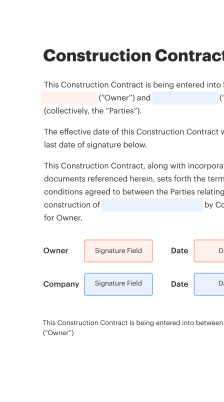
Centralized templates with variable fields and clause tagging reduce drafting time and ensure consistent legal language across engineering and commercial agreements.




Adopting an electronic contract management system for technology industry reduces turnaround time, enforces consistent templates and approvals, and preserves legal-grade audit trails — mitigating risk while improving cross-functional collaboration between engineering, legal, procurement, and sales teams.

Oversees template libraries, approval routing, and compliance controls for company-wide agreements. Works with legal and procurement to ensure clauses reflect negotiated terms and regulatory requirements, and maintains audit logs for internal and external review.
Configures document templates, pricing tables, and signing sequences for customer-facing agreements. Coordinates with CRM and billing systems to automate contract generation and to track signature status through the sales pipeline.
Technology organizations use electronic contract management systems across product, legal, procurement, and revenue operations to streamline agreements and approvals.
Adoption typically spreads from legal and sales to adjacent teams once integrations and templates are established, increasing organization-wide efficiency.
Centralized templates with variable fields and clause tagging reduce drafting time and ensure consistent legal language across engineering and commercial agreements.
Configurable, condition-based routing supports multi-stage approvals and automated escalations tied to contract value or counterparty risk.
Legally binding electronic signature support with multiple signing flows for remote and in-person execution, preserving timestamps and signer authentication metadata.
Comprehensive logs capture each event, edit, and signature to support internal audits, compliance checks, and eDiscovery requests.
Developer-friendly APIs and webhooks enable automated document generation, status updates, and integration with CI/CD, CRM, and billing systems.
Dashboards and exportable reports give visibility into cycle times, bottlenecks, renewal windows, and contract exposure across the portfolio.
Two-way sync with CRM systems ensures contract metadata and signature status update account and opportunity records, enabling more accurate pipeline forecasting and automated contract generation from CRM fields.
Direct connections to common cloud file services centralize signed documents and enable consistent backup, lifecycle policies, and unified search across contract repositories.
Editor integrations let teams create and edit contract drafts within familiar tools while preserving version history and enabling one-click send for signature.
SSO integration with enterprise identity providers simplifies access management and enforces secure authentication across users and teams.
| Setting Name | Configuration |
|---|---|
| Approval Routing Rules | Conditional approvers per value |
| Reminder Frequency | 48 hours |
| Signature Order | Sequential or parallel |
| Document Expiry Actions | Archive or notify |
| Retention Schedule | 7 years |
Ensure user devices and browsers meet minimum requirements for secure electronic signing and document editing.
For enterprise deployments validate corporate firewall and SSO settings, and test integrations with CRM and storage services to prevent access issues during rollout.
A mid-size cloud infrastructure team automated supplier onboarding documents to centralize insurance certificates and SLAs
Leading to faster vendor activation and clearer compliance records for audits.
A SaaS product group used contract templates integrated with CRM to auto-populate subscription terms and pricing
Resulting in shorter sales cycles and fewer missed renewals across enterprise accounts.
| Criteria Compared Across Major eSignature Providers | signNow (Recommended) | DocuSign | Adobe Sign |
|---|---|---|---|
| Basic eSignature support | |||
| Advanced authentication methods | |||
| API and developer tools | |||
| SAML SSO on plans |
Preserve contracts per applicable statute of limitations.
Align retention with contract lifecycle and renewal schedules.
Move expired contracts to cold storage automatically.
Require approvals before permanent deletion.
Retain fully accessible during performance and renewals.
Schedule compliance review within 90 days after termination.
Move to long-term storage after five years of inactivity.
Suspend deletion while under dispute or investigation.
Execute only after approvals and retention expiry.
| Pricing and Plans Comparison | signNow (Recommended) | DocuSign | Adobe Sign | HelloSign | PandaDoc |
|---|---|---|---|---|---|
| Pricing model | Subscription tiers with per-user pricing | Subscription tiers with per-user pricing | Subscription tiers per user | Subscription tiers per user | Subscription tiers per user |
| Free trial availability | Trial available | Trial available | Trial available | Trial available | Trial available |
| API access included | Available on API-enabled plans | Available on most plans | Available on developer plans | Available on business plans | Available on business plans |
| Enterprise SSO support | Available on enterprise plans | Available on enterprise plans | Available on enterprise plans | Available on enterprise plans | Available on enterprise plans |
| Dedicated enterprise support | Offer dedicated support and onboarding | Offer enterprise support options | Offer enterprise SLA and support | Offer business support | Offer enterprise onboarding and support |