Invoice Website for Logistics: Secure Solutions

Transform the way you handle invoicing with airSlate SignNow. Enjoy seamless eSigning and document management that's both user-friendly and budget-friendly.

Award-winning eSignature solution

What an invoice website for logistics is and why it matters

An invoice website for logistics centralizes billing, proof-of-delivery, and payment authorizations into a single online portal that supports electronic signing, secure document exchange, and automated invoice routing. For logistics providers, a purpose-built site reduces manual data entry, accelerates payment cycles, and preserves auditable records tied to shipments, PODs, and rate confirmations. When paired with a compliant eSignature solution that meets U.S. standards, the platform supports legally binding approvals, multi-factor authentication, and integration with TMS, accounting systems, and cloud storage to maintain operational continuity and regulatory traceability.

Why use an invoice website for logistics

A dedicated invoice website streamlines billing workflows, reduces invoice-to-payment time, and consolidates signatures and delivery documentation for clearer audit trails.

Why use an invoice website for logistics

Common invoicing challenges in logistics

  • Fragmented document sources force manual reconciliation across carriers, brokers, and shippers, increasing errors and delays.
  • Paper-based signatures slow approval cycles and create storage and retrieval inefficiencies for high-volume shipments.
  • Inconsistent authentication increases risk of disputed invoices and complicates proof of authorization for payments.
  • Integration gaps between TMS, accounting, and storage services lead to duplicate data entry and reconciliation overhead.

Typical user profiles and responsibilities

Freight Manager

A Freight Manager oversees shipment billing and claims, verifies carrier invoices against contracts, and requires consolidated access to signed PODs and rate confirmations to resolve disputes and validate payment approvals across multiple lanes and partners.

AP Lead

An Accounts Payable Lead manages invoice intake, applies three-way matching where needed, enforces approval workflows, and needs auditable signature records to support payment schedules, vendor reconciliations, and month-end closing procedures.

Roles that typically use an invoice website for logistics

Logistics teams, accounts payable, and carrier operations staff rely on centralized invoice portals to reduce manual steps and maintain records.

  • Freight managers who need consolidated billing and proof-of-delivery for audits and carrier settlements.
  • Accounts payable teams seeking faster invoice approval, automated matching, and reduced payment cycles.
  • Carrier and driver operations requiring signed PODs and quick electronic acknowledgements to clear shipments.

These users share responsibility for accuracy, compliance, and timely financial reconciliation across the transport and payment lifecycle.

Core features to look for in an invoice website for logistics

Choose capabilities that reduce manual work, secure signatures, and integrate with logistics and finance systems to improve accuracy and speed of settlement.

Template Builder

A visual template builder lets teams create invoice and POD templates with required fields and conditional logic so documents are consistent and ready for automated processing across multiple shipping scenarios.


Bulk Send

Bulk Send supports high-volume dispatch of identical invoices or signature requests to many recipients with per-recipient tracking, enabling efficient invoice campaigns and mass approvals for recurring lanes or periodic settlements.

Mobile Signing

Mobile-friendly signing supports drivers and carriers who capture signatures at delivery, upload photos, and sign receipts using a phone or tablet without requiring full desktop access or specialized hardware.

Audit Trail

A detailed audit trail timestamps events, records IP addresses, and logs authentication steps to provide an immutable record for dispute resolution and compliance reporting.

Custom Workflows

Configurable workflows route invoices through predefined approvers, enforce thresholds, and trigger escalations or reminders to maintain SLAs and reduce processing delays.

API Access

Comprehensive API access and webhooks support integration with TMS, ERP, and accounting platforms, enabling automated invoice creation, status updates, and document retrieval without manual intervention.

be ready to get more

Choose a better solution

Integrations that streamline invoice workflows

Integrate your invoice website with document editors, cloud storage, and CRM or accounting systems to reduce manual entry and preserve consistency across records.

Google Docs integration

Link templates and export finalized invoices directly to Google Drive; allow editing and version control within Docs before converting to signed PDFs and syncing signed copies back to the driven folder for storage and collaboration.

CRM and accounting

Connect with CRM or accounting platforms to populate customer data and invoice line items automatically, update payment status, and push approved invoices into AP systems for payment scheduling and ledger reconciliation.

Dropbox sync

Automatically save uploaded invoices and signed documents to designated Dropbox folders with naming conventions and metadata to support retrieval and retention policies across teams.

API and webhooks

Use REST APIs and webhooks to trigger events, send signed documents to downstream systems, and automate status changes in transportation management or ERP tools.
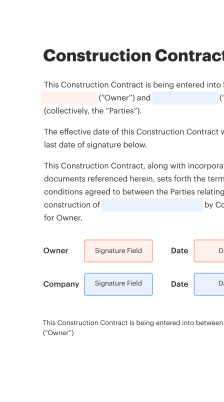
How to create and manage invoices online

A straightforward flow covers document creation, attachment of supporting files, signature collection, and final archival for audit purposes.

  • Draft invoice: Generate invoice from template or upload PDF.
  • Attach POD: Add proof-of-delivery or supporting docs.
  • Send for signature: Route to approvers via email or link.
  • Archive: Store signed copy with metadata for audits.
Collect signatures
24x
faster
Reduce costs by
$30
per document
Save up to
40h
per employee / month

Quick setup steps for an invoice website for logistics

Set up an invoice website with configured templates, authentication, and integrations to begin receiving and signing logistics invoices quickly.

  • 01
    Create account: Register organizational profile and verify contact details.
  • 02
    Configure templates: Upload invoice and POD templates with required fields.
  • 03
    Set authentication: Enable MFA and signer verification methods.
  • 04
    Connect systems: Integrate TMS, accounting, and cloud storage links.

Audit trail and recordkeeping: steps to ensure traceability

Implementing clear steps for capturing and preserving audit data ensures signed invoices remain verifiable throughout their lifecycle.

01

Capture metadata:

Embed shipment and invoice identifiers.
02

Record signer details:

Log name, email, and IP address.
03

Timestamp events:

Record time for each action.
04

Store original files:

Preserve unaltered source documents.
05

Archive signed copies:

Save final PDFs with metadata.
06

Provide export options:

Enable CSV or PDF export.
be ready to get more

Why choose airSlate SignNow

  • Free 7-day trial. Choose the plan you need and try it risk-free.
  • Honest pricing for full-featured plans. airSlate SignNow offers subscription plans with no overages or hidden fees at renewal.
  • Enterprise-grade security. airSlate SignNow helps you comply with global security standards.
illustrations signature

Recommended workflow configuration for invoice processing

Below are common workflow settings and example default values to streamline invoice routing, reminders, and exception handling in logistics.

Workflow Setting Name and Configuration Default Configuration
Approval escalation threshold 3 days
Reminder frequency 48 hours
Exception owner assignment Accounts Payable Lead
Bulk send batch size 500 recipients
Document retention enforcement 7 years

Platform and device requirements for signing and management

Ensure your invoice website supports common browsers, mobile devices, and secure API connections to serve drivers and office staff.

  • Supported browsers: Chrome, Edge, Safari
  • Mobile OS: iOS 13+ and Android 9+
  • API protocols: REST with OAuth2

Confirm IT security policies, firewall rules, and single sign-on configurations before full rollout to ensure uninterrupted access and compliance.

Security and document protection features

Encryption at rest: AES-256 encryption
Encryption in transit: TLS 1.2+ connections
Access controls: Role-based permissions
Multi-factor authentication: Email and SMS OTP
Document watermarking: Dynamic watermarking
Audit logging: Immutable event records

Logistics use cases demonstrating an invoice website in action

Two concise examples illustrate how invoice portals reduce cycle time and resolve disputes while keeping signature records intact.

Brokered Freight Reconciliation

A freight broker receives electronic invoices and PODs via the invoice website, automatically matches them against booking data

  • automated three-way match
  • fewer disputes and faster payments

Resulting in reduced DSO and accelerated carrier settlement.

Carrier POD Confirmation

A carrier uploads signed proof-of-delivery through a mobile-friendly portal, notifies the shipper and AP team instantly

  • real-time document availability
  • quicker invoice approval and fewer chargebacks

Leading to faster payment cycles and clearer audit records.

Recommended practices for secure and accurate e-invoicing

Follow consistent formatting, verification steps, and document controls to reduce disputes and maintain compliance across logistic billing workflows.

Standardize invoice templates and required fields
Design templates that include standardized headings, required identifiers (BOL, PO, shipment ID), and clearly marked fields to reduce interpretation errors and support automated matching across systems.
Require signer identity verification for approvals
Implement multi-factor authentication and signer identity checks for approvals that affect payment or liability to ensure signatures are attributable and defensible in audits and disputes.
Maintain retention and archival policies
Define retention schedules that meet regulatory and contract requirements, store documents with immutable audit logs, and ensure searchable metadata to expedite audits and claim resolution.
Log and monitor workflow exceptions
Track matching failures, disputed amounts, and authentication issues as exceptions with assigned owners and SLA targets to ensure timely resolution and continuous process improvement.

FAQs About invoice website for logistics

Common questions cover legal validity, signature troubleshooting, integration behaviors, and access controls for logistics invoicing systems.

Feature comparison: signNow (Recommended) vs DocuSign vs Adobe Sign

A concise capability comparison highlights common requirements for logistics invoicing portals and how each vendor addresses them.

Capability comparison across three vendors signNow (Recommended) DocuSign Adobe Sign
Legal validity: ESIGN and UETA
Authentication methods and strength options Email, SMS OTP Email, SMS, ID Check Email, ID Check
Bulk Send and high-volume signing Yes, Bulk Send Yes, Bulk Send Limited bulk options
API integration and developer tooling REST API, Webhooks REST API, Connect REST API, SDKs
be ready to get more

Get legally-binding signatures now!

Cloud storage, backup, and document retention guidelines

Set clear retention and backup schedules to comply with financial recordkeeping and support routine audit requests and legal discovery needs.

Minimum retention period for invoices:

Seven years

Backup frequency for signed documents:

Daily incremental backups

Archival location policy:

Geo-redundant cloud storage

Retention review cadence:

Annual retention audit

Disposition and secure deletion:

Policy-based secure purge

Operational and compliance risks to consider

Payment disputes: Delayed settlements
Regulatory noncompliance: Fines or penalties
Data breaches: Reputational damage
Lost records: Audit failures
Invalid signatures: Contract disputes
Integration failures: Operational downtime

Pricing and plan feature comparison across leading eSignature providers

High-level pricing attributes and plan components vary by vendor; this table outlines typical plan characteristics and feature availability for logistics teams.

Pricing plan attributes comparison signNow (Recommended) DocuSign Adobe Sign HelloSign PandaDoc
Entry-level plan description and suitability Affordable plans for small teams with core eSign and templates Broad enterprise focus with advanced governance Integrated document cloud with enterprise features Simple SMB plans with basic eSign Sales-oriented plans with document workflows
Free trial or free tier availability Free trial available Free trial available Free trial available Free tier with limits Free trial available
API access on paid plans Included on business and above Enterprise API plans Available with Acrobat Sign plans Developer API available API in business plans
Bulk sending and mass distribution Bulk Send feature supported Bulk Send supported Batch sending available Limited bulk features Bulk distribution supported
Enterprise governance and compliance features Role-based controls and audit logs Advanced admin controls Integrated DLP and controls Basic admin controls Workflow and template controls
walmart logo
exonMobil logo
apple logo
comcast logo
facebook logo
FedEx logo
be ready to get more

Get legally-binding signatures now!