Rfp Automation Tools for IT: Streamline Your Processes

Streamline your document processes with airSlate SignNow's easy-to-use eSignature solution. Experience cost-effective efficiency that empowers your business.

Award-winning eSignature solution

What rfp automation tools for it actually do

rfp automation tools for it streamline the creation, distribution, evaluation, and storage of requests for proposals in IT procurement cycles. They consolidate templates, automate repetitive tasks like vendor outreach and scoring, track responses and deadlines, and integrate with procurement systems and CRMs to reduce manual coordination. For U.S. organizations, these tools often tie into electronic signature platforms, audit trails, and access controls to preserve evidentiary records. Adoption typically reduces cycle time, increases consistency across solicitations, and centralizes vendor data for repeatable sourcing decisions.

Why use automation for IT RFPs

Automating IT RFPs reduces manual errors, enforces standardized criteria, and shortens procurement cycles while providing auditable records suitable for compliance and internal review.

Why use automation for IT RFPs

Common challenges RFP automation addresses

  • Inconsistent document versions across departments cause rework and confusion during evaluation stages, slowing procurement.
  • Manual distribution and follow-up create delays and make it hard to enforce submission deadlines reliably.
  • Scoring and vendor comparisons are error-prone when done in spreadsheets without standardized criteria or automatic aggregation.
  • Maintaining audit trails and compliance records manually increases risk during audits and contract disputes.

Representative user profiles

IT Procurement Manager

Responsible for sourcing infrastructure and software, this role configures templates, coordinates vendor evaluations, and enforces procurement policies. They rely on automation to centralize vendor answers, compare technical responses, and reduce time to award while preserving documentation for audit and review.

Vendor Management Lead

Manages vendor relationships and onboarding, using RFP automation to track vendor performance metrics and ensure consistent information. Automation helps scale outreach, monitor compliance milestones, and maintain a searchable history of proposals and contracts for account reviews.

Who benefits from rfp automation tools for it

Typical users include procurement teams, IT sourcing managers, legal reviewers, and vendor management professionals coordinating solicitations across organizations.

  • Procurement teams streamlining vendor selection and standardizing evaluation criteria across projects.
  • IT sourcing managers consolidating technical requirements, timelines, and vendor responses for complex procurements.
  • Legal and compliance teams ensuring documentation and approval traces meet internal and regulatory needs.

These groups use automation to reduce repetitive tasks, improve transparency, and maintain defensible records for procurement decisions.

Advanced features that improve IT sourcing outcomes

Advanced capabilities further reduce risk and support enterprise procurement scale, particularly for complex or regulated IT purchases.

Version control

Track changes and compare historical RFP versions to maintain an auditable record of edits and approvals.

Vendor portals

Provide secure, role-based vendor submission portals to collect attachments, clarifications, and structured responses.

Conditional logic

Use dynamic question flows that adapt to vendor answers, reducing irrelevant fields and improving response quality.

Bulk Send

Distribute identical RFPs or amendments to many vendors efficiently while maintaining individualized tracking for each recipient.

Reporting and analytics

Generate reports on cycle times, response rates, and scoring distributions to identify bottlenecks and improve sourcing performance.

Audit trail export

Export complete activity logs, signatures, and document versions for legal review and compliance audits.

be ready to get more

Choose a better solution

Essential features to look for in RFP automation

Focus on capabilities that directly reduce manual work, improve transparency, and support compliant recordkeeping for IT procurements.

Template library

Centralized templates with configurable question banks let teams enforce consistent requirements, reduce drafting time, and ensure that technical, security, and compliance queries are included in every solicitation.

Workflow automation

Configurable routing and approval flows automate stakeholder reviews and reminders, making it easier to enforce procurement policies and keep procurement timelines predictable.

Scoring engine

A rules-based scoring system standardizes vendor evaluation across technical and commercial dimensions, enabling objective comparisons and exportable scorecards for decision records.

Integrations

Prebuilt connectors and APIs tie RFP workflows to CRMs, contract repositories, and eSignature platforms so data flows without manual re-entry and records remain synchronized.
How automated RFP workflows operate

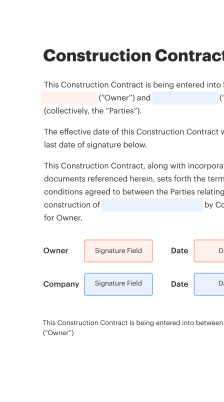
Automation orchestrates document generation, distribution, response collection, and evaluation while maintaining a secure record of decisions and changes.

  • Template generation: Populate RFPs from reusable templates.
  • Automated distribution: Send RFPs to selected vendors with deadlines.
  • Response aggregation: Collect and normalize vendor submissions automatically.
  • Scoring and approval: Apply weighted scoring and route approvals.
Collect signatures
24x
faster
Reduce costs by
$30
per document
Save up to
40h
per employee / month

Quick setup steps for RFP automation

Follow these core steps to set up rfp automation tools for it in a typical IT procurement workflow.

  • 01
    Define templates: Create standard RFP templates and evaluation criteria.
  • 02
    Configure workflows: Set routing, approval rules, and reminders.
  • 03
    Integrate systems: Connect CRM, contract repository, and signature tools.
  • 04
    Train users: Provide role-based training and documentation.
be ready to get more

Why choose airSlate SignNow

  • Free 7-day trial. Choose the plan you need and try it risk-free.
  • Honest pricing for full-featured plans. airSlate SignNow offers subscription plans with no overages or hidden fees at renewal.
  • Enterprise-grade security. airSlate SignNow helps you comply with global security standards.
illustrations signature

Typical workflow configuration settings

These settings illustrate a common configuration for automating RFP workflows, including notifications, deadlines, and scoring behavior.

Workflow configuration setting name header Default configuration or expected value
Reminder Frequency for pending approvals 48 hours
Response Deadline enforcement and escalation Auto-escalate after 72 hours
Scoring weight distribution across criteria Technical 50%, Cost 30%, Security 20%
Default document retention period for RFP assets 7 years
Signature requirement and signer order Sequential signing for approvals

Supported platforms and access options

Ensure chosen rfp automation tools for it support the platforms your team uses and provide consistent access across devices.

  • Web browser: Chrome, Edge, Firefox compatible
  • Mobile access: iOS and Android apps available
  • Desktop integrations: Office and PDF tool plugins

Verify browser compatibility, authentication options like SSO and MFA, and whether mobile apps support full review and approval workflows to enable flexible, secure access for on-the-go decision makers.

Security controls commonly available

Encryption at rest: AES-256 or similar
Encryption in transit: TLS 1.2+ connections
Role-based access: Least-privilege roles
Multi-factor authentication: MFA for users
Audit logging: Immutable audit trails
Data residency options: US-based storage

Real-world IT RFP automation examples

Two concise case scenarios illustrate how automation improves IT sourcing, evaluation, and compliance in U.S. organizations.

Large public university procurement

A university standardized its RFP templates and automated vendor outreach to reduce cycle time by centralizing responses and approval routing.

  • Template enforcement ensured consistent technical and FERPA-related questions appeared in each solicitation.
  • Automated reminders and integrated review workflows sped approvals and improved vendor compliance.

Resulting in faster procurement cycles and clearer audit records for internal and regulatory reviews.

Mid-size enterprise cloud migration

An IT team issuing a multi-vendor RFP used automation to aggregate vendor feature matrices and compliance attestations into a single scorecard.

  • Automated scoring weighted security, architecture, and cost uniformly across submissions.
  • Integration with contract and signature platforms preserved evidence of approvals and negotiations.

Leading to a documented selection process and reduced time to contract execution.

Best practices for secure and accurate RFP automation

Apply these concise best practices to maximize the security, clarity, and legal defensibility of automated IT RFP workflows.

Standardize templates and evaluation criteria
Maintain a single source of approved templates and clearly defined scoring rubrics so every RFP captures the technical, security, and commercial data needed for fair vendor comparison and consistent decision-making.
Enforce role-based approvals and separation of duties
Use role definitions and sequential approvals to ensure procurement, technical, and legal reviews occur independently and that no single user can both select vendors and approve contracts without oversight.
Retain complete audit trails and exports
Configure exportable audit logs, signed documents, and version histories as part of retention policy to support internal reviews and external audits, aligning retention with legal and contractual obligations.
Test integrations and run pilot projects
Pilot integrations with CRM, contract systems, and eSignature platforms on small RFPs to validate mappings, authentication, and data flows before scaling to enterprise-wide usage.

FAQs About rfp automation tools for it

Common questions and practical answers about implementation, security, and day-to-day operation of RFP automation for IT teams.

Feature availability: quick comparison of eSign and RFP capabilities

A concise feature matrix comparing signNow and other leading providers on common RFP and signature capabilities used in IT procurement.

Feature and vendor comparison header signNow (Recommended) DocuSign Adobe Sign
eSignature legal validity and enforcement
Bulk Send and mass distribution support Limited
API access and published rate limits REST API, documented limits REST API, rate limits REST API, usage quotas
Native CRM integration availability and sync Salesforce and Dynamics Salesforce and Dynamics Salesforce only
be ready to get more

Get legally-binding signatures now!

Retention, backup, and timeline policies

Define clear timelines for retention, backups, and review cycles to manage records for audits, legal holds, and procurement governance.

Document retention policy length:

Retain RFPs and records for seven years

Backup frequency for procurement data:

Daily backups with weekly verification

Response submission deadline enforcement:

Strict cutoffs with automated closure

Periodic review of templates and criteria:

Annual review and update cycle

Legal hold procedure for disputes:

Immediate preservation on notice

Compliance risks and potential penalties

Breach of confidentiality: Regulatory fines
Improper retention: Legal exposure
Invalid signatures: Contract disputes
Unauthorized access: Data loss
Noncompliant handling: Audit failures
Incomplete audit trails: Evidentiary gaps

Pricing and plan highlights across providers

Pricing varies by plan features, user counts, and compliance options; this table summarizes starting prices and key plan differences for common use cases.

Pricing and plan comparison header signNow (Recommended) DocuSign Adobe Sign PandaDoc HelloSign
Starting monthly price (single user) $8 per user per month billed annually $10 per user per month billed annually $9.99 per user per month billed annually $19 per user per month billed annually $15 per user per month billed annually
Free trial availability and duration Free trial available for seven days Free trial available for thirty days Free trial available for fourteen days Free trial available for fourteen days Free trial available for thirty days
Enterprise features and SSO support SSO, SCIM provisioning, advanced admin controls SSO, SCIM, enterprise admin SSO, enterprise admin, directory sync SSO on higher tiers, team management SSO available on business plans
HIPAA compliance availability and options HIPAA options with BAAs available on enterprise plans HIPAA support and BAAs available HIPAA features with BAAs available HIPAA available via enterprise agreements HIPAA options for eligible plans
API access and developer resources Comprehensive API, SDKs, and developer docs Extensive API and developer tools APIs and SDKs with documentation Public API and developer portal API access with documentation
Bulk Send and team templates availability Bulk Send and team templates included in business plans Bulk send and templates available Bulk send supported on business tiers Bulk send available on higher tiers Bulk send and templates on business plans
walmart logo
exonMobil logo
apple logo
comcast logo
facebook logo
FedEx logo
be ready to get more

Get legally-binding signatures now!