Search for Documents across the Whole Organization

Get accurate search results fast by adding filters. airSlate SignNow allows you to search for documents across the whole organization by name, email address and any text added to a document.

Award-winning eSignature solution

What enterprise-wide document search means for teams

Searching for documents across the whole organization refers to a centralized capability that indexes files, metadata, and audit records across users, groups, and connected storage so administrators and authorized staff can locate documents quickly. This includes full-text search, metadata and field filters, saved queries, and permission-aware results so users only see records they are authorized to access. In regulated environments, integrated search links results to audit trails and retention policies, helping teams find signed agreements, drafts, and templates without manual file-by-file review.

Why centralized search matters for operational speed

Centralized search reduces time spent locating documents, lowers risk of duplicate records, and supports compliance by surfacing required files and their audit history without manual retrieval.

Why centralized search matters for operational speed

Common challenges when implementing organization-wide search

  • Fragmented storage across cloud apps and local drives complicates indexing and consistent search results for users.
  • Inconsistent metadata and naming conventions make relevance ranking and filter accuracy unreliable for enterprise queries.
  • Permission models can restrict results unpredictably unless search is designed to respect granular access controls.
  • Large volumes of historical documents require efficient indexing and scheduled re-indexing to keep results current.

Representative user roles and how they interact with search

IT Administrator

An IT Administrator configures indexing sources, retention tags, and connectors to cloud storage. They schedule re-indexing, manage API tokens, and enforce encryption and access policies so searches return accurate, permission-aware results across the organization.

HR Manager

An HR Manager uses organization-wide search to locate personnel files, onboarding agreements, and benefits forms. They rely on saved filters and field-based searches to find employee documents while ensuring results conform to privacy and access policies.

Teams that typically rely on organization-wide document search

Legal, compliance, HR, sales, and IT teams commonly use enterprise search to find agreements, records, and templates while maintaining access controls.

  • Legal teams retrieving signed contracts and clause histories across departments.
  • HR teams locating onboarding paperwork and personnel records quickly.
  • Sales teams finding executed proposals and recurring-terms contracts for renewals.

Access patterns vary by role, so configuring roles and query views helps surface relevant results while preserving least-privilege access.

Additional features to enhance search accuracy and governance

Extended capabilities improve relevance, governance, and operational integration for enterprise search deployments.

Saved queries

Users and admins can save common searches and share them across teams, reducing repetitive query setup and standardizing discovery workflows for recurring audit or retrieval tasks.


Relevance tuning

Administrators can adjust ranking rules and boost fields such as signer name or contract value so the most pertinent documents appear first for typical business queries.

Audit trail linkage

Search results link directly to transaction audit records, showing signature events and timestamps to support compliance reviews and evidence collection.

Retention and legal holds

Integrates retention labels and legal hold status so search results reflect preserved documents even if general deletion policies would otherwise remove them.

Activity monitoring

Reports on search usage, query trends, and access patterns help security teams detect anomalies and optimize indexing priorities.

API and automation

APIs allow programmatic queries, integration with BI tools, and automated exports for downstream processing and reporting workflows.

be ready to get more

Choose a better solution

Core features that make enterprise search effective

Several capabilities distinguish a practical organization-wide search: indexing breadth, permission-awareness, metadata handling, and integrations for connected repositories.

Full-text indexing

Searches document bodies, form fields, and annotations so teams can find agreements and clauses without relying solely on file names or folders; this reduces missed records and manual review time across departments.

Permission-aware results

Results respect role-based access control and folder permissions so users only see documents they are authorized to view, supporting least-privilege access models and maintaining confidentiality.

Metadata and field filters

Structured filters for dates, signer names, document types, and custom fields help users narrow results quickly, enabling targeted retrievals for audits, renewals, or legal reviews.

Connected storage connectors

Native connectors to cloud storage and common enterprise content platforms ensure the search index includes documents stored outside the eSignature system, providing a unified view.

How organization-wide search functions at a glance

Core components work together to deliver accurate, permission-respecting search results across the enterprise.

  • Indexing engine: Crawls connected storage and builds searchable indexes.
  • Metadata mapper: Normalizes fields and tags for consistent filtering.
  • Permission layer: Applies role and group rules to query results.
  • Query interface: Supports full-text, field, and saved searches.
Collect signatures
24x
faster
Reduce costs by
$30
per document
Save up to
40h
per employee / month

Quick setup steps to enable enterprise search

Follow these initial configuration steps to enable organization-wide search and ensure results respect permissions and retention rules.

  • 01
    Enable indexing: Turn on global indexing in the admin console.
  • 02
    Add connectors: Connect cloud storage and third-party repositories.
  • 03
    Map metadata: Establish standard fields and tags across teams.
  • 04
    Set permissions: Configure role-based access for search visibility.

How audit trails link to search results

Linking search results to audit trails helps verify signature events, access history, and document lifecycle details required for compliance and review.

01

Locate document:

Search by metadata or full text.
02

Open audit record:

Access the signed transaction record.
03

Verify events:

Confirm signer timestamps and IPs.
04

Export evidence:

Download transaction history and copies.
05

Archive or retain:

Apply retention or legal hold as needed.
06

Report activity:

Generate logs for compliance review.
be ready to get more

Why choose airSlate SignNow

  • Free 7-day trial. Choose the plan you need and try it risk-free.
  • Honest pricing for full-featured plans. airSlate SignNow offers subscription plans with no overages or hidden fees at renewal.
  • Enterprise-grade security. airSlate SignNow helps you comply with global security standards.
illustrations signature

Suggested workflow settings for organization-wide search

These configuration settings provide a baseline for indexing, permissions, and refresh behavior to maintain accurate search results across the organization.

Workflow Setting Name Column Header Default configuration and expected values
Indexing Scope Across Organization and Sources All user workspaces and connected cloud accounts
Metadata Fields Required for Indexing Signer name, date, document type
Access Control Enforcement Mode Strict role-based filtering
Index Refresh Interval and Schedule 24 hours incremental re-index
Retention Tag Application and Policy Apply organizational retention tags

Supported platforms and minimum requirements

Ensure client devices and server connectors meet supported OS and browser versions to guarantee stable indexing and query performance.

  • Desktop browsers: Chrome, Edge, Safari
  • Mobile platforms: iOS and Android supported
  • Connector protocols: OAuth and SAML

For enterprise deployments, validate network settings, firewall rules for connectors, and API access tokens ahead of a full-scale index to avoid partial crawls and missing results.

Security controls that support enterprise search

Encryption standards: AES-256 at rest and TLS in transit
Access control: Role-based and group-aware permissions
Authentication methods: SAML, OAuth, and multi-factor authentication
Audit logging: Search queries and result access recorded
Data isolation: Tenant separation for enterprise accounts
Connector security: Scoped tokens and OAuth-based connectors

Industry and departmental examples

Concrete examples show how cross-organizational search speeds tasks and supports compliance in different environments.

Human Resources onboarding

HR consolidates onboarding packets from multiple departments into a single searchable index to speed verification of required forms

  • fielded search for employee name and hire date
  • reduces time to assemble complete files during audits

Resulting in faster compliance checks and fewer missing documents during employee lifecycle reviews.

Legal contract discovery

Legal teams index executed contracts, email attachments, and amendment records across repositories to support dispute resolution

  • full-text clause search and metadata filters for parties and dates
  • surface signed records and related audit trails quickly

Resulting in accelerated discovery efforts and more defensible compliance posture during litigation or regulatory review.

Best practices for accurate, secure organizational search

Adopt consistent policies and technical settings to keep search results reliable, secure, and compliant with internal and regulatory requirements.

Standardize metadata and naming conventions
Define required fields and a consistent naming scheme across teams. Use controlled vocabularies where possible to improve filter accuracy and reduce ambiguous results during searches.
Enforce role-based access and review regularly
Configure search to honor role and group permissions, and audit those assignments periodically to prevent privilege creep and unintended exposure of sensitive documents.
Schedule indexing and retention reviews
Set routine re-indexing intervals and review retention tags to ensure older documents remain discoverable when required for audits or legal matters.
Train users on advanced filters and saved searches
Provide brief training and templates so users can leverage field searches, date ranges, and saved queries for efficient discovery during routine and exceptional tasks.

FAQs and troubleshooting for organization-wide search

Answers to common questions and steps to resolve typical issues encountered when enabling search across multiple teams and storage systems.

How leading eSignature platforms handle organization-wide search

A capability-level comparison shows whether search across the whole organization, connectors, and permission-aware results are provided by major vendors.

Enterprise eSignature Vendor Capabilities Comparison Table signNow (Recommended) Adobe Sign DocuSign
Search across whole organization
Full-text indexing
Permissions-aware results
Cross-storage connectors Native and third-party Connectors available Connectors available
be ready to get more

Get legally-binding signatures now!

Operational milestones for deploying enterprise search

Typical timeline milestones help plan indexing, training, and compliance validation before going live with organization-wide search.

Discovery and scoping phase:

2–4 weeks to map sources and requirements

Connector and credential setup:

1–2 weeks to provision and test connectors

Indexing and initial crawl:

3–7 days depending on data volume

User training and saved queries rollout:

1 week for key teams

Compliance verification and audit testing:

1–2 weeks for legal and security checks

Risks and potential penalties from improper search configurations

Unauthorized access: Data exposure
Noncompliance: Regulatory fines
Data loss: Incomplete retrievals
Business disruption: Operational delays
Reputational harm: Customer distrust
Audit failures: Missing records

How to search for documents in your airSlate SignNow account

Need to locate a document you worked on or sent out some time ago? Use the airSlate SignNow search tool. Easily find your document among all the others stored in your account by configuring the search settings and entering your query in the search bar.

Take advantage of the airSlate SignNow search tool

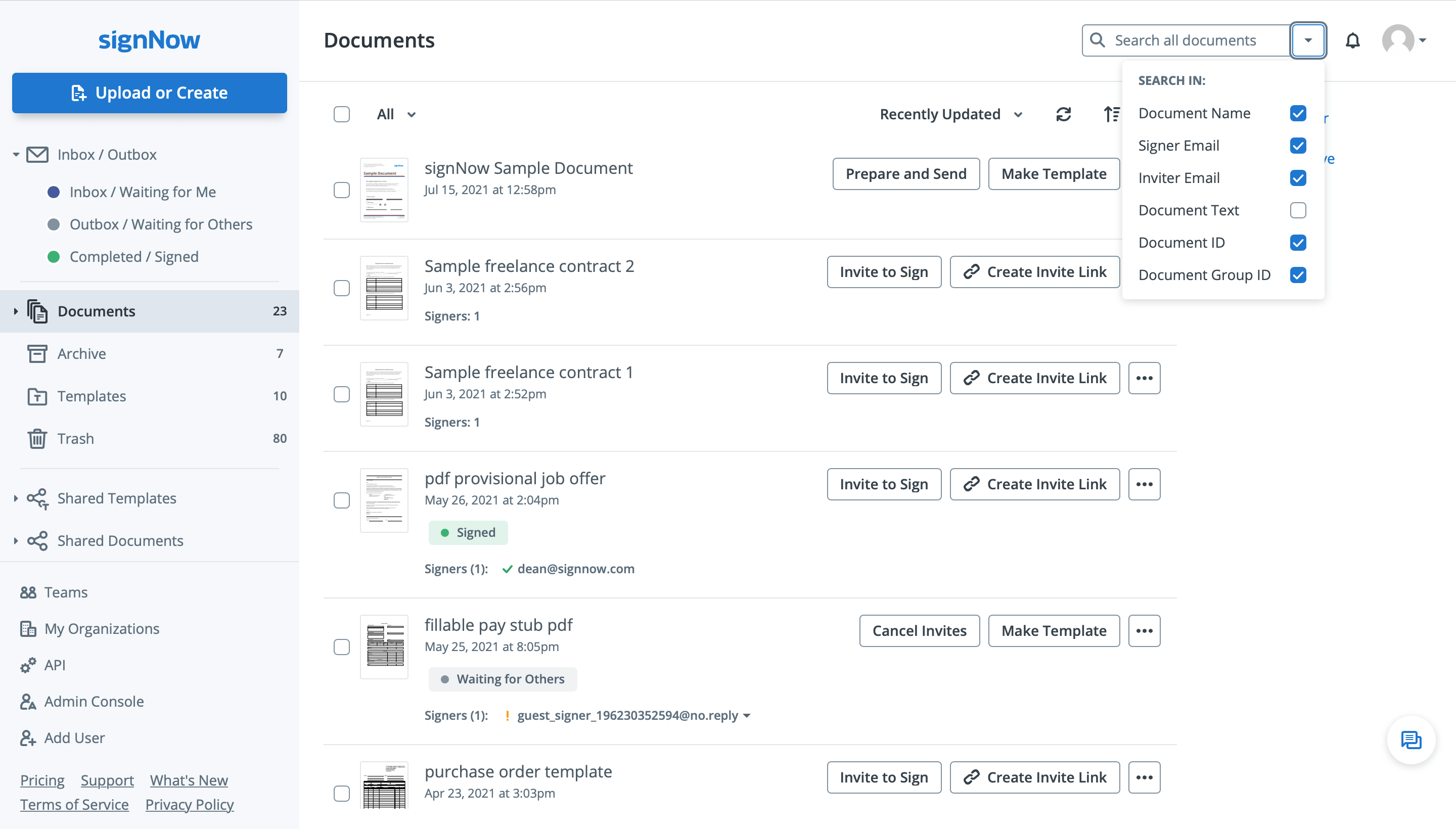
The search bar is conveniently located in the interface panel at the top of the airSlate SignNow dashboard. Click on the dropdown arrow to access search settings.
fill-guide-illustration

Check the desired search parameters and type your query in the search bar.

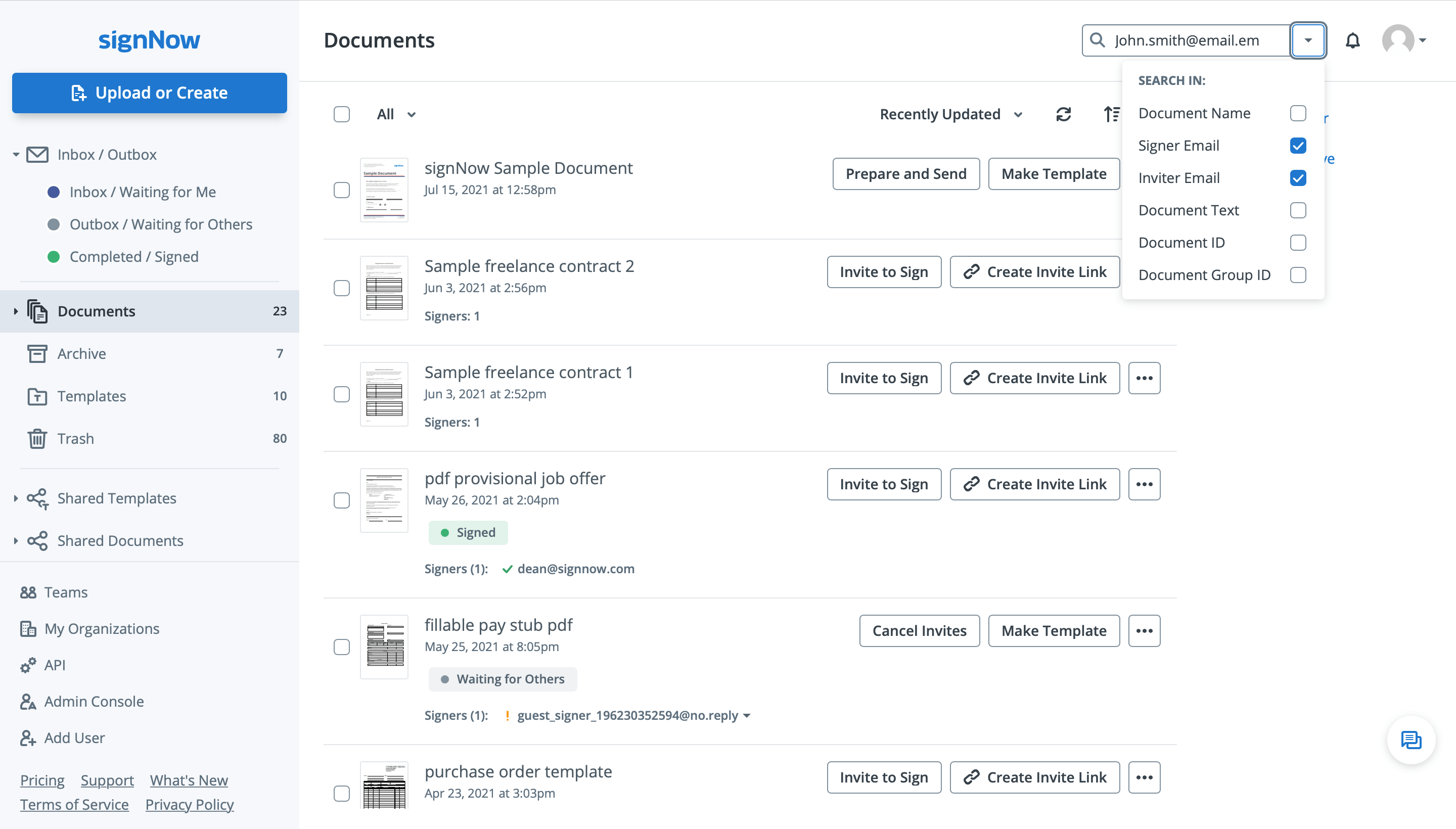
You can search documents by inviter or signer email address. To do so, check the corresponding boxes in the dropdown and enter an email address.
fill-guide-illustration

Likewise, apply other search parameters:
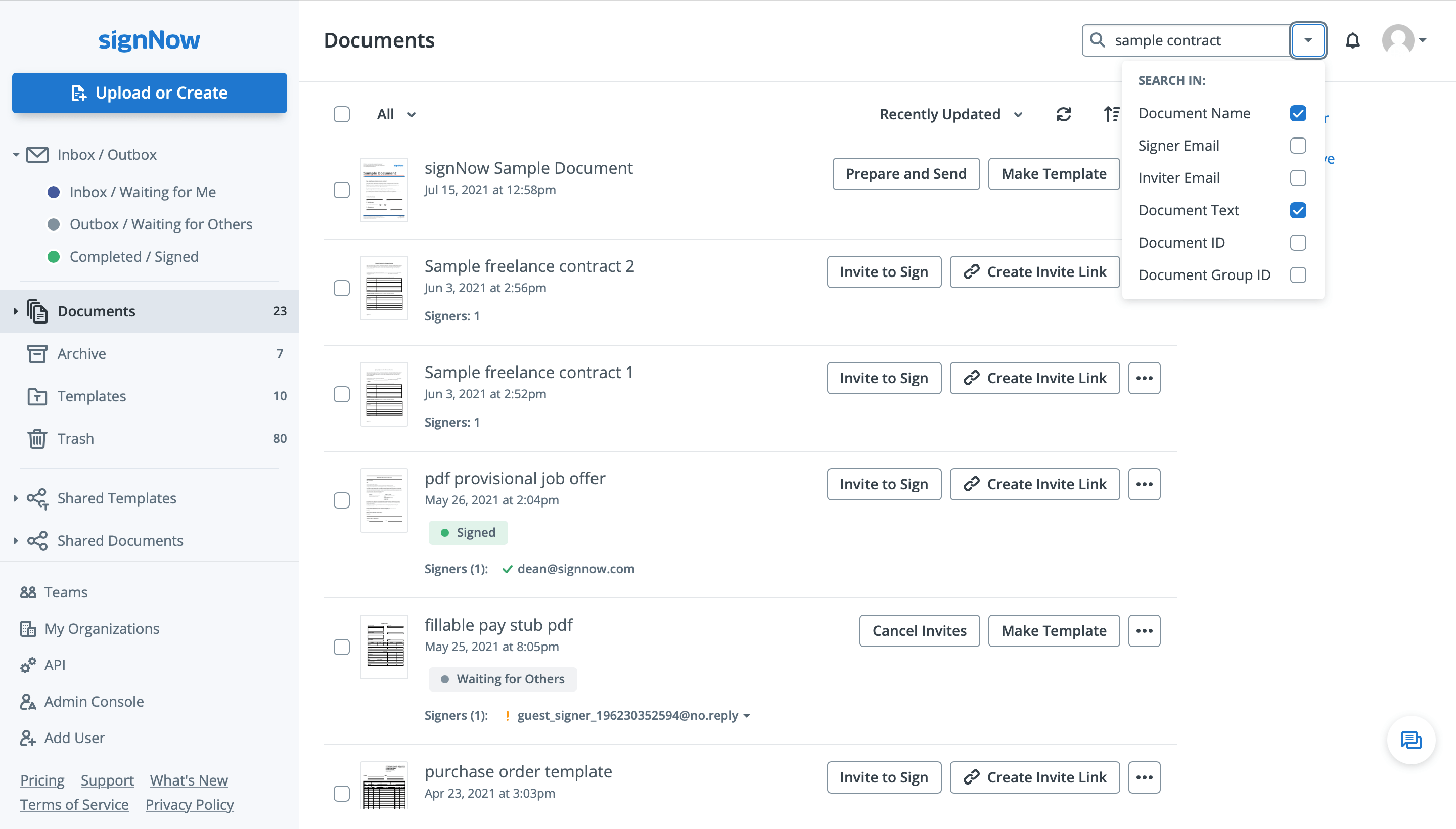
  • Select Document Name to find a document by specific keywords in its name.
  • Check the Document Text box to find a document by a keyword or key phrase it contains.
  • To find a document or a document group by its ID, select the Document ID or Document Group ID parameter. You don’t have to enter an entire ID. The first few characters will do.
fill-guide-illustration
walmart logo
exonMobil logo
apple logo
comcast logo
facebook logo
FedEx logo
be ready to get more

Get legally-binding signatures now!







