Set Validation for Form Fields with SignNow

Be sure that correct data is added in fields using airSlate SignNow's field validators. Validation for form fields makes it easier to correctly complete and sign a document with multiple fields.

Award-winning eSignature solution

What it means to set validation for form fields

Set validation for form fields is the practice of defining rules that control allowed input, format, and required data before a form is submitted. This reduces errors, enforces data consistency, and improves downstream processing by rejecting invalid entries in real time. In eSignature workflows, validation prevents incomplete or malformed values that can delay approvals or create compliance gaps. Vendors such as signNow provide field-level controls that integrate with document fields and templates so validation applies consistently across web, mobile, and API-driven signing processes.

Why add validation to your form fields

Validation improves data quality, shortens review cycles, and reduces manual corrections. It also helps maintain compliance by ensuring required legal and operational fields are completed accurately before signatures are captured.

Why add validation to your form fields

Common challenges without field validation

  • Frequent submission errors require time-consuming manual corrections and resubmissions.
  • Inconsistent data formats hinder automated processing and integration with CRMs.
  • Missing required information can invalidate agreements or delay approvals.
  • Poor input control increases risk of incorrect legal or billing information.

Typical user roles that configure validation

Account Admin

An Account Admin defines organization-wide validation templates, manages permissions for form editing, and reviews audit logs. They coordinate with IT and compliance to ensure validation rules align with policy and system integrations, and they monitor error rates to refine rules over time.

Form Designer

A Form Designer creates the document layout and applies field-level rules, such as required fields, dropdown lists, and regular expressions. They test rule behavior across devices and ensure validation messages are clear for signers to reduce abandonment.

Teams that benefit from field validation

Legal, HR, sales, and operations teams routinely use field validation to enforce required data and prevent common form errors before signature.

  • Sales teams standardize contact and payment fields to speed contract execution.
  • HR uses validation to ensure accurate employee identifiers and tax fields.
  • Legal and compliance require validated checkboxes and consent fields for records.

Implementing validation reduces back-and-forth with signers and improves the reliability of signed records for auditing and integration.

Core validation features to evaluate

When configuring validation, consider features that enforce format, logic, and usability to reduce signer friction and prevent errors.

Required fields

Mark fields as mandatory to prevent submission until essential data is provided, ensuring legally and operationally necessary items are captured consistently.

Data type enforcement

Assign types such as date, number, email, or phone to automatically verify format and reduce formatting-related errors during entry and later processing.

Regular expressions

Use regex patterns for precise control over acceptable input formats, such as specific ID structures, account numbers, or custom codes.

Conditional logic

Show, hide, or require fields depending on other inputs to keep forms concise and enforce context-specific data collection rules for different scenarios.

Custom error messaging

Provide clear, actionable messages tied to validation failures so signers understand required corrections and reduce abandonment or help requests.

Bulk validation

Apply validation across multiple documents or templates programmatically to ensure consistency in large-scale sending and template distribution workflows.

be ready to get more

Choose a better solution

Integrations and templates that work with validation

Validation should integrate with document sources and business systems so structured data enters CRMs, storage, or downstream workflows consistently.

Google Docs

Embedding validation-capable templates within Google Docs enables collaborative drafting while preserving field rules; when exported to an eSignature platform the rules remain attached, ensuring consistent enforcement across sharing and sending scenarios for contract teams.

CRM integration

Connecting form validation to a CRM pre-populates fields and enforces formats that match CRM schema, which reduces duplicates and import errors when signed documents sync back to lead and account records.

Cloud storage

Validated documents stored in cloud services keep structured metadata intact, supporting searches, retention policies, and automated processing without manual rekeying or cleanup of invalid entries.

Reusable templates

Templates with built-in validation standardize forms across teams, simplify onboarding for new users, and ensure that every sent document enforces the same field-level rules without repeated configuration.

How validation works in online form workflows

Validation runs at form fill time, blocking invalid inputs and showing contextual messages to signers before submission.

  • Rule evaluation: Applied when a field loses focus or on submit.
  • Immediate feedback: Shows clear error messages for correction.
  • Conditional logic: Activates or hides fields based on inputs.
  • Submission gating: Prevents completion until rules are satisfied.
Collect signatures
24x
faster
Reduce costs by
$30
per document
Save up to
40h
per employee / month

Quick steps to set validation for form fields

Follow these core steps to configure validation rules on form fields and test them before sending documents for signature.

  • 01
    Open template: Select the saved document or template to edit.
  • 02
    Add fields: Place text, date, checkbox, and dropdown fields where needed.
  • 03
    Define rules: Set required status, patterns, and conditional logic.
  • 04
    Test and save: Preview on devices and save rule-enabled template.

Managing audit trails for validated transactions

Maintain an audit trail that records validation events, signer confirmations, and timestamps to support compliance and dispute resolution.

01

Capture events:

Log validation failures and corrections.
02

Record timestamps:

Save times for each interaction.
03

Store signer data:

Associate signers with entries.
04

Retain versions:

Keep pre- and post-submission files.
05

Export logs:

Provide CSV or JSON exports.
06

Review access:

Limit log access to auditors.
be ready to get more

Why choose airSlate SignNow

  • Free 7-day trial. Choose the plan you need and try it risk-free.
  • Honest pricing for full-featured plans. airSlate SignNow offers subscription plans with no overages or hidden fees at renewal.
  • Enterprise-grade security. airSlate SignNow helps you comply with global security standards.
illustrations signature

Configuring validation within document workflows

Use these settings when you establish document workflows to ensure validation rules operate predictably and align with business processes.

Setting Name Configuration
Validation Rules Per-field rules
Reminder Frequency 48 hours
Conditional Logic Scope Single document
Bulk Apply Templates Enabled by admin
API Enforcement Mode Strict mode

Device and platform considerations for validation

Ensure validation behaviors are tested across desktop browsers, mobile browsers, and native apps to confirm consistent behavior for all signers.

  • Desktop browsers: Chrome, Edge, Safari support
  • Mobile browsers: iOS and Android compatibility
  • Native apps: iOS and Android apps

Validate default input patterns and error rendering on small screens, and provide alternate input methods where native keyboards or accessibility settings affect expected formats.

Security and authentication options related to validation

Two-factor authentication: Adds signer identity verification
Access control: Limits who edits rules
Field-level encryption: Protects sensitive entries
Audit logging: Records rule enforcement events
Role-based permissions: Restricts configuration access
Secure API keys: Protects automated rule calls

Industry examples using validation for forms

Two brief case examples show how field validation prevents errors and enforces policy in common workflows.

Healthcare patient intake

A hospital replaced paper intake with validated digital forms to capture patient IDs, insurance numbers, and consent statements using pattern matching and required checks

  • Uses date, numeric, and regex validation to ensure correct entries
  • Reduces intake errors and speeds registration staff workflows

Resulting in fewer claim denials and clearer audit trails for HIPAA compliance reviews.

Sales contract execution

An enterprise sales team applied validation to pricing, discount, and customer ID fields in templates to prevent incorrect pricing entries

  • Validation includes dropdown lists and conditional required fields
  • Ensures that contracts include approvals for nonstandard terms

Leading to more accurate invoices, faster order processing, and lower reconciliation time.

FAQs About set validation for form fields

Answers to common questions about configuring, testing, and troubleshooting validation rules for form fields in eSignature workflows.

Quick feature comparison for field validation

A concise comparison of validation capabilities between two leading eSignature providers for common field validation requirements.

Field validation capability comparison for eSignature vendors signNow (Recommended) DocuSign
Regex support
Conditional field logic
Custom error messages Limited
Bulk validation across templates Limited
be ready to get more

Get legally-binding signatures now!

Document retention and validation record timelines

Retention policies should include both signed documents and the associated validation logs so you can demonstrate what checks were enforced at signing time.

Immediate retention start:

Begin storing files and logs at signature completion.

Short-term audit window:

Retain active validation logs for 2 years for operational review.

Long-term archival:

Store signed records for 7 years to meet common business needs.

Sensitive data schedule:

Apply separate retention for PHI or student records.

Deletion and purge:

Automate purge after retention period ends.

Risks from missing or weak validation

Data errors: Incorrect records
Compliance gaps: Regulatory exposure
Processing delays: Approval slowdowns
Billing mistakes: Revenue loss
Legal challenges: Contract disputes
Privacy incidents: Unauthorized disclosure

Feature comparison across major eSignature platforms

This table compares validation and related capabilities across prominent eSignature vendors, listed with signNow first as Recommended.

Vendor comparison for validation and security features signNow (Recommended) DocuSign Adobe Sign HelloSign PandaDoc
Validation rules included Yes Yes Yes Limited Yes
Regex pattern support Yes Yes Limited No Limited
Conditional logic Yes Yes Limited No Yes
Audit trail detail Full Full Full Basic Full
API validation enforcement Yes Yes Yes Yes Yes

How to add field validators with airSlate SignNow

Since different kinds of data can be presented in different ways, it is important to make sure the recipients of your documents understand how exactly they are expected to fill out specific fields. Field validators will help them enter data correctly, and thus, eliminate errors in the forms they submit.

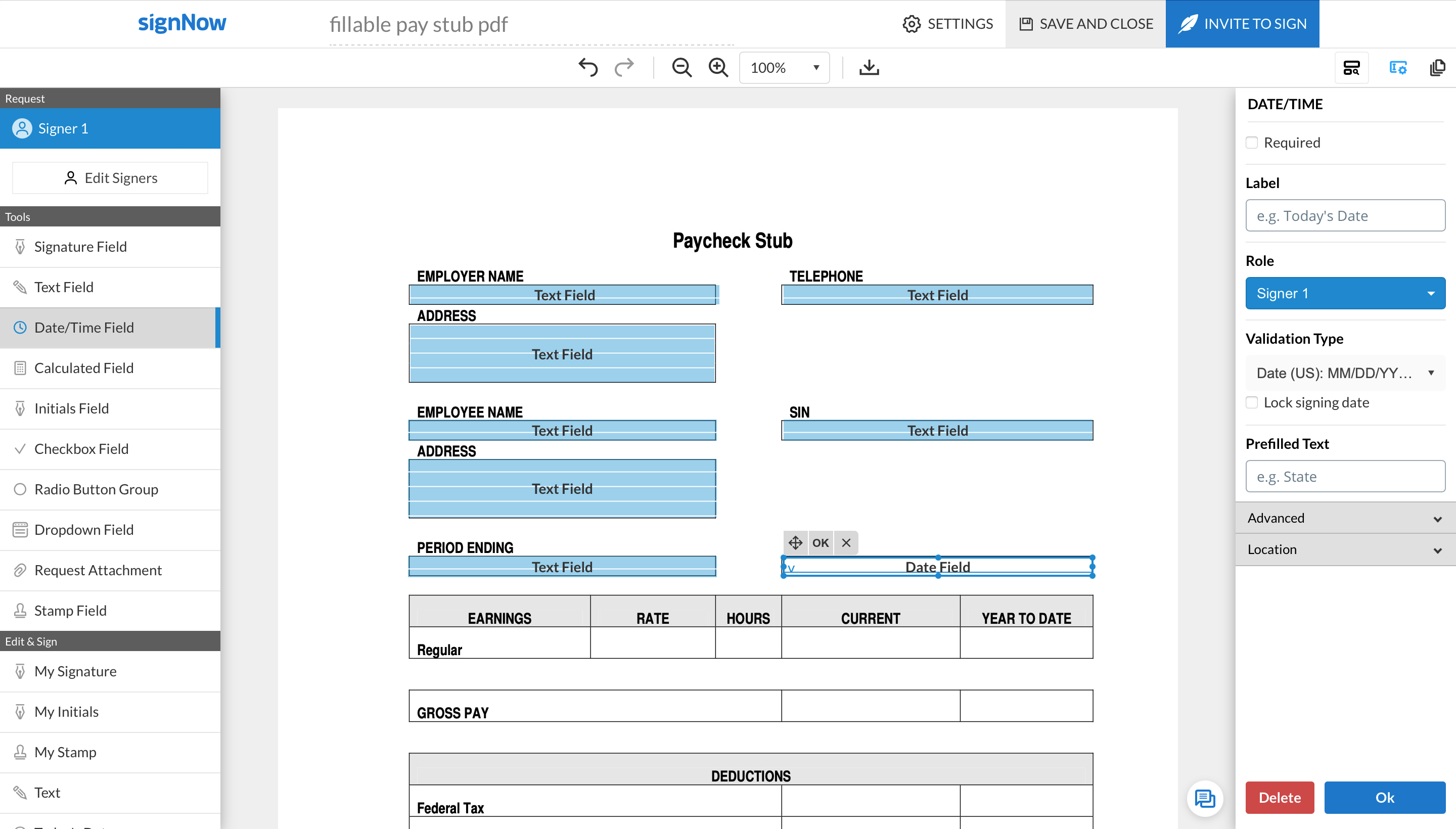
Add fillable fields

Before applying validators, insert fillable fields in your document. Please note that validators are only available for Text fields and Date/Time fields.
fill-guide-illustration

Choose and apply validators

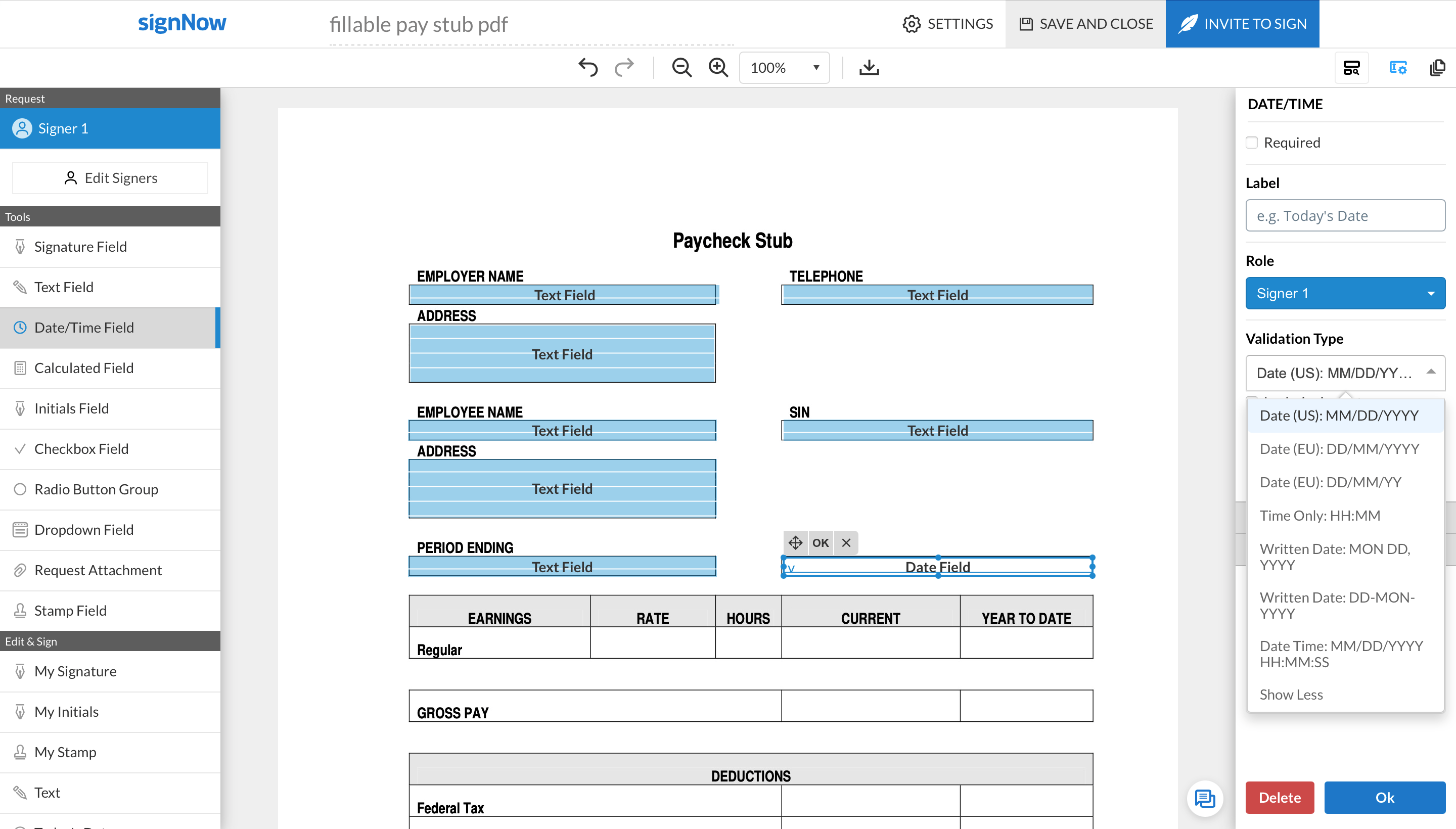
Different types of fields have different validators. Let’s start with the date field. Click on it and open the Validation Type dropdown in the sidebar on the right. Then, select the validator you want to apply to the field.

For Date/Time fields, you can set the American or European date format or choose several other options.
fill-guide-illustration

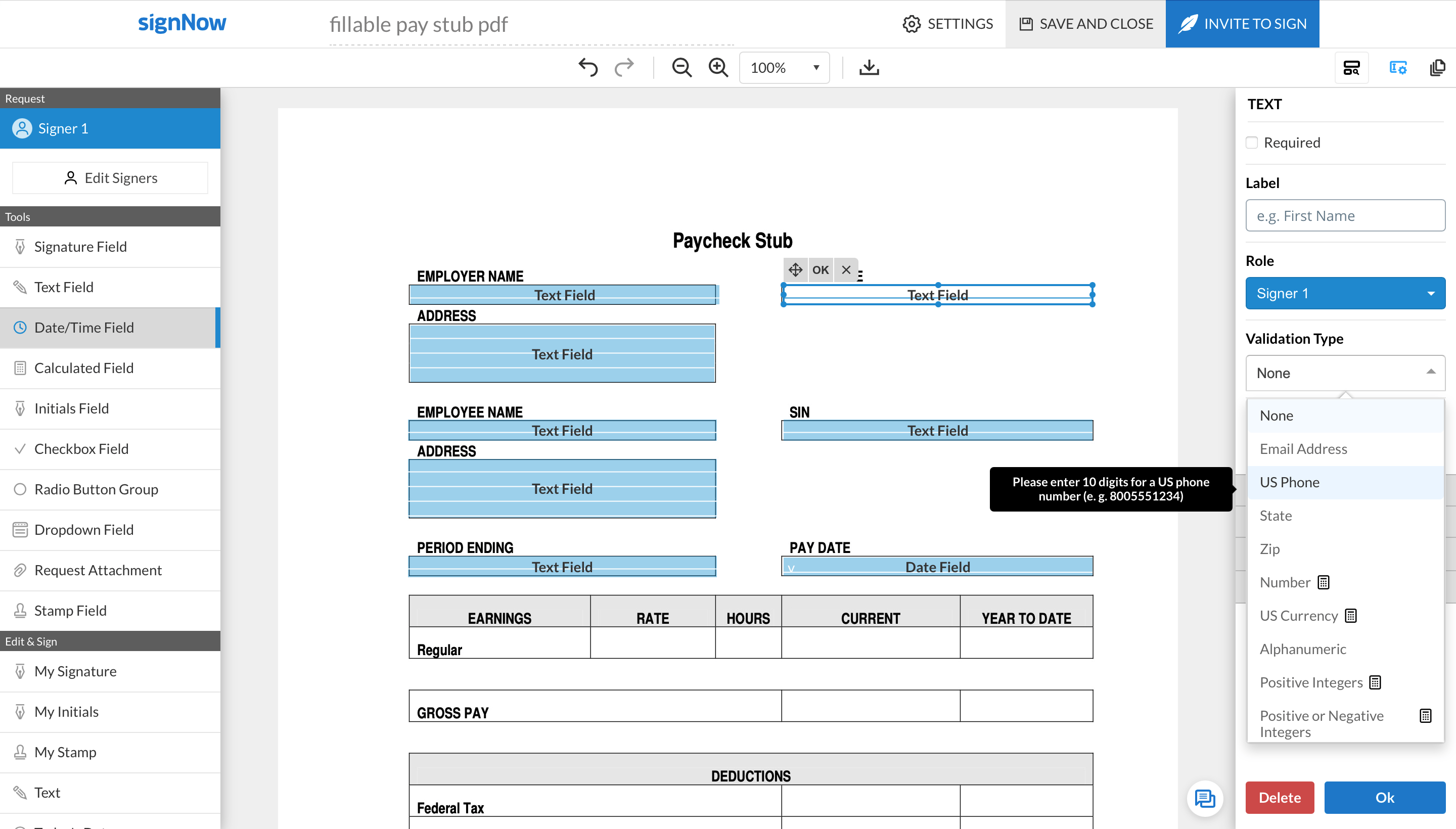
For Text fields, the variety of validators is even greater. You can request a recipient to provide their phone number, email address, state, zip code, and other types of information.

Note that the validators marked with a calculator icon allow you to request specific numerical values such as numbers or US currency. These numerical validators are also used for formulas applied to calculated fields.
fill-guide-illustration

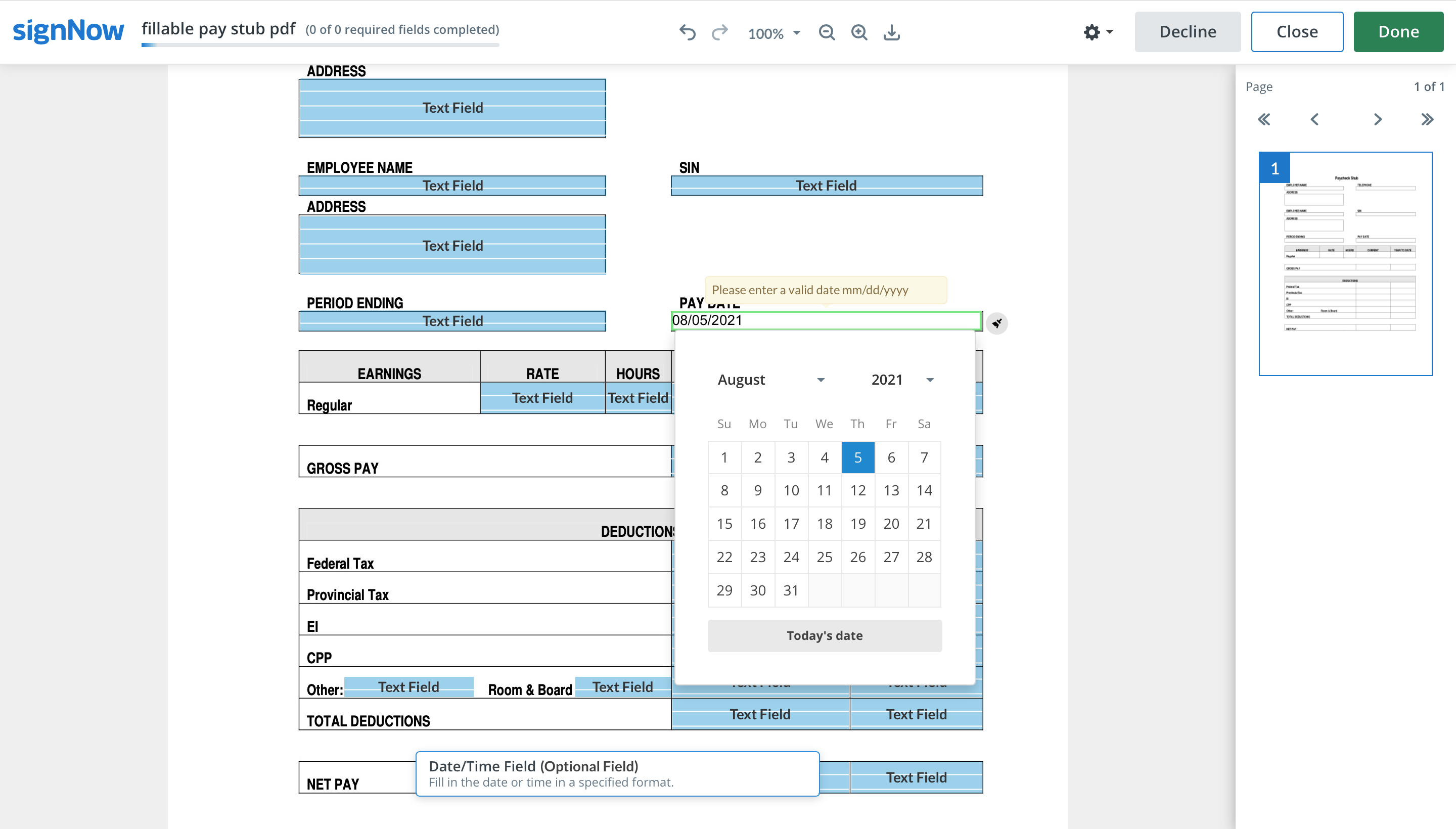
The validators you’ve chosen will ensure that the data is entered correctly in the fields during the completion process.

fill-guide-illustration
walmart logo
exonMobil logo
apple logo
comcast logo
facebook logo
FedEx logo
be ready to get more

Get legally-binding signatures now!









