Voluntary Petition
The primary filing that opens the case and identifies the chapter sought, jurisdiction, and basic debtor information required by the clerk.
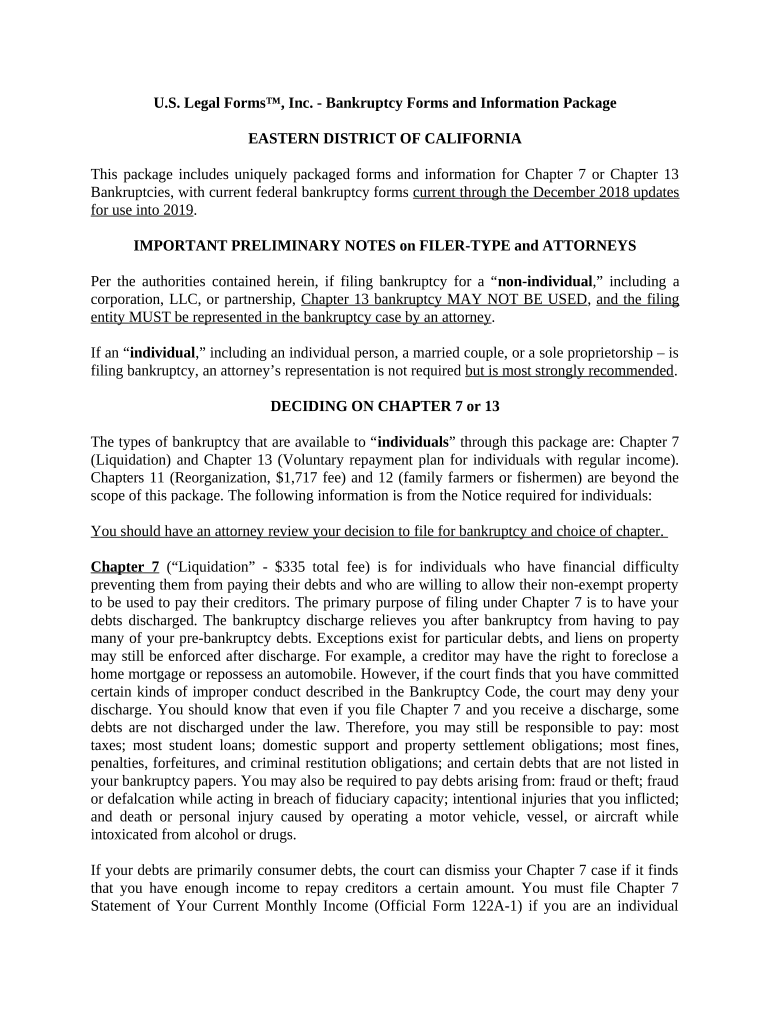
Submitting a comprehensive California Bankruptcy Forms and Information Package reduces filing delays, helps satisfy statutory disclosure requirements, and supports faster case administration by the clerk and trustee.

Each party has distinct responsibilities: debtors provide accurate financial data, attorneys verify legal compliance, and court staff check form completeness.
The debtor signs the petition and schedules under penalty of perjury. Ensure names, Social Security number, and current address match government records; inaccuracies can delay the case and trigger further verification.
A licensed bankruptcy attorney signs any appearances and verifies legal claims, while the trustee reviews schedules and assets. Attorneys commonly file documents electronically and manage court communications on behalf of debtors.
The primary filing that opens the case and identifies the chapter sought, jurisdiction, and basic debtor information required by the clerk.
Detailed listings of assets, liabilities, income, and expenses; these schedules form the factual basis for discharge or plan treatment.
Narrative answers about recent payments, transfers, and financial history required under bankruptcy rules for disclosure.
Form to calculate presumed abuse for Chapter 7 eligibility or to support a Chapter 13 plan; includes income and deduction detail.
A formatted list of creditor names and addresses used by the clerk to issue notices; accuracy prevents missed service.
District-specific declarations, fee instructions, or trustee checklists required by the California bankruptcy court and local standing orders.
| Field | Configuration |
|---|---|
| Authentication | Use email + SMS or two-factor for signer validation |
| Document format | Submit PDF/A where court requires long-term preservation |
| Signer sequence | Order signatures: debtor then attorney |
| Retention | Store signed PDFs and audit trails for required retention period |
Ensure the chosen platform can preserve an auditable record (timestamps, IP, signer consent) and export the completed package for filing.
Complete approved counseling within 180 days before filing (11 U.S.C. §109(h)).
File completed means test with the petition at the time of case opening.
Typically held about 20–40 days after filing; attendance is mandatory for the debtor.
Correct errors promptly after filing; trustees or courts may set short deadlines to amend.
Trustee or court will set the deadline for creditor claims; missing it may forfeit claims.
Clerk accepts the petition and assigns a case number; automatic stay takes effect.
Trustee questions debtor under oath about schedules and finances.
For Chapter 13, the court confirms a repayment plan after objections and hearings.
Court issues discharge or closes the case after trustee administration completes.
| signNow | DocuSign | Adobe Sign | PandaDoc | HelloSign | |
|---|---|---|---|---|---|
| Starting Price | $8/user/mo | $15/user/mo | $14/user/mo | $19/user/mo | $15/user/mo |
| Free Trial | 7-day free trial | No | No | Yes, limited | Yes, limited |
| Bulk Send | Yes | Yes | Yes | Yes | No |
| Audit Trail | Yes | Yes | Yes | Yes | Yes |
| HIPAA Compliant | Yes | Yes | Yes | No | No |
Optica streamlined customer-facing forms to reduce processing friction.
A small real estate firm moved lease and closing paperwork online to eliminate in-person signings.