Establishing secure connection…Loading editor…Preparing document…

Complaint for Breach of Contract

This template is fully customizable. Edit the text, fill out the fields, and send it for signature. Give it a try!
Complaint for Breach of Contract

What a Complaint for Breach of Contract Is

A Complaint for Breach of Contract is a civil court pleading a plaintiff files to initiate a lawsuit alleging that another party failed to perform contractual obligations. The complaint identifies the parties, states the governing law and venue, summarizes facts showing the breach, quantifies damages or other requested relief, and asks the court to enter judgment or other remedies such as specific performance or declaratory relief. Filing the complaint starts litigation procedures including service of process, discovery, and potential motions to dismiss or for summary judgment.

Why filing a complaint matters

Filing a complaint preserves legal rights, starts the statute of limitations clock, creates formal procedural protections (discovery, subpoenas), and positions a claimant to obtain damages, injunctive relief, or settlement under court supervision.

Why filing a complaint matters

Who typically files this complaint and why

Plaintiffs across business and consumer contexts use a breach of contract complaint to assert contract-based claims and seek remedies through the courts.

  • Individual claimants: Consumers or sole proprietors seeking unpaid amounts or contract-specific performance.
  • Businesses: Vendors, purchasers, or contractors asserting monetary damages or injunctive relief for contractual nonperformance.
  • Attorneys: Counsel draft and file complaints, manage service, and coordinate discovery and motions.

Core parts every professional complaint should include

A clear, well-structured complaint improves enforceability and reduces procedural risks by addressing jurisdiction, parties, facts, legal claims, requested relief, and required procedural exhibits.

Caption

Court name, docket caption, case number placeholder; jurisdiction and venue must be correct and reflect where the contract is enforceable.
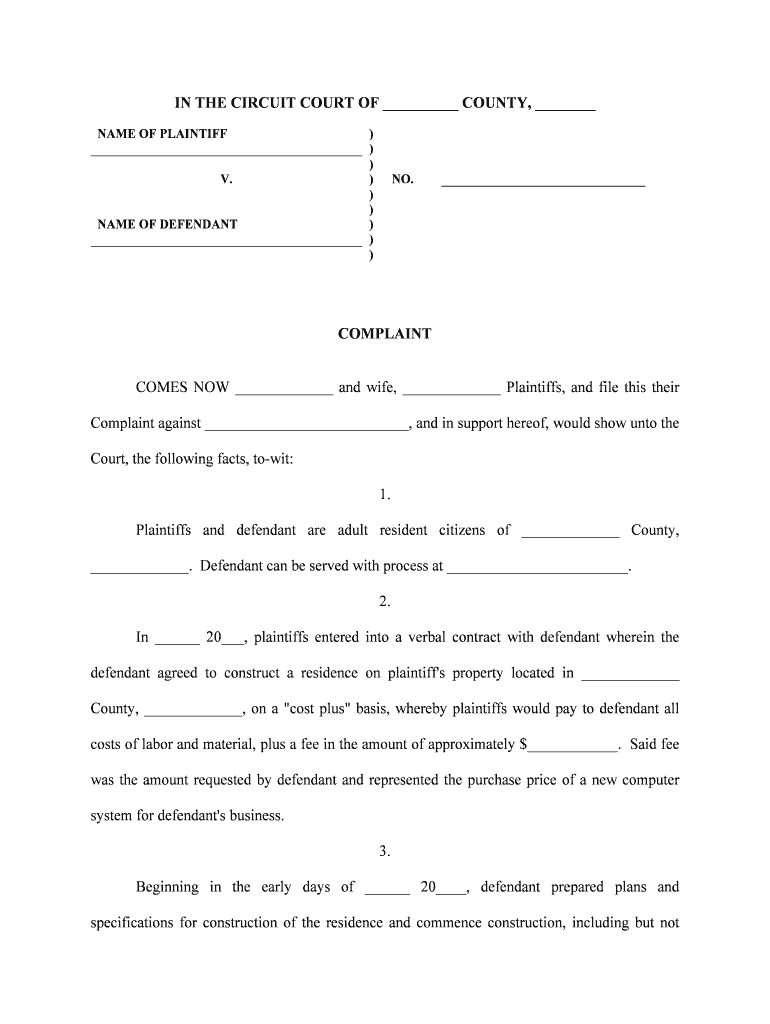
Parties

Full legal names and business entity types for plaintiff(s) and defendant(s), including state of formation and principal place of business where relevant.

Statement of Facts

Chronological allegations describing the contract formation, material terms, performance history, the defendant's breach, and factual basis for damages or equitable relief.

Cause of Action

Specific legal claim language (e.g., breach of contract) tied to the alleged facts and elements required by state or federal law.

Damages and Relief

Precise categories of damages (compensatory, consequential, restitution), any request for specific performance, injunctive relief, or declaratory judgment.

Exhibits & Verification

Attach the contract, correspondence, invoices, and any required verification, certificate of service, or affidavit supporting the factual allegations.

Step-by-step: preparing and filing the complaint

Follow a clear sequence: prepare the document, assemble exhibits, file with the correct court, serve defendants, and preserve proof of service.

  • 01
    Draft Complaint: Prepare caption, facts, claims, damages, and exhibits.
  • 02
    File with Court: Submit via e-filing or clerk's office with required filing fee.
  • 03
    Serve Defendants: Serve per jurisdictional rules and obtain proof of service.
  • 04
    Preserve Evidence: Preserve emails, contracts, and transaction logs for discovery.

How to set up an online complaint workflow

Configure templates, signer roles, and notifications to streamline preparation, filing, and service while maintaining an audit trail.

Template Fields Create reusable fields for names, dates, amounts, and exhibit placeholders.
Signer Authentication Choose email, SMS code, or advanced verification per court or client requirements.
Exhibit Management Attach contracts and supporting documents as indexed PDF exhibits.
Auto-Notifications Enable alerts for filing confirmations and signature completion.
Retention Settings Set automatic retention and export rules to meet legal hold obligations.

Technical considerations for eFiling and eSubmission

Confirm the court accepts electronic filings, the required file formats, and any authentication or signing standards before e-submitting.

  • File Formats: PDF/A or court-specified PDF format.
  • Integrations: E-filing portals, case management systems.
  • Authentication: Email or multi-factor signer verification.

Court filing, service, and initial case flow

Understand the filing-to-service flow and required proofs to keep the case moving within procedural deadlines.

  • File Document: Clerk assigns case number and provides filing receipt.
  • Serve Defendant: Deliver complaint per state or federal rules.
  • Defendant Response: Defendant files answer or motion to dismiss.
  • Discovery Phase: Parties exchange documents and take depositions.

Key deadlines to track after filing

Timely compliance with service and pleading deadlines prevents waivers and preserves remedies.

Service Deadline:

Federal: typically 90 days under FRCP 4(m); states vary.

Answer Period:

Commonly 21–30 days after service depending on jurisdiction.

Motion Timing:

Motions to dismiss usually due with the answer or shortly after.

Discovery Period:

Court schedules vary; initial disclosures often within 14–30 days.

Appeal Period:

Post-judgment appeals commonly due within 30 days from entry.

Milestone timeline from filing to judgment

Typical numbered milestones show the litigation arc and expected sequencing until final judgment or settlement.

01

Filing

Complaint filed and docketed with court clerk.

02

Service

Defendant served and proof of service filed.

03

Pleadings

Defendant files answer or dispositive motion.

04

Discovery

Document exchange, depositions, and motions practice.

Consequences of an incorrect or defective complaint

Dismissal Risk: Loss of claim if pleading fails to state a cause
Default Judgment: Failure to serve can lead to default against defendant
Sanctions: Court sanctions for frivolous or improper filings
Statute of Limitations: Late filing may bar recovery
Increased Costs: Additional litigation expense from fixes or re-filing
Enforcement Issues: Errors can complicate later judgment enforcement

Common mistakes to avoid when preparing a complaint

  • Listing the wrong legal entity as a party, which can require costly amended pleadings and new service.
  • Failing to attach the controlling contract or attaching an incomplete or unsigned copy as an exhibit.
  • Vague or formulaic damage claims without a clear method for calculating compensatory amounts.
  • Misstating venue or jurisdiction, which can lead to transfer or dismissal for improper venue.

Security and compliance details for electronic complaints

Encryption: TLS 1.2/1.3 in transit; AES-256 at rest
Audit Trail: Detailed timestamps, IPs, and action logs
Regulatory Compliance: ESIGN, UETA, ISO 27001, SOC 2 Type II
HIPAA Support: BAA available for protected health information
21 CFR Part 11: Capabilities for FDA-regulated electronic records
Access Controls: Role-based permissions and SSO/SAML options

Who has authority to sign and file the complaint

In-House Counsel

General counsel or an attorney admitted in the jurisdiction may sign and file on behalf of a corporate plaintiff after corporate authorization; ensure corporate resolution or board approval is documented where required by entity bylaws.

Authorized Officer

A corporate officer or authorized agent with a written corporate resolution or power of attorney can sign and file; individual plaintiffs may sign personally or have counsel file on their behalf.

Illustrative scenarios where a complaint is used

Two brief example case arcs show common factual patterns and typical relief sought.

Small Business Vendor Claim

A vendor supplied goods and invoiced a local retailer for $48,000 owed over 90 days

  • Retailer failed to pay after written demand
  • The vendor files for breach seeking compensatory damages, pre- and post-judgment interest, and costs while preserving lien and setoff claims in the complaint.

Commercial Services Dispute

A contractor performed milestone work under a commercial services agreement but the owner refused payment citing alleged defects

  • Contractor disputes the defects and requests payment with interest
  • Complaint requests damages for unpaid invoices, declaratory ruling that work complied with contract, and attorney fees where contract allows.

How a complaint compares with other dispute documents

Choose the right initial document based on desired formality, remedies, and likelihood of court involvement.

Document Type Complaint Demand Letter Arbitration Demand Small Claims
When used formal litigation pre-suit settlement contract arbitration clause simplified court process
Formality high low moderate low
Remedy sought damages or equitable relief payment or negotiation contract remedies limited monetary relief
Filing required yes (court) file with arbitrator yes (small claims court)

eSignature vendor comparison relevant to filing and serving complaints

Basic pricing and feature differences for common eSignature vendors used to sign or manage complaint documents; signNow is listed first per marketplace comparison.

signNow DocuSign Adobe Sign PandaDoc HelloSign
Starting Price $8/user/mo $15/user/mo $14/user/mo $19/user/mo $15/user/mo
Free Trial 7-day free trial No No Yes, limited Yes, limited
Bulk Send Yes Yes Yes Yes No
Audit Trail Yes Yes Yes Yes Yes
HIPAA Compliant Yes Yes Yes No No

Practical tips for an accurate and enforceable complaint

Follow these practices to reduce procedural delays, preserve remedies, and improve the complaint's clarity and defensibility.

Be specific on facts
Allege dates, contract provisions, communications, and exact amounts where possible; factual specificity supports pleading standards and discovery requests.
Attach key exhibits
Always attach the contract and critical correspondence as numbered exhibits to avoid arguments about terms or authenticity.
Confirm service rules
Follow state or federal service requirements precisely, and file proof of service promptly to avoid default disputes.
Preserve evidence
Issue legal holds, secure transactional records, and snapshot relevant electronic systems to support claims and oppose spoliation allegations.

Frequently asked questions about drafting and filing a complaint

Answers to common procedural and legal questions help resolve typical uncertainties during complaint preparation and initial litigation steps.


Need help? Contact support

be ready to get more
Join over 28 million airSlate SignNow users