Establishing secure connection…Loading editor…Preparing document…

Foreclosure Dispute

This template is fully customizable. Edit the text, fill out the fields, and send it for signature. Give it a try!
Foreclosure Dispute

What a Foreclosure Dispute Is and when it applies

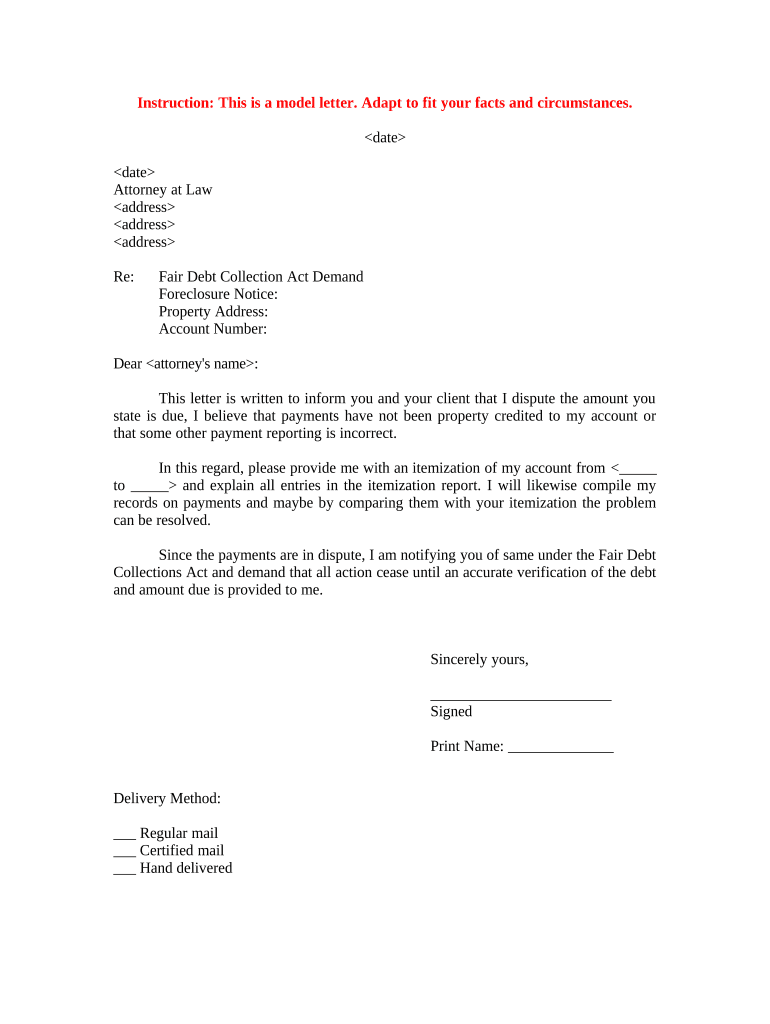
A Foreclosure Dispute is a formal written challenge submitted by a homeowner, borrower, or authorized representative to contest a foreclosure action, alleged default, or related servicing error. It typically asserts errors in account calculations, improper notice, identity or ownership of the mortgage, payment application, or violation of loss-mitigation procedures. The dispute may be sent to a loan servicer, lender, or filed in court or bankruptcy proceedings depending on timing and jurisdiction. Use clear factual statements, attach supporting evidence, and preserve original documents and communications to support the dispute and establish a record for administrative or judicial review.

Why preparing a clear Foreclosure Dispute matters

Use a Foreclosure Dispute to correct factual errors, preserve legal defenses, and trigger lender review processes. Timely, documented disputes can halt foreclosure timelines in some jurisdictions, create an administrative record, and improve prospects for loan reinstatement, modification, or dismissal.

Why preparing a clear Foreclosure Dispute matters

Who prepares and handles Foreclosure Disputes

Typical users who prepare or file a Foreclosure Dispute include homeowners, attorneys, HUD-approved counselors, and loan servicer representatives.

  • Homeowners — document facts, payment history, and supporting records for lender review and legal preservation.
  • Attorneys — prepare legal arguments, cite statutory defenses, and file disputes in court or bankruptcy.
  • Housing counselors — assist with documentation, mediation, and negotiating loss mitigation or reinstatement options.

Step-by-step: preparing and submitting your Foreclosure Dispute

Follow these steps to prepare, submit, and track a Foreclosure Dispute with accurate documentation and legal clarity.

  • 01
    Gather Documents: Collect loan statements, payment records, and notices.
  • 02
    Draft Dispute: State facts, legal basis, requested relief succinctly.
  • 03
    Send to Servicer: Use certified mail or documented electronic delivery.
  • 04
    Preserve Records: Keep copies, delivery receipts, and any responses.

Core elements to include in a professional Foreclosure Dispute

A thorough Foreclosure Dispute combines a clear issue summary, supporting evidence, legal basis, requested remedies, accurate contact information, and an authenticated signature block to make review and resolution efficient.

Dispute Summary

Summarize the disputed issue plainly, include account identifiers and dates, and state why the borrower believes the foreclosure action is incorrect or premature. Attach relevant documents and a concise list of requested remedies.
Supporting Evidence

List and attach copies of payment records, account statements, escrow analysis, correspondence, loan modification applications, and any trustee sale notices that relate to the dispute.

Legal Basis

Cite statutes, servicer policies, or contract provisions alleged to have been violated and explain how the facts map to those legal elements with references to relevant notices.

Relief Requested

Specify the remedy sought, such as reinstatement, loan modification, removal of incorrect charges, rescission of sale, correction of credit reporting, and a proposed timeline for lender response.

Contact Info

Provide borrower name, current mailing address, phone number, email, mortgage account number, and the name and contact of any authorized representative and specify whether the representative has a power of attorney.

Signature Block

Include dated signature lines for the borrower and any authorized representative; indicate capacity (owner, attorney-in-fact) and include printed names and identification reference, and attach photocopy of government ID where permitted.

Security and compliance considerations when submitting disputes electronically

Encryption Standards: TLS 1.2/1.3 in transit; AES-256 at rest.
Audit Trail: Timestamped actions, IP address, signer history.
Access Controls: Role-based permissions and multi-factor options.
BAA Availability: Business Associate Agreement available when required.
Compliance Certifications: SOC 2 Type II, ISO 27001, PCI DSS.
Retention Options: Secure archival and exportable audit records.

Configuring an electronic workflow for Foreclosure Disputes

Configure an e-submission workflow to route, authenticate, and record the Foreclosure Dispute for efficient handling.

Field Configuration
Signer Authentication Email verification; SMS OTP or KBA for higher assurance.
Routing Order Sequential or parallel signer routing as required.
Document Fields Signature, date, initials, evidence upload fields.
Notifications Automated emails for received, signed, and status updates.

Choosing delivery and filing methods that preserve evidence

Choose distribution channels that preserve evidence of delivery and allow secure exchange with servicers, counsel, and courts.

  • Email Delivery: Document attached or secure link with delivery record.
  • Certified Mail: Trackable physical delivery with return receipt.
  • eFiling / Court: Court-specific portals accept electronic filings and PDF packages.

How the dispute process typically moves from submission to resolution

A Foreclosure Dispute workflow moves from submission through servicer review, borrower response, and administrative or court resolution.

  • Submit: Provide dispute document and supporting attachments.
  • Acknowledgment: Servicer confirms receipt and assigns case number.
  • Investigation: Servicer reviews records, contacts creditors, and updates status.
  • Resolution: Outcome communicated; remedies applied or further legal steps.

Critical timing considerations and typical response windows

Key timelines for a Foreclosure Dispute depend on servicer procedures, state law, and whether the dispute is administrative or filed in court.

Submit promptly after receiving foreclosure notice:

Send dispute as soon as possible; some protections depend on timing.

Servicer response timeframes vary by contract:

Expect initial acknowledgement within 30 days in many policies; timelines vary.

Court filing deadlines may be shorter:

If filing in court, follow local rules for pleadings and responsive deadlines.

Preserve evidence retention schedules promptly:

Retain originals, delivery proofs, and correspondence for statutory retention periods.

Act before trustee sale or sheriff sale date:

Timely disputes may delay sale processes in some jurisdictions and trigger review.

Common pitfalls to avoid when preparing a Foreclosure Dispute

  • Incomplete or inconsistent evidence — failing to attach clear payment histories, escrow statements, or correspondence commonly causes disputes to be ignored or rejected by servicer investigators.
  • Late submission — missing statutory or contractual deadlines can eliminate procedural protections and reduce the borrower’s ability to obtain temporary relief prior to sale or auction.
  • Poorly framed legal claims — vague assertions without citation to contract terms, federal regulations, or state statutes increase the likelihood of dismissal or administrative denial.
  • Failure to follow servicer procedures — not using designated dispute forms or required submission channels may forfeit internal remedy steps and slow resolution timelines.

Risks and penalties if a dispute is incorrect or not timely

Credit Reporting: Continued negative reporting.
Loss of Home: Possible foreclosure sale.
Legal Costs: Attorney and court fees.
Statute of Limitations: Claim window may close.
Civil Penalties: Damages for wrongful foreclosure.
Tax Consequences: Debt forgiveness may be taxable.

Frequently asked questions about Foreclosure Disputes

Answers to common questions about preparing, submitting, and enforcing a Foreclosure Dispute, including timing, evidence, and electronic submission considerations.


Need help? Contact support

Comparing eSignature vendors on features that matter for disputes

Compare common eSignature vendor criteria that affect Foreclosure Dispute workflows: price, trial availability, bulk send, audit trail, HIPAA support, and envelope limits.

signNow DocuSign Adobe Sign PandaDoc HelloSign
Starting Price $8/user/mo $15/user/mo $14/user/mo $19/user/mo $15/user/mo
Free Trial 7-day free trial Varied Varied Varied Varied
Bulk Send Yes Yes Yes Yes Varied
Audit Trail Yes Yes Yes Yes Yes
HIPAA Compliant Yes Yes Yes No No
Envelope Cap No cap 100 envelopes/user/year Varied Varied Varied
be ready to get more
Join over 28 million airSlate SignNow users