Caption
Court or agency caption including jurisdiction and case or matter number so the recipient can readily identify the proceeding and link the notice to official records.
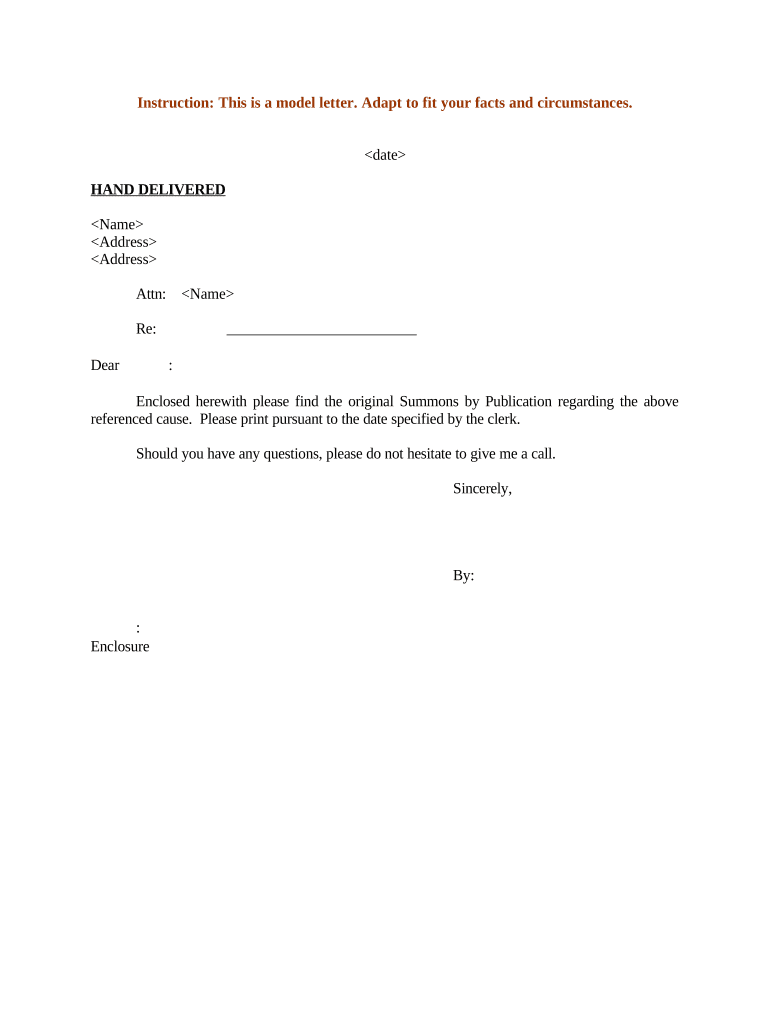
A clear, correctly prepared letter summons establishes official notice, documents the request for records or appearance, and sets enforceable response expectations under governing rules.

Organizations and individuals use letter summonses in civil, administrative, and internal compliance contexts; the exact issuer depends on the proceeding type.
A court clerk or deputy clerk may issue or enter a court-originated summons under local rules; their signature or seal confirms issuance and supports service documentation.
An attorney of record commonly signs or prepares a letter summons for initial service; counsel must ensure the document complies with rules for service and relevant statutory deadlines.
Court or agency caption including jurisdiction and case or matter number so the recipient can readily identify the proceeding and link the notice to official records.
Full legal name, business name (if applicable), address for service, and a contact point to ensure proper delivery and traceability.
A concise description of why the recipient is being summoned — appearance, deposition, document production, or compliance review — with scope specified.
A clear response or appearance date, stated in MM/DD/YYYY format when possible, and any time-of-day or venue-specific details.
How the summons will be delivered or served, including process server, certified mail, or electronic delivery options, plus proof of service requirements.
Signature block for issuer, printed name, title, and any notary or clerk certification required to validate issuance under local rules.
| Field | Configuration |
|---|---|
| Authentication Method | Select email-only, SMS code, or knowledge-based verification depending on required assurance. |
| Bulk Send | Enable when issuing identical summonses to multiple recipients to maintain consistent content and tracking. |
| Conditional Fields | Use conditional fields to show or hide request scopes based on recipient role or matter type. |
| Audit Trail | Ensure the system records signer identity, timestamps, IP, and document version history for evidentiary use. |
Confirm the chosen channel meets jurisdictional service rules and that recipients can access the selected format without technical barriers.
Federal rule FRCP 4(m) generally requires service within 90 days of filing.
Defendant typically must respond within 21 days after service under FRCP 12(a)(1)(A).
File proof of service promptly to document compliance with service rules.
Specify production dates and ranges; allow reasonable time consistent with scope.
Document any agreed extensions in writing before original deadlines expire.
Finalize language, scope, and service instructions before obtaining signatures.
Issuer or court clerk signs; include notarization if required by local rules.
Deliver per chosen method and obtain proof of delivery or affidavit of service.
File proof of service or certificate with the court or retain for administrative records.
| signNow | DocuSign | Adobe Sign | PandaDoc | HelloSign | |
|---|---|---|---|---|---|
| Starting Price | $8/user/mo | $15/user/mo | $14/user/mo | $19/user/mo | $15/user/mo |
| Free Trial | 7-day free trial, no card | Varies by plan | Varies by plan | Varies by plan | Varies by plan |
| Bulk Send | Yes | Yes | Yes | Yes | No |
| Audit Trail | Yes | Yes | Yes | Yes | Yes |
| HIPAA Compliant | Yes | Yes | Yes | No | No |
Managing partner served for document production in a transaction dispute
Property manager issued internal compliance summons for tenant file review
Provide signed versions as PDF/A for long-term archival and as DOCX for redaction or editing when allowed; maintain audit metadata with each export.
Include a print-optimized version for process servers or clerks who must provide a physical copy as proof of service.
Attach a certificate of completion or audit log showing signer identity, timestamps, and IP addresses to support admissibility.
Attach exhibits that define scope (e.g., date ranges, record types) and reference privilege protocols or confidentiality designations.